


.jpg)


.svg)
The United Kingdom has entered a period of unprecedented political volatility as 2026 begins, marked by a profound "Bregret" and a historical fracturing of the traditional two-party system. Ten years after the fateful referendum, a landmark survey of 20,000 people across 27 democracies by FGS Global and Yonder Data Solutions reveals that Britons are now the most pessimistic nation in the developed world, Daily Dazzling Dawn realized.
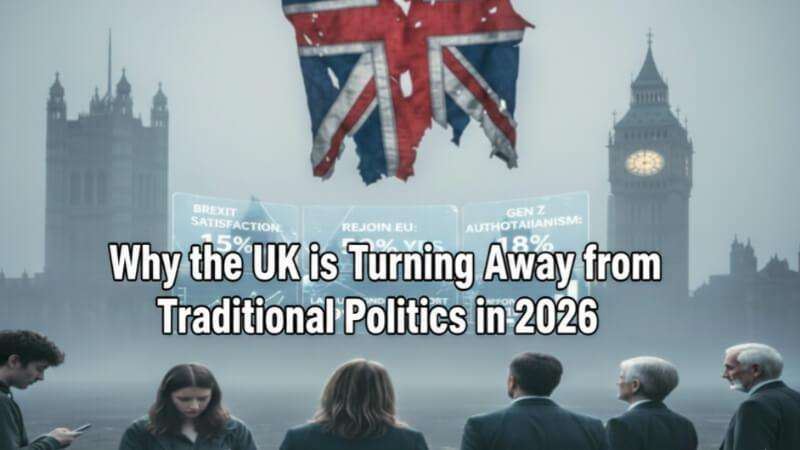
This shift is not merely about policy; it is a fundamental transformation of the British mindset. For the first time, a staggering 72% of voters believe the UK has less control over its affairs now than it did inside the European Union. The rallying cry of "Take Back Control" has, for many, become a symbol of unfulfilled promises, with only 15% of the population believing the slogan lived up to its intent.
The Brexit Reality Check: Statistics Reveal a Nation in Regret-The data paints a grim picture of the post-Brexit landscape. Two-thirds of the British public (66%) now state explicitly that leaving the EU has damaged the economy, while only 22% see any positive impact. This economic dissatisfaction is fueling a surge in "Rejoin" sentiment, which has now reached a critical tipping point.
Current polling shows that 50% of the public would vote to rejoin the EU if a referendum were held tomorrow, compared to 38% who would remain out. Furthermore, the "Project Fear" warnings of the 2016 campaign are being reconsidered by the electorate; 55% of voters now believe those grim forecasts were accurate, while only 23% maintain they were exaggerated. Perhaps most tellingly, even European voters seem ready to welcome the UK back, with 66% of EU citizens favoring a British return to the fold.
A Crisis of Faith: Gen Z and the Rise of the 'Strongman'-Beyond Brexit, a more alarming trend is emerging within the British social fabric: a collapse in faith in democracy itself. The UK’s "Gen Z" (adults up to age 28) are increasingly disillusioned with the parliamentary process. The FGS Global poll found that young Britons are more than twice as likely as "Baby Boomers" to favor an authoritarian leader who governs without the "bother" of elections.
Specifically, 18% of Gen Z now favor authoritarianism, compared to just 7% of those aged 61-79. This shift is driven by a feeling of systemic exclusion; 73% of the total population believe the UK is "heading in the wrong direction," and only 14% believe the country's best years are still ahead. When the youth—the future of the electorate—feel that voting makes no difference to their daily lives, the door opens to radical alternatives.
The London Collapse: Labour and Tories Sinking in the Capital-Nowhere is this political fracturing more evident than in London, traditionally a fortress for the Labour Party. A new Savanta poll for the Mile End Institute shows Labour support has plummeted to a record low of 31%, a 12-point drop since Sir Keir Starmer’s 2024 General Election victory.
The political vacuum is being filled by insurgent forces. For the first time in modern history, the Conservative Party has been pushed into a humiliating fourth place in the capital at just 17%. They have been overtaken by Nigel Farage’s Reform UK (19%) and the Green Party (18%), the latter seeing a massive surge under the leadership of Zack Polanski. This "multi-polar" political landscape suggests that the era of two-party dominance is effectively over in the UK’s most influential city.
What Happens Next: A Fragmented Future-The reason for this rapid change is clear: a combination of economic stagnation, a perceived loss of national sovereignty, and a lack of faith in the current leadership to provide a "Brexit dividend." As Chancellor Rachel Reeves faces backlash over fiscal decisions and Sir Keir Starmer struggles to maintain his "reset" with the EU without crossing "red lines" like the Customs Union, the public is looking elsewhere.
The immediate future points toward a high-stakes electoral cycle. With the Green Party and Reform UK now legitimate contenders in urban centers, the 2026 local elections are set to be a bloodbath for the traditional "Big Two." If the current trajectory continues, the pressure for a second referendum or a radical constitutional overhaul will become impossible for Westminster to ignore. Britain is no longer just "unhappy" with its current state; it is actively searching for a completely new way to be governed.

_1.jpg)