
.jpg)





.svg)
This report clarifies the legal status of siblings sharing a father under the divine framework of the Quran. The modern Western linguistic classification of "step-siblings" has created a profound theological misunderstanding among English-speaking Muslim communities in Britain and America regarding the sanctity of the paternal bond. While secular society often views children from a father’s different marriages as "half" or "step" relatives, the Quranic paradigm establishes an unbreakable, full-blooded legal identity that grants these individuals the same domestic and spiritual status as those born of the same mother.
The Divine Prohibition of Marriage- The primary verification of this relationship’s "wholeness" is found in the definitive legal boundaries set by the Creator. In Surah An-Nisa (4:23), Allah declares the categories of women forbidden for marriage, explicitly stating "Prohibited to you are your mothers, your daughters, and your sisters." Islamic jurisprudence, spanning fourteen centuries of consensus, confirms that the term "sisters" in this verse is not limited to those sharing both parents but encompasses any woman sharing the same father.
To further strengthen this verification, the recognized classical exegesis Tafsir Ibn Kathir explicitly states regarding this verse:
“The sisters [forbidden in marriage] include full sisters, half-sisters from the father’s side, and half-sisters from the mother’s side.” Because marriage is divinely prohibited, these siblings are "Mahram," meaning the sanctity of their home life and their interactions are identical to those of "full" siblings, rendering the "step" or "half" label spiritually irrelevant.
The Primacy of Paternal Nasab- The Quranic system of identity, known as Nasab, is anchored firmly in the father’s lineage to protect the integrity of the family unit. Surah Al-Ahzab (33:5) commands believers to "Call them by the names of their fathers; it is more just in the sight of Allah." This decree ensures that children from different mothers but the same father carry the same lineage, the same family name, and the same legal origin. In the sight of the Divine Law, the "bond of the loin" creates a singular family tree where every branch sharing the same root is considered a full member, leaving no room for the sociological "step" distancing found in contemporary Western culture.
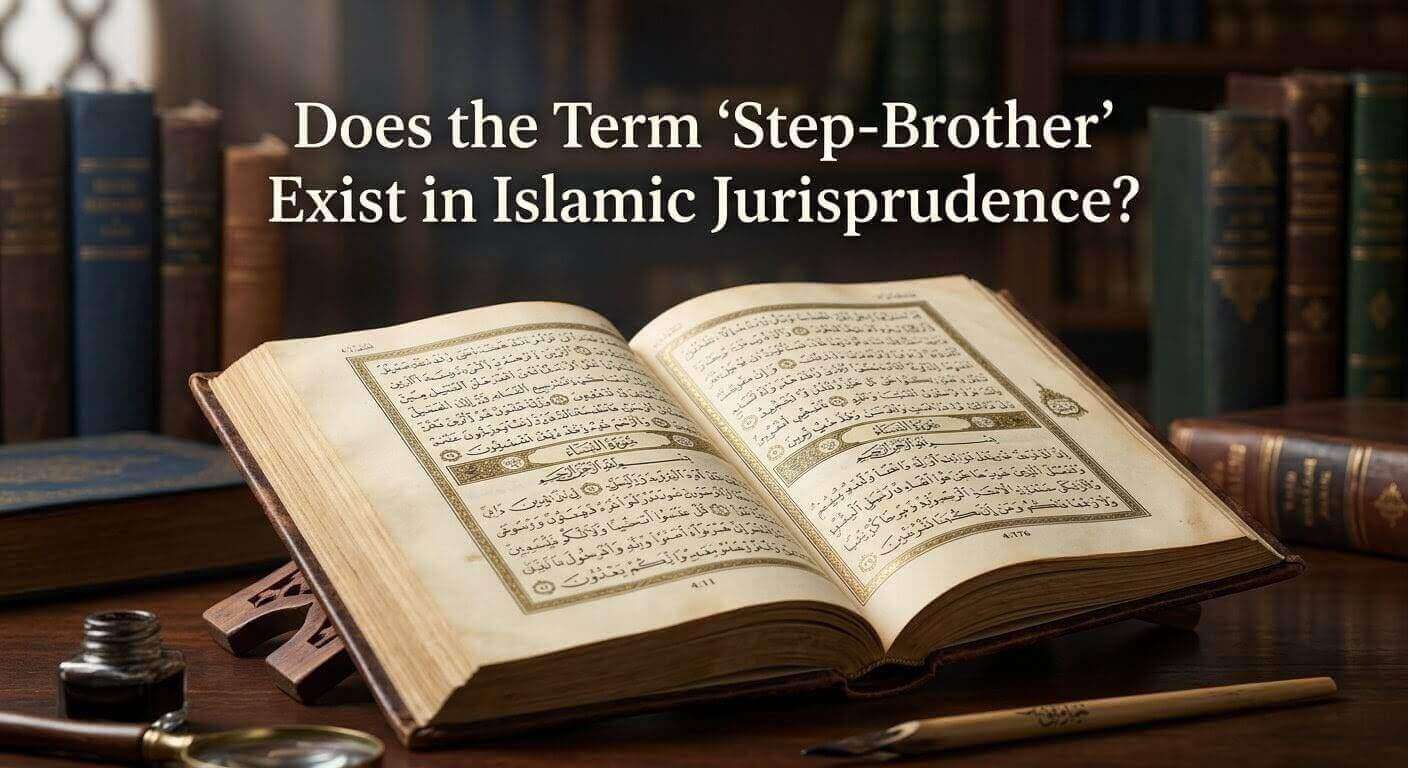
Inheritance as a Measure of Kinship- Financial rights in Islam serve as a factual audit of a relationship's strength, and the Quranic mandate on inheritance further proves the "full" status of paternal siblings. Under the laws of Fara'id detailed in Surah An-Nisa (4:11 and 4:176), paternal brothers and sisters are recognized as legitimate heirs of their father’s estate. While a full brother may prioritize over a paternal brother in specific exclusion scenarios due to the "double bond" of the mother, the paternal brother remains a primary "Asabah" (residuaries), a status reserved only for the closest male relatives. This right to the father’s wealth is not a "step" privilege but a birthright anchored in their shared blood.
The Prophetic Clarification on Lineage- The Sunnah of Prophet Muhammad (peace be upon him) reinforces this Quranic structure by emphasizing that the bed of a valid marriage establishes a complete and total relationship. A famous Hadith narrated in Sahih Bukhari and Muslim states, "The child belongs to the bed," signifying that any child born within the father’s marriage is his legitimate offspring. Consequently, the Prophet (peace be upon him) never distinguished between his own children or the children of his companions based on which mother they were born to when it came to their fundamental rights as brothers and sisters in a household.
The Crucial Distinction of Unrelated Step-Siblings- To avoid legal confusion, it is essential to note what Islam actually considers a "step" relationship. If a man marries a woman who already has children from a previous husband, those children and the man’s own children share no blood. In this specific case, and only this case, they are not blood siblings; they may marry one another and must observe hijab. However, the moment two children share a biological father, the Quranic "Brotherhood" is activated, granting them a permanent, unchangeable, and "full" status that transcends modern cultural labels.


.jpg)

_2.jpg)