



.svg)
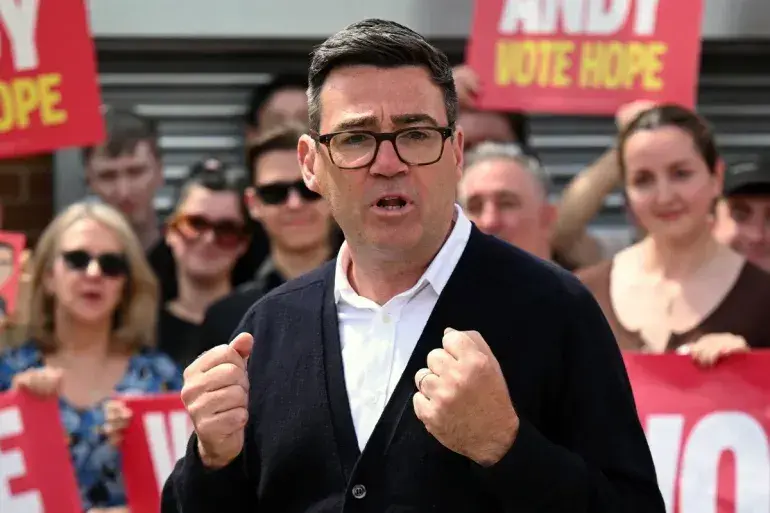
Greater Manchester Mayor Andy Burnham has secured a commanding victory in the closely watched Makerfield by-election in northern England, strengthening his position to challenge Prime Minister Keir Starmer for the leadership of the Labour Party and potentially become the United Kingdom’s next prime minister.
Official results announced early Friday showed Burnham comfortably defeating Reform UK candidate Robert Kenyon, winning the parliamentary seat required to launch a leadership bid. Burnham received 24,927 votes, finishing more than 9,000 votes ahead of Kenyon.
Restore Britain candidate Rebecca Shepherd placed third, followed by Conservative candidate Michael Winstanley, Green Party candidate Sarah Wakefield, and Liberal Democrat Jake Austin.
Addressing supporters after his victory, Burnham said Britain was facing a crisis of confidence in politics.
“Everyone knows that politics is not working,” he said. “Everyone can feel that the country isn’t where it should be. Tonight could – just could – be the turning point. From here on, I will give everything that I have got to make it so, to ensure the name Makerfield is forever synonymous with bringing about the change this country needs.”
His decisive win is expected to intensify pressure on Starmer, potentially triggering either the prime minister’s resignation or a Labour leadership contest involving Burnham and former health secretary Wes Streeting.
Under the UK’s parliamentary system, a governing party can replace its leader—and therefore the prime minister—without holding a general election.
Political analysts increasingly view Burnham as one of the strongest contenders to succeed Starmer. An Ipsos poll released earlier this week found that 25 percent of British adults preferred Burnham as prime minister, while only 12 percent backed Starmer.
If Burnham ultimately becomes Labour leader and prime minister, he would become Britain’s seventh prime minister since the country voted to leave the European Union in 2016.
Although Starmer led Labour to a landslide general election victory in 2024, his leadership has since come under growing scrutiny due to declining public support and internal party unrest.
Calls for him to step aside have intensified since Labour suffered significant setbacks in local and regional elections in May.
His administration has also been weakened by the resignation of 20 ministers in less than two years, with many citing disagreements over policy or expressing a lack of confidence in his leadership. Wes Streeting was among the senior figures to leave the government.
Despite mounting criticism, Starmer has repeatedly rejected calls to resign, insisting he will fight any challenge to his leadership and arguing that such a contest would not serve the country's interests.
Known as the “King of the North” because of his popularity across northern England and his readiness to challenge Westminster, Burnham campaigned on promises to reform Labour, overhaul British politics and deliver change for communities that feel left behind.
Since becoming Greater Manchester mayor in 2017, and winning re-election in both 2021 and 2024, Burnham has built a strong political base by championing northern communities and criticising what he describes as a London-centric political system. He has also argued that decades of neoliberal and trickle-down economic policies have failed to benefit many parts of the country.
In his victory speech, Burnham said Makerfield would become the benchmark for his political agenda.
“A Makerfield test at the heart of British politics will ensure that the places Westminster has neglected will now get fairness,” he said.
Before serving as mayor, Burnham held several cabinet positions under former prime ministers Tony Blair and Gordon Brown.
He entered the by-election as the slight favourite, leading Kenyon by five percentage points in an Opinium poll published last Saturday.
The contest was triggered after Labour MP Josh Simons resigned from Parliament last month, clearing the way for Burnham to seek a Commons seat and position himself for a leadership challenge.
Approximately 75,000 voters were eligible to cast ballots in the Makerfield constituency, located around 320 kilometres (200 miles) northwest of London. Voter turnout reached 58.75 percent, an increase from the 52.4 percent recorded during the 2024 general election.