.jpg)
_1.jpg)



.svg)
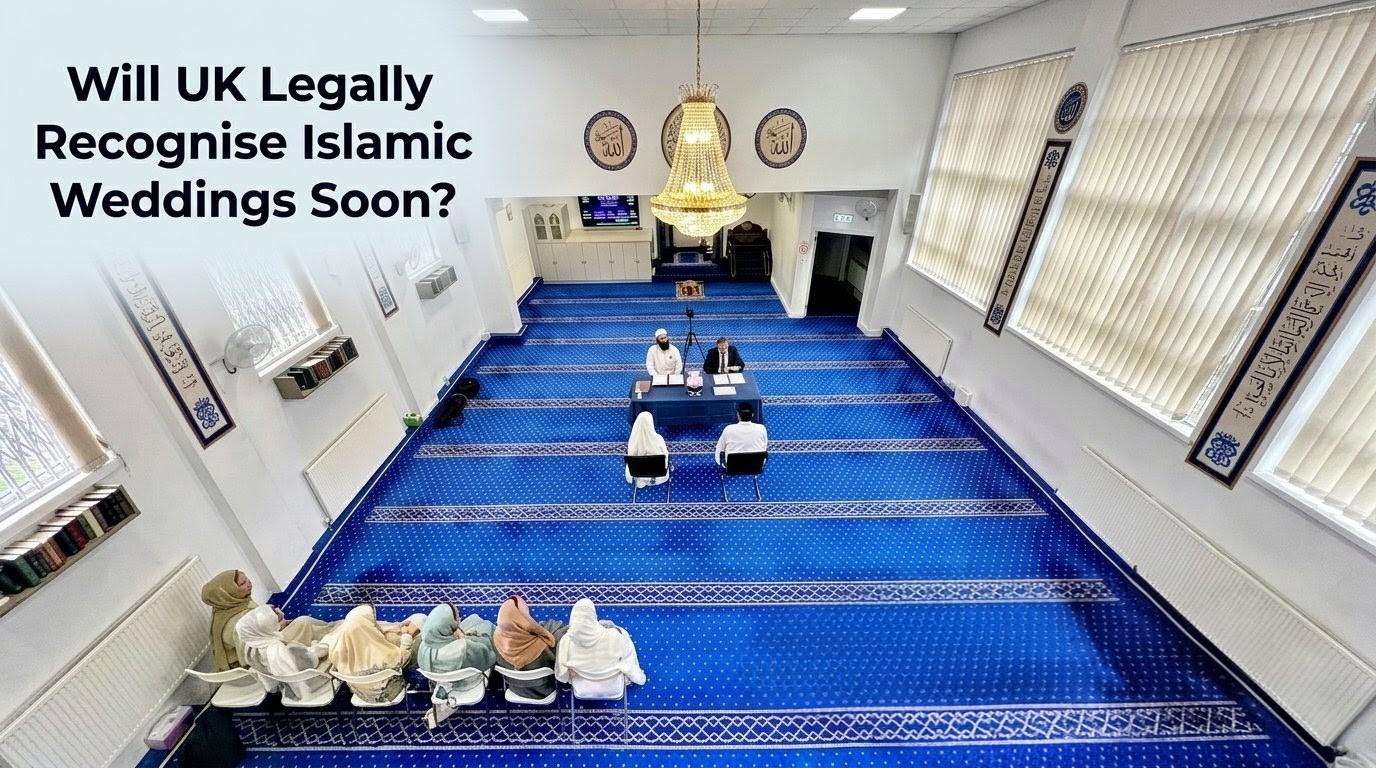
The United Kingdom stands on the precipice of its most significant marital law transformation in nearly two centuries, as formal consultations progress on proposals that could grant full legal validity to Islamic Nikah ceremonies without requiring a separate civil service.
Under the framework currently under consultation through 24 September 2026, the legal focus of marriage in England and Wales will shift from the physical building where a ceremony takes place to the registered officiant presiding over it. This structural shift means that sacred religious vows, such as the exchange of ijāb (offer) and qubūl (acceptance), will for the first time constitute legally binding consent, provided preliminary administrative notices and formal registration obligations are fulfilled.
Statistics highlight the profound urgency of this statutory reform. Up to four in ten Muslim couples in the UK who have undergone a traditional Nikah currently possess no legal status as a married couple under civil law. Following the landmark Akhter v Khan Court of Appeal precedent, unregistered Nikahs are classified as "non-qualifying ceremonies" rather than void marriages, leaving approximately three in ten individuals entirely unaware that they lack recourse to financial remedies, spousal maintenance, or property protection upon relationship breakdown.
Religious scholars and legal experts have overwhelmingly welcomed the transition toward equal recognition. Speaking on the implications of the legislative movement, Islamic legal scholar Shaykh Mohammad Ahmad told journalists: "For decades, Muslim women in particular have carried the heavy burden of legal ambiguity, entering into sacred unions that offered divine sanctity but zero protection under domestic law. Codifying the Nikah within the national legal framework preserves religious integrity while securing essential statutory rights for families across Britain."
Journalists at Daily Dazzling Dawn have monitored the political momentum surrounding the draft legislation, which seeks to standardise marriage protocols across faith groups while regulating officiants as "fit and proper" custodians of legal record. Officiants will be legally required to check capacity, verify free consent, enforce age limits, and screen for forced or sham marriages. If Parliament allocates legislative time following the consultation period, the reforms will also grant legal weight to non-traditional venues chosen by officiants.
In a parallel discussion surrounding the cultural role of faith in modern Britain, social analysts note that mainstream conservative thought is increasingly examining traditional Islamic household structures as a counterweight to modern social fragmentation. The lingering consequences of mid-twentieth-century social liberalism and late-century consumerism are observed to have had a noticeably lighter impact on Islamic family life, where intergenerational cohabitation, marital stability, and communal responsibility remain central pillars.
What happens next rests on the outcome of the public consultation closing in September 2026. Once public submissions are synthesized by the Ministry of Justice, ministers are expected to introduce a unified Marriage Bill to Parliament. If enacted, the legislation will eliminate the double-ceremony burden for tens of thousands of faith communities, establishing a modernised system built on equality and statutory protection.