



.svg)
The final days of the New York City mayoral contest are being eclipsed by the extraordinary academic claims of Columbia University Professor Mahmood Mamdani, the intellectual touchstone for his son, Zohran Mamdani, the race's frontrunner. Rather than focusing on policy, the campaign is now grappling with the elder Mamdani's radical reinterpretations of modern history, where he relentlessly argues that the foundational violence of Western powers directly inspired and shaped the 20th century’s worst atrocities.
Mahmood Mamdani is a highly prominent figure in global academia, holding the title of Herbert Lehman Professor of Government and a professorship in anthropology, political science, and African studies at Columbia University. A Ugandan academic born in India, his research career has focused intensely on colonialism, decolonization, the history of civil war and genocide in Africa, and the geopolitical intersection of the Cold War and the War on Terror, establishing him as a leading scholar of postcolonial studies with a reputation for uncompromising and often inflammatory critiques of Western state power.
Professor Mamdani’s most stunning thesis establishes a direct, provocative link between historical American statecraft and the rise of Nazi Germany. In his writings, including the book Neither Settler Nor Native, he contends that the US's treatment of its Native American population was not merely a tragic history but a template for subsequent genocidal projects. He asserts that the US is the “outcome of a history of genocide, ethnic cleansing, official racism, an concentration camps,” and that "Nazi Germany followed a similar path in the construction of the German nation.” Specifically, he claims Adolf Hitler “studied” the treatment of Native Americans, finding “proof” that the Nazi project could succeed, and would adopt “the eugenic justifications of genocide that Americans promoted at the end of the 19th century and into the 20th.”
This profound critique is extended to American political icons. Professor Mamdani labels President Teddy Roosevelt, whose career was forged in New York, a “warmonger, whose sense of history as a contest for racial supremacy was shared by the likes of Hitler.” He further argues that Roosevelt’s writings on the “genocide” of Native Americans made a “signal contribution to Nazism and other doctrines of scientific racism.” Even Abraham Lincoln, the Great Emancipator, is implicated, with Mamdani claiming his policy of “herd[ing] American Indians” into reservations was an “inspiration” to the Nazis.
Beyond history, Mamdani radically shifts the blame for modern terrorism. In his work, Good Muslim, Bad Muslim, he dismisses the narrative of 9/11 as an isolated act of barbarism, instead framing it as a direct consequence of decades of US foreign policy. He argues that by spending 40 years backing terror groups abroad to win the Cold War, the US set the stage for the attacks that killed over 2,700 people in New York alone. In a stunning inversion of traditional political narratives, he states that by the final years of the Cold War, Ronald Reagan made a “bold and brazen embrace of terror,” with the CIA actively seeking to create an “American jihad” in Afghanistan to “bleed the Soviet Union white.” Mamdani proceeds to draw a direct “moral equivalence” between the US wars in Iraq and Afghanistan and the 9/11 attacks, and in the case of the Bush administration, argues that its “open disdain for the rule of law is unmatched in the history of Western imperialism.” He concludes this line of thought by insisting that suicide bombers should be seen as a category of “soldier” rather than “stigmatised as a mark of barbarism.”
The professor does not spare Britain, either, comparing Harold Wilson’s 1968 Commonwealth Immigrants Act to the Nuremberg laws, stating the “race-based citizenship law... followed earlier precedents set by Nazi Germany.” Furthermore, he provides a highly controversial reinterpretation of Ugandan dictator Idi Amin, whom critics describe as a bloodthirsty tyrant. Mamdani, who was himself expelled by Amin, defends the dictator against comparisons to Hitler, calling the idea a “media-driven preconception.” He insists that Amin “did everything in his power to spare Asian lives” during the expulsion, and attributes the regime’s violence—an “orgy of blood”—to the dictator’s training in suppressing rebellions as a member of the colonial army, thus tracing the blame back to Britain’s colonial legacy.
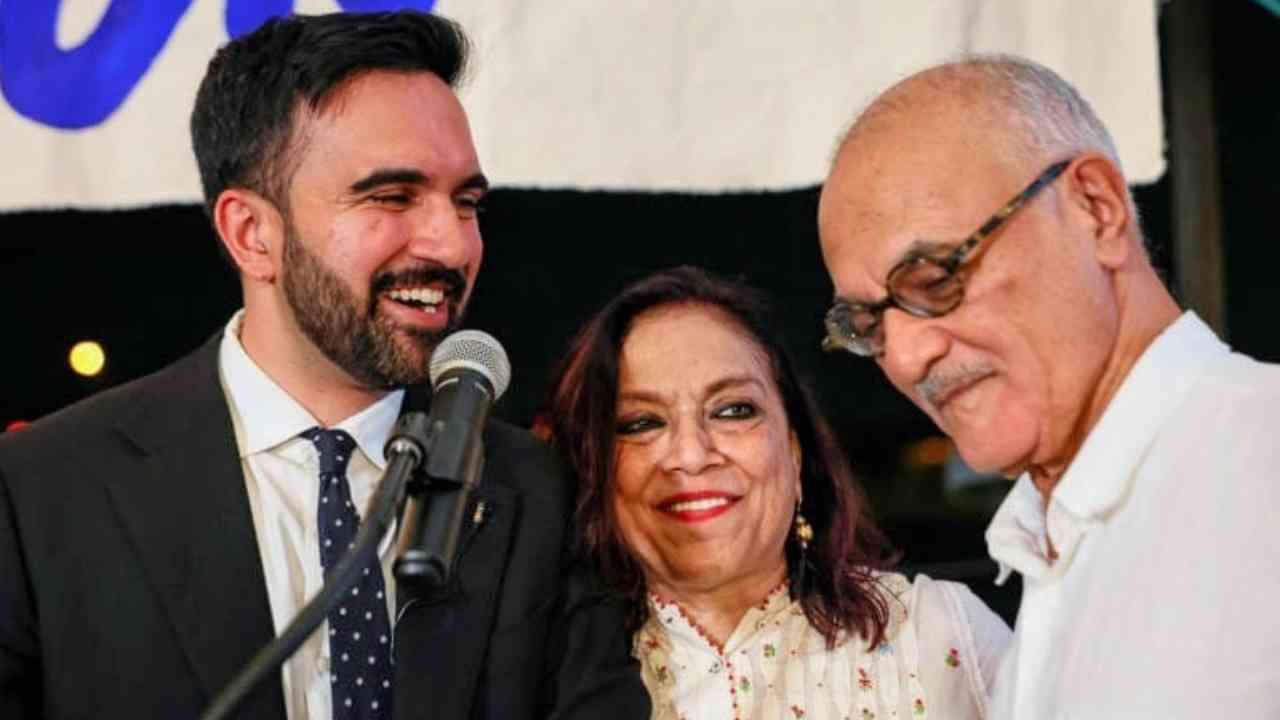
The political fallout for his son is undeniable. Zohran Mamdani, who is dedicated to a preface in one of his father’s most critical books, has credited the academic with fundamentally shaping his worldview, claiming he would help edit his parents’ writings “to make it more accessible.” The professor’s intellectual project, which dismantles traditional Western narratives and places the historical violence of the US and UK at the very foundation of modern atrocities, has now become the central, unavoidable subtext of the New York mayoral race.


.jpg)