






.svg)
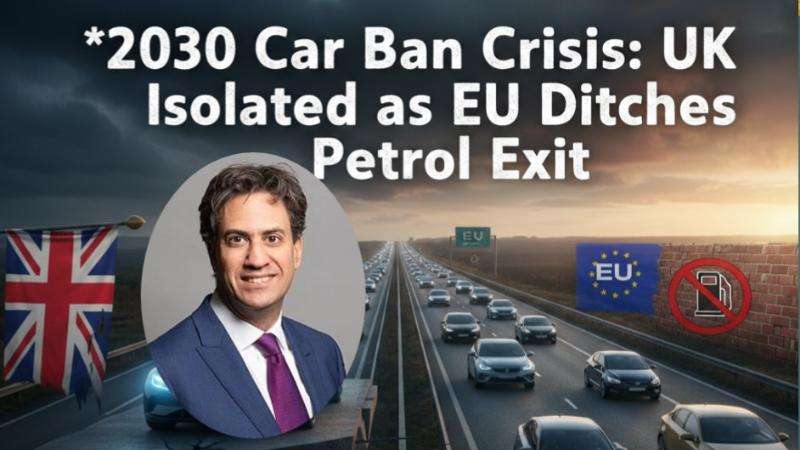
The dramatic decision by the European Union to drop its flagship pledge to ban sales of new petrol and diesel cars by 2035 has sent shockwaves through the UK automotive sector, leaving Britain’s own aggressive Net Zero timeline—and its political backers—in a precarious position. This major climbdown in Brussels, driven by a revolt among key member states like Germany and Italy amid economic concerns and fierce competition from cheap Chinese electric vehicles (EVs), fundamentally alters the landscape for the UK, Daily Dazzling Dawn understands.
The UK Car Market: A Sudden Competitive Chasm-The UK is now staring down the barrel of a significant competitive disadvantage. The Government remains publicly committed to its plan to ban the sale of new pure petrol and diesel cars from 2030, and hybrids from 2035, underpinned by the stringent Zero Emission Vehicle (ZEV) mandate. However, with the EU ban now "off the table indefinitely"—as confirmed by Manfred Weber, head of the European Parliament’s largest grouping of MEPs—UK car manufacturers face the unprecedented challenge of operating to a far stricter deadline than their largest export market.
Three-quarters of UK-built cars are exported, with Europe being the primary destination. Industry leaders are warning that this disparity forces manufacturers to maintain dual production strategies, catering to a rapidly shrinking combustion engine market in the UK while having more flexibility to supply a combustion-engine-friendly Continent. This necessitates increased investment, higher complexity, and risks making UK-based manufacturing less attractive. Robert Forrester, Chief Executive of dealership chain Vertu, was explicit, stating the European reversal makes the EU appear "more pragmatic and flexible than the UK," and that it is "imperative for the future of our manufacturers... that an urgent review of the ZEV mandate is undertaken."
While the short-term news may benefit UK factories of companies like Mini and Nissan, allowing them to export existing combustion engine products to the EU for longer, the long-term threat to EV investment is palpable. Automotive expert Andrew Bergbaum of AlixPartners warns the EU’s decision will be a blow to the business case for new EV and battery factories planned in the UK, such as the major facility proposed by Jaguar Land Rover’s parent company in Somerset. Investment in British electric infrastructure and manufacturing, therefore, is now highly dependent on the government upholding its current, isolated timeline.
Seismic Shift in the Second-Hand Market-The consequences of the EU's policy reversal, and the corresponding calls to soften the UK’s 2030 stance, have an immediate and confusing impact on the second-hand car market. Any hint of a delay to the 2030 new car ban effectively secures the long-term desirability and residual value of existing petrol and diesel vehicles.
The second-hand market for internal combustion engine (ICE) cars has already been experiencing a supply shortage, which drives up prices. If consumers sense a potential policy U-turn or a slowdown in the mandated shift to electric—as indicated by the EU—demand for high-quality used petrol and diesel models will be sustained, potentially inflating their prices further. For used EV sales, however, the situation is double-edged. Policy uncertainty tends to undermine buyer confidence, causing some consumers to delay their first EV purchase. This hesitation could temporarily depress the value of used EVs, even as government mandates—like the ZEV mandate—continue to funnel new electric vehicles into the car parc, thus maintaining or increasing the longer-term supply pipeline. The net effect is likely to be a prolonged and more robust lifespan for the used ICE market, slowing the speed of the transition many had anticipated.
Political Isolation and Public Backlash-The news has immediately thrust Energy Secretary Ed Miliband into a spotlight of political isolation. A vocal advocate for the electric car rollout, Miliband has consistently argued it represents a "global opportunity" for domestic manufacturers. However, this pro-EV stance, which critics say risks damaging industry and hiking household costs, is now dangerously exposed by the pragmatic retreat of Europe’s largest economies.
Claire Coutinho, the Conservative shadow energy secretary, seized the moment to call for the repeal of the Net Zero legislation, arguing the government must "get out of the way and back consumer choice" rather than "banning, taxing and forcing people into electric cars." Richard Tice of Reform UK echoed this sentiment, demanding the "internal combustion engine ban" be scrapped entirely to save the UK automotive industry.
This high-stakes policy divide is reflected in public opinion, highlighting the frustration over cost and practicality. Commentator Allan Taylor asserts that a slower, phased introduction of environmental policies is the only path that avoids economic ruin. Unlike the reckless net zero agenda pushed by Miliband, which has left the UK teetering, a measured approach balances sustainability with survival. Britain must adopt this model before more damage is done. Another commentator simply added, Maybe the government here will smell the coffee and at least follow suit or do better. Cars with real engines are getting cleaner all the time anyway. James Bottle, referencing broader emissions debate, stated, President Trump is proposing that the requirement for diesel engines to use ad-blu should be dropped as the need to make these engines and the extra equipment they need outweighs the environmental gains! Seeing the mess that the EGR valves make on lesser engines and the effects on the environment that DPF equipped vehicles do when "re-genning," I can only agree.
Despite the intense pressure, a UK Government spokesman insisted: “We remain committed to phasing out all new non-zero emission car and van sales by 2035," citing increased EV sales in November. Yet, with the UK now appearing to be a lone torchbearer for rapid mandatory transition, the industry's demand for an urgent, comprehensive review of the ZEV mandate and the 2030 deadline is becoming deafening. The pencilled-in 2027 review now seems insufficient to address the economic and manufacturing realities of a newly bifurcated European automotive market.




.jpeg)