




.svg)
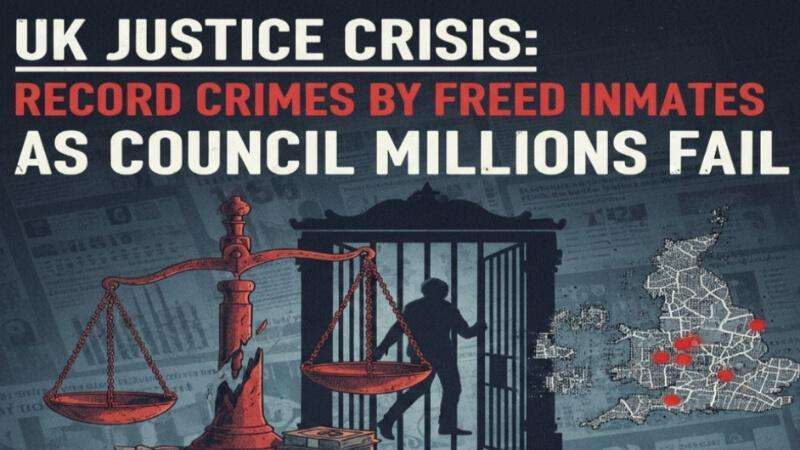
The United Kingdom’s legal and rehabilitative framework is facing a systemic collapse as official data reveals that offenders under probation supervision committed nearly 900 serious crimes in the past year. This unprecedented surge in violence, which includes at least one murder and two rapes every single week, comes at a time when local authorities like Tower Hamlets Council are funneling millions into community safety—only to see violent crime rates continue to climb, Daily Dazzling Dawn realized.
The Human Cost of a "Broken" System-Figures for the 2024-25 period show a chilling 13% increase in "Serious Further Offences" (SFOs), reaching a total of 872 notifications. This is the highest level since records began, representing a 51% jump compared to just two years ago. The statistics translate into a grim reality: 56 murders and 107 rapes committed by individuals who were supposed to be under the watchful eye of the state.
Martin Jones, the Chief Inspector of Probation, has raised a red alert, warning that public safety is being "put at risk" due to a 30% shortage of frontline staff and a fundamental breakdown in communication between the police, social services, and probation officers. Every single frontline delivery unit inspected recently was graded as "inadequate" or "requiring improvement." The crisis is further exacerbated by the government’s emergency early release schemes, designed to ease prison overcrowding, which police chiefs warn will push local forces toward "absolute horror stories" of re-offending.
Tower Hamlets: Millions Spent, But Is It Working?
At the local level, the disconnect between record spending and public safety is starkly visible in the London Borough of Tower Hamlets. Under the leadership of Mayor Lutfur Rahman, the council has launched an ambitious £8 million Anti-Crime Task Force. This investment includes £3.8 million specifically earmarked to digitize and expand the borough’s CCTV network and the recruitment of 26 council-funded police officers.
Despite this massive injection of public funds, the results remain questionable. While the council highlights that its "Tower Hamlets Enforcement Officers" (THEOs) completed nearly 30,000 hours of patrols, the borough’s own "Crime Scorecard" for 2025 paints a different picture. Violence and sexual offences in Tower Hamlets rose by 8% over the last year, with over 11,400 offences recorded. Furthermore, the borough recently held the unwanted title of the worst area in London for drug-related crimes.
Critics and internal reports suggest that while the public supports the visible presence of CCTV, there is "limited evidence" that these multi-million-pound systems actually prevent violent crime. Instead, they primarily serve as a tool for investigation after the damage is already done. With the council facing a gross service overspend of over £30 million, the question for taxpayers is no longer just "where is the money going," but "why isn't it making us safer?"
A Nationwide Failure of Oversight-The failure is not limited to local budgets. Nationally, the Ministry of Justice has promised to boost probation funding by 45%, reaching £700 million by 2028. However, the Inspectorate’s 2025 Annual Report reveals that 53% of all serious offence reviews were rated as "Requires Improvement." The system is currently plagued by a backlog of cases where dangerous criminals, such as Jordan McSweeney—who murdered law graduate Zara Aleena—are incorrectly assessed as "medium risk" until it is too late.
As the government continues to release inmates early to manage a "drug-ridden" penal system, the burden falls on overstretched local police. Gavin Stephens, Chairman of the National Police Chiefs’ Council, predicts crime will rise by another 6% this year. Without a fundamental shift from "emergency spending" to "effective rehabilitation," the record-breaking crime statistics of 2025 may soon become the new, tragic baseline for the British public.



_1.jpg)