






.svg)
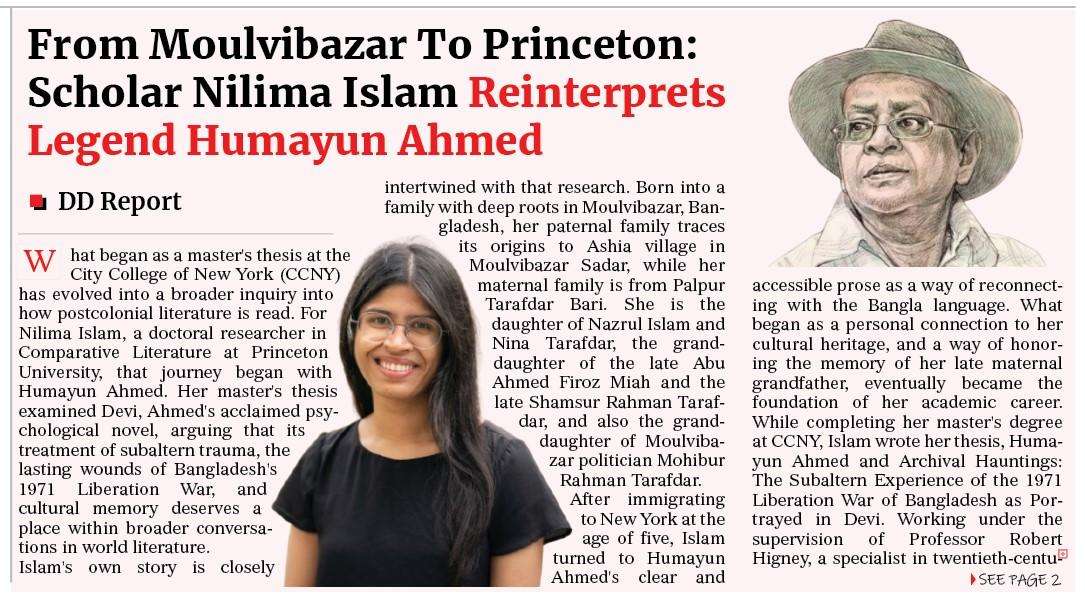
What began as a master's thesis at the City College of New York (CCNY) has evolved into a broader inquiry into how postcolonial literature is read. For Nilima Islam, a doctoral researcher in Comparative Literature at Princeton University, that journey began with Humayun Ahmed. Her master's thesis examined Devi, Ahmed's acclaimed psychological novel, arguing that its treatment of subaltern trauma, the lasting wounds of Bangladesh's 1971 Liberation War, and cultural memory deserves a place within broader conversations in world literature.
Islam's own story is closely intertwined with that research. Born into a family with deep roots in Moulvibazar, Bangladesh, her paternal family traces its origins to Ashia village in Moulvibazar Sadar, while her maternal family is from Palpur Tarafdar Bari. She is the daughter of Nazrul Islam and Nina Tarafdar, the granddaughter of the late Abu Ahmed Firoz Miah and the late Shamsur Rahman Tarafdar, and also the granddaughter of Moulvibazar politician Mohibur Rahman Tarafdar.
After immigrating to New York at the age of five, Islam turned to Humayun Ahmed's clear and accessible prose as a way of reconnecting with the Bangla language. What began as a personal connection to her cultural heritage, and a way of honoring the memory of her late maternal grandfather, eventually became the foundation of her academic career. While completing her master's degree at CCNY, Islam wrote her thesis, Humayun Ahmed and Archival Hauntings: The Subaltern Experience of the 1971 Liberation War of Bangladesh as Portrayed in Devi. Working under the supervision of Professor Robert Higney, a specialist in twentieth-century British literature, she examined Ahmed's narrative techniques through the philosophical thought of Jacques Derrida, magical realism, and other literary and critical frameworks.
Her research challenges the long-standing perception that Ahmed remained politically silent. Instead, Islam argues that his deliberate narrative silences are themselves a literary strategy. By leaving emotional and historical questions unresolved, she suggests, Ahmed invites readers to confront memory, grief, and justice on their own terms, allowing marginalized voices to emerge through the novel's form rather than through explicit political commentary.
Today, however, Islam's research has expanded well beyond the work of a single author. At Princeton University, under the guidance of Professor Claudia Brodsky, she is examining a broader question: how should postcolonial literature be read? Rather than approaching these works primarily through national or historical categories, Islam argues that readers and critics should first encounter them as works of literature. Her scholarship emphasizes close reading, literary form, judgment, and interpretation, suggesting that postcolonial writing should be valued not only for the histories it preserves but also for its artistic innovation, philosophical depth, and literary craftsmanship.
"My hope isn't simply to bring greater recognition to one writer," Islam said. "It's to encourage us to read Bangladeshi literature, and postcolonial literature more broadly, as being about more, rather than about less."
She believes that changing the way readers approach these texts can reshape how Bangladeshi literature is understood within world literature. By creating space for these works to be read on their own literary terms, Islam hopes future Bangladeshi writers will increasingly be read and evaluated alongside the world's greatest authors, opening the possibility for them to receive some of literature's highest international honors, which could potentially include the Nobel Prize in Literature.






.jpg)