




.svg)
Iranian student Ahoo Daryaei continues to endure rigorous state surveillance and mandatory anti-psychotic injections following her November 2024 university protest against mandatory hijab enforcement. Independent accounts expose the systematic state strategy of weaponising psychiatric labels to neutralise female dissent while evading international judicial accountability.
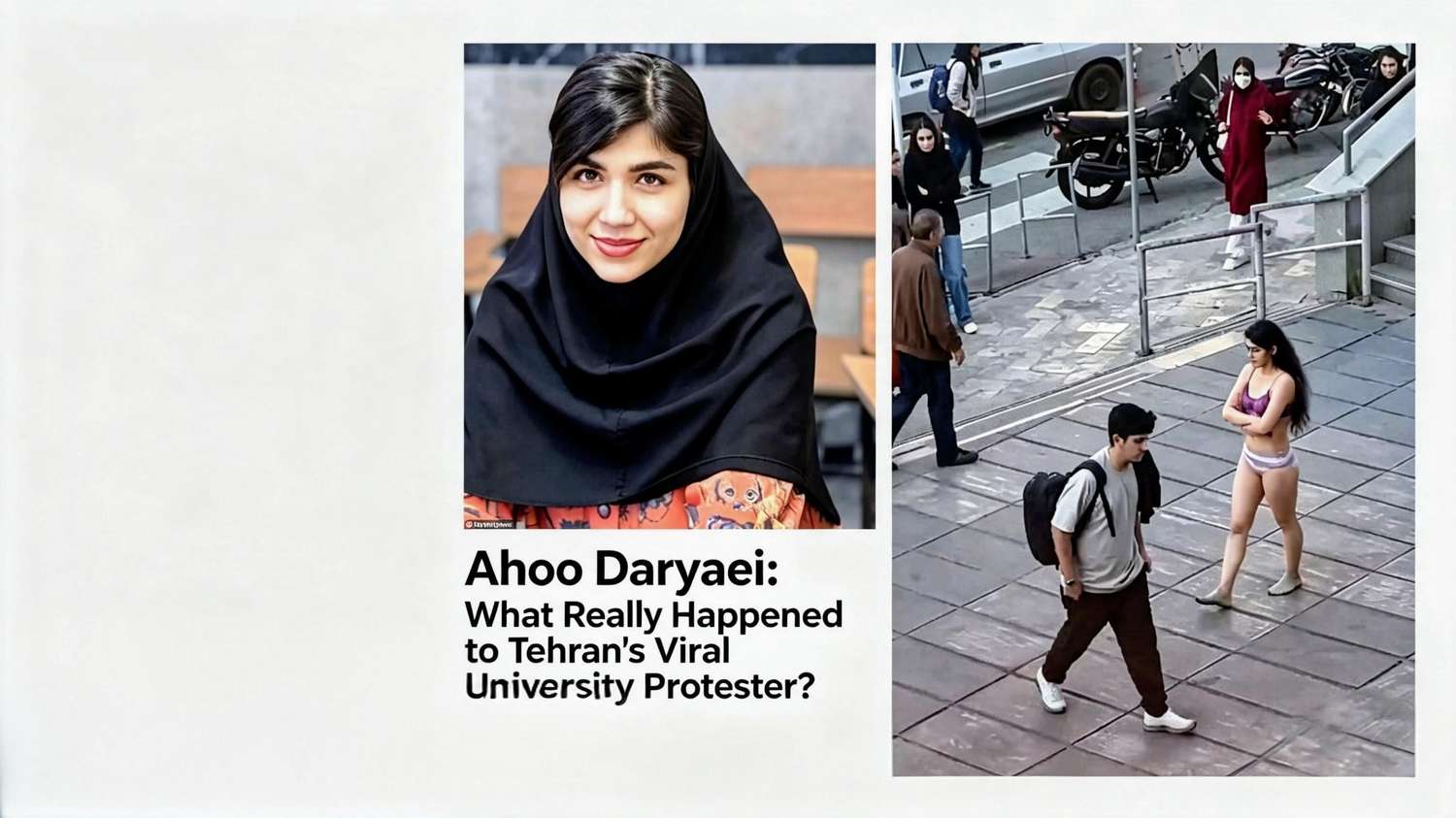
The true circumstances surrounding Ahoo Daryaei, the Iranian university scholar who captured global attention by stripping to her underwear on a Tehran campus, reveal a sobering pattern of state retaliation, enforced psychiatric confinement, and continuous surveillance. In November 2024, the 32-year-old mother of two was walking on the grounds of Tehran’s Islamic Azad University Science and Research Branch when her headscarf inadvertently slipped. What began as a routine campus day rapidly escalated when morality security personnel harassed Ms Daryaei, aggressively pulling at her clothing in an attempt to drag her into a disciplinary detention room.
In an act of immediate defiance against the physical assault and state-enforced modesty laws, Ms Daryaei removed her outer garments, pacing the courtyard in her underwear before sitting calmly on a perimeter wall. The resulting footage went viral internationally, sparking worldwide solidarity demonstrations, including protests outside the Palace of Westminster in London. Yet behind the viral imagery lies a sustained campaign by authorities to suppress her autonomy through medical coercion.
State Detentions and the Weaponisation of Psychiatry
Following her campus protest on 2 November 2024, Ms Daryaei was forced into a security van where officers subjected her to severe physical mistreatment during transit to a local police precinct. Upon arrival, security personnel sedated her before transferring her under guard to a specialised psychiatric facility. Iranian government spokeswoman Fatemeh Mohajerani publicly dismissed the incident as non-political, insisting Ms Daryaei was mentally unwell and requiring medical treatment rather than facing formal criminal prosecution.
However, human rights observers and independent documentation establish that the Iranian judiciary frequently deploys psychiatric institutionalisation as an alternative mechanism of suppression. By categorising female anti-compulsory hijab demonstrators as psychologically impaired, the state seeks to invalidate their political agency while circumventing standard judicial procedures and international human rights scrutiny.
Coerced Confinement and Ongoing Surveillance
During her 18-day detention within the psychiatric unit, Ms Daryaei remained restrained to a hospital bed and was subjected to repeated chemical sedation without independent medical oversight. Daily Dazzling Dawn understands that state security agents exerted intense pressure on her family members, including coercing statements from her former spouse to validate the official narrative of psychological distress.
Although international bodies, including Amnesty International, demanded her unconditional release, her discharge was granted only under stringent administrative constraints. Ms Daryaei was instructed that non-compliance would result in immediate re-institutionalisation. Daily Dazzling Dawn learned that she remains under continuous monitoring and is mandated to receive monthly injections of flupentixol, a high-potency typical antipsychotic commonly prescribed for schizophrenia, with the cost charged directly to her personal health insurance.
The Broader Context of Iranian Civil Dissent
Now continuing her studies as a textiles scholar at an alternative academic institution, Ms Daryaei remains a powerful emblem of the enduring resistance against Iran’s 1979 compulsory modesty mandates. Her calculated act of stripping down challenged the core authority of the Gasht-e Ershad morality patrols, illustrating how Iranian women continue to reclaim bodily autonomy despite the threat of detention, chemical restraint, and long-term state intimidation.