






.svg)
An extensive examination of more than 700 Land Registry titles and official Energy Performance Certificates has established that 143 domestic properties leased across the Duchy of Lancaster, the Duchy of Cornwall, and the Sandringham estate fail to meet statutory Minimum Energy Efficiency Standards (MEES). Despite generating more than £400 million in private income for King Charles III and Prince William since 2018 while remaining largely exempt from corporation and inheritance taxes, the royal estates continue to let cold, mould-afflicted homes rated F and G, relying on regulatory loopholes and leaving elderly and rural tenants in severe fuel poverty.
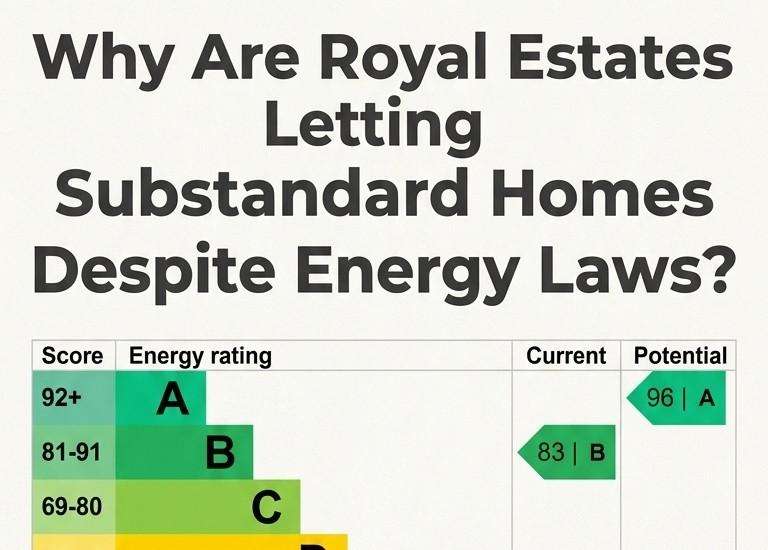
The audit of domestic rental stock across the British monarchy’s inherited private property portfolios reveals that approximately one in five surveyed homes breaches baseline United Kingdom energy standards. Under national regulations in force across England and Wales since 2020, private landlords are legally barred from leasing properties with Energy Performance Certificate (EPC) ratings of F or G unless a formal statutory exemption is recorded on the national register, with non-compliance carrying civil penalties of up to £5,000 per breach. The revelations present a profound institutional paradox for King Charles III and the Prince of Wales, both of whom have built prominent international profiles around climate advocacy, environmental preservation, and social welfare.
Official data indicates that out of 143 domestic properties failing minimum efficiency standards, fewer than one in twelve have registered statutory exemptions. The Duchy of Lancaster, an 18,000-hectare estate founded in 1265 to provide private revenue for the reigning sovereign, holds nearly 40 properties rated F or G out of more than 200 surveyed domestic dwellings, yet has logged only eight formal exemptions. Prince William’s Duchy of Cornwall, covering 55,000 hectares across south-west England, contains more than 80 homes rated F or G out of 340 audited properties, with merely four registered exemptions. The King’s private 8,000-hectare Sandringham estate in Norfolk, purchased by Queen Victoria in 1862, accounts for 18 substandard lets with only five registered exemptions.
Where exemptions are officially recorded, nine cite refusal of consent or unmeetable planning conditions on historical structures, four state that solid-wall insulation is technically unviable, and three assert that necessary retrofit costs would exceed the statutory £3,500 landlord spending cap. Assessing assessors noted that none of those capped properties possessed central heating or full double glazing, relying entirely on solid fuel or portable electric heaters rated as very poor.
The investigation highlights how royal property managers navigate legislative gaps to continue renting poorly insulated dwellings. Around half of the substandard homes identified within the Duchy of Lancaster are agricultural farmhouses let under historic tenancy agreements. Of these, 15 were rated F and six were awarded a G rating, including two farmhouses that scored the lowest possible evaluation of a single point out of 100. Although agricultural tenancies are not explicitly cited within standard MEES frameworks, legal specialists at the royal family’s own advisory firm, Farrer & Co, have advised landowners that treating farmhouses as exempt contradicts the core public policy intentions of domestic decarbonisation.
A further regulatory gap applies to tenancies established before October 2008. For these enduring agreements, landlords are not legally compelled to obtain or act upon an EPC unless the tenancy changes hands or the property is placed on the open sales market. As a result, assessments carried out during continuous tenancies are classified as voluntary, effectively exempting estates from mandatory upgrade expenditure while long-term occupants remain in unmodernised properties.
Field inspections across estate villages in Cheshire, Cornwall, and the Midlands uncovered widespread structural neglect, including rotten timber frames, severe draughts, and walls covered in toxic black mould. In several Cheshire cottages, vulnerable elderly residents reported living without central heating, relying on coal grates or expensive electric heaters. Multiple tenants told to journalists that they refrained from formally demanding remedial building works out of fear that estate managers would retaliate by increasing long-standing sub-market rents.
In another documented case, a Duchy of Lancaster cottage previously occupied for six decades by a tenant who died in his 90s was sold in a derelict condition featuring single glazing, crumbling brickwork, severe damp, and an outdated oil heating unit. In Cornwall, an off-market tenancy established without the legally required upfront EPC left an elderly couple reliant on unaffordable oil boilers and manual log burners in an F-rated stone cottage. Fuel Poverty Action described the conditions as archaic and unacceptable, warning that pervasive damp and prolonged cold present severe, life-threatening risks of respiratory failure and cardiovascular disease among older occupants.
Estate administrators insist that heritage constraints pose unique logistical challenges. A spokesperson for the Duchy of Lancaster stated that the estate invested over £3 million in residential repairs over the past year, maintaining that 97 per cent of properties subject to MEES comply with bands A to E. The estate emphasised that any tenant raising maintenance concerns is addressed constructively. Sandringham representatives confirmed that ongoing improvement programmes operate across the estate, noting that statutory exemptions apply where historic fabric cannot be altered.
Daily Dazzling Dawn understands that while the Duchy of Cornwall announced a £500 million community fund alongside £50 million earmarked for legacy estate upgrades, its recent delivery of 150 top-rated EPC homes included only six additions to its private rental register, with the vast majority sold to private buyers on the open market. Daily Dazzling Dawn learned that housing advocates and parliamentary representatives continue to demand that the monarchy close existing leasing loopholes, allocate direct profits towards retrofitting, and bring all ancestral rental holdings into full compliance with national safety and energy laws.