





.svg)
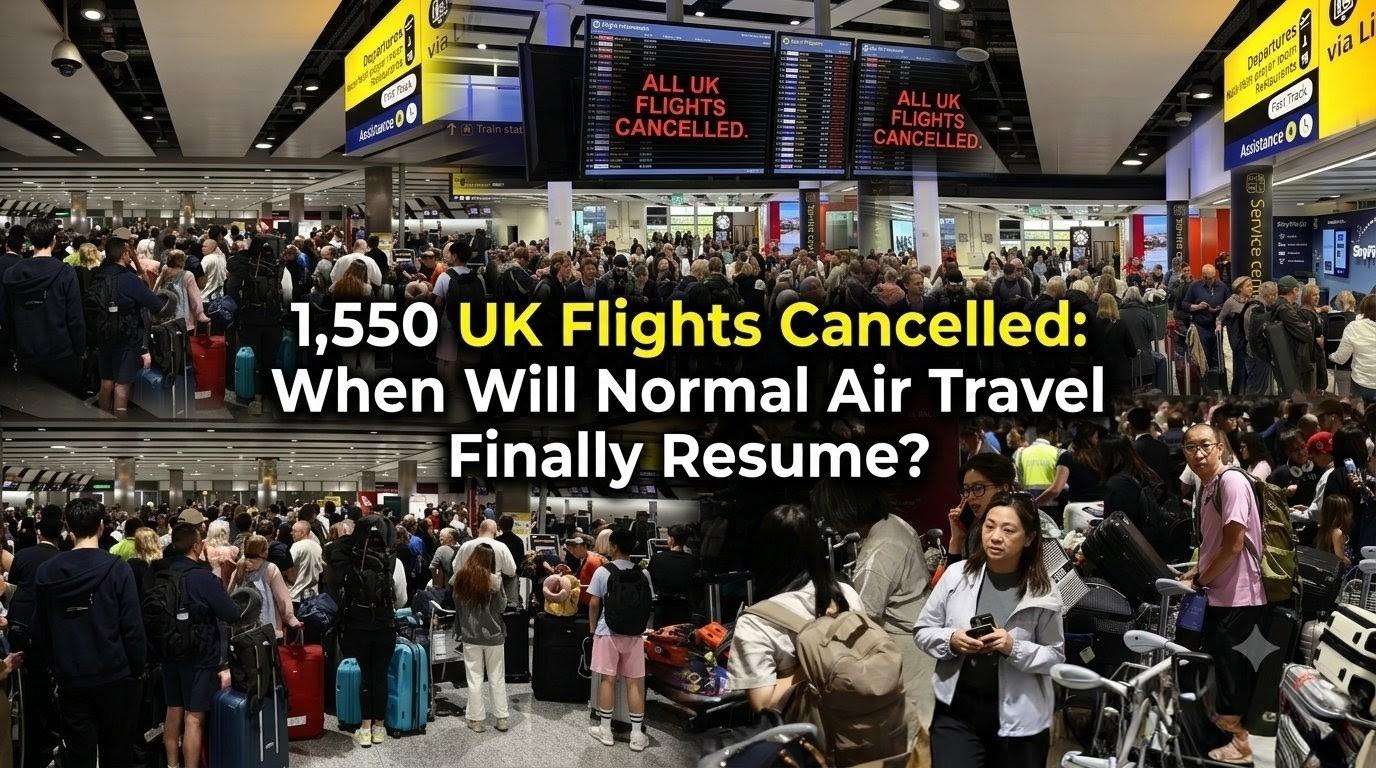
Tens of thousands of airline passengers face widespread disruption across Britain after a severe air traffic control system breakdown grounded more than 1,550 flights, leaving aviation networks in logistical deadlock that experts warn will take several days to return to normal. The crisis originated on the afternoon of Tuesday, 8 September 2026, when an automated technical glitch hit National Air Traffic Services (NATS), which manages air movement from Swanwick in Hampshire. Although engineers announced an operational fix within three hours, NATS admitted that recovery was taking longer than anticipated, leaving airports nationwide struggling to rebalance flight schedules, reposition displaced aircraft, and accommodate marooned travellers.
Disruption rippled across 15 airports nationwide, with roughly 1,300 flights grounded on Tuesday and more than 250 additional services axed early Wednesday morning. Heathrow Airport bore the brunt of the fallout, recording 246 cancellations before 6:00am on Wednesday alongside 16 further cancellations between 7:00am and 8:00am, while Gatwick Airport logged 33 cancellations. Regional transport hubs also felt the shockwave, with Manchester Airport cancelling early services to Heathrow and Paris, and Glasgow Airport grounding flights bound for Heathrow, Luton, and Gatwick. Air tracking data from Flightradar24 revealed virtually cleared skies over southern Britain, where Eurocontrol recorded 590 peak-period flights affected within the London air traffic control sector, leaving more than 65,000 Ryanair passengers alone stranded across Europe.
Extended Recovery Horizon and Ground Bottlenecks
Aviation analysts warn that restoring British air operations to full stability will take days rather than hours due to the sheer complexity of global flight schedules. Because aircraft and flight crews were unable to depart from UK hubs on Tuesday night, reciprocal morning flights into London could not operate, triggering a cascading cycle of stranded equipment and compulsory rest periods for exhausted flight crews. Travel journalist Simon Calder warned that Wednesday would be a protracted ordeal for passengers, noting that lingering backlogs and aircraft displacement will plague airline networks well into the coming days.
In an effort to accelerate recovery, the Department for Transport granted emergency night-flight dispensations to London Heathrow, Gatwick, and Stansted, relaxing strict regulations that normally ban operations between 11:30pm and 6:00am. While London Stansted confirmed it would utilise the waiver to clear tarmac backlogs, Heathrow did not operate overnight flights and suspended all incoming arrivals for the remainder of Tuesday night before resuming departures under heavy delays. Inside Heathrow Terminal 5, hundreds of passengers were forced to sleep on cold floor tiles and plastic baggage trays when airline customer desks ran out of hotel rooms. On airport aprons, passengers endured up to nine hours confined inside stationary aircraft due to shortages of ground handlers and disembarkation stairs, with tensions flaring on one stranded Ryanair aircraft to the point where cabin crew summoned police after passengers demanded drinking water. Prominent travel schedules were also thrown into disarray, including Arsenal's men's first-team squad, whose travel plans to Naples for a UEFA Champions League match suffered significant delays.
Political Clashes and Scrutiny over NATS Leadership
The travel chaos has ignited fierce political fury and calls for executive accountability across the aviation sector. Budget airline Ryanair demanded the immediate resignation of NATS Chief Executive Martin Rolfe, while the head of Wizz Air UK condemned the agency's performance as systemic and urged comprehensive industry reform. Rolfe offered an unreserved apology to disrupted holidaymakers and business travellers, admitting Tuesday was an unfortunate day while defending his focus on air safety. Comparing the bottleneck to an accident on the M25 motorway that produces long residual tailbacks after being cleared, Rolfe claimed NATS does not yet know the exact technical cause of the failure, though he maintained the fault differed from previous historic incidents.
Daily Dazzling Dawn understands that Transport Secretary Heidi Alexander will hold urgent bilateral talks with Rolfe before appearing before Members of Parliament in the House of Commons for the second reading of the Civil Aviation Bill. Ministers are expected to demand rigorous explanations regarding why critical public transport infrastructure experienced its third major technological collapse under current management, alongside scrutiny over rising navigation charges levied on commercial carriers.
Statutory Rights and Passenger Protections
Under United Kingdom Civil Aviation Authority regulations, passengers affected by flight cancellations and extensive delays retain fundamental statutory protections regardless of the underlying operational cause. UK law protects passengers departing from British airports, arriving on UK or EU airlines, or landing in Europe on British carriers. When flights face severe delays—defined as two hours for short-haul routes under 1,500km, three hours for medium-haul journeys, and four hours for long-haul sectors—airlines must provide duty of care assistance, encompassing food, refreshments, telephone expense reimbursements, overnight hotel accommodation, and ground transfers.
For cancelled bookings, carriers are legally required to provide consumers with an immediate choice between a full refund for unused tickets or rerouting to their destination at the earliest possible opportunity. While statutory cash compensation between £220 and £520 is generally exempt under extraordinary circumstances when failures stem from third-party air traffic software rather than direct airline negligence, passengers may book their own modest accommodation and meals, retaining receipts to claim direct reimbursement from their ticketing carriers.





.jpeg)

.jpeg)