





.svg)
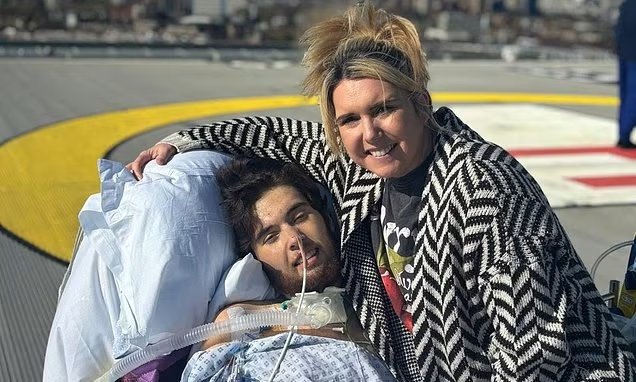
A university student who accidentally took too much paracetamol after combining cold and flu medicine with separate painkillers was left fighting multiple organ failure and had to learn to walk and speak again.
Riley Lubas, 20, had only recently started studying creative media at the University of Bath when he developed what he believed was a typical bout of “freshers’ flu”.
Like many people suffering from cold and flu symptoms, Riley visited a pharmacy and bought cold and flu tablets along with 500mg paracetamol tablets.
However, he did not realise that the cold and flu medicine already contained 250mg of paracetamol.
Within days, the accidental combination left him critically ill and facing liver failure.
Riley's condition deteriorated rapidly, and doctors warned his parents, Chris and Kate, that his liver was heading towards failure.
He developed delirium and hallucinations as his condition became increasingly severe.
Doctors eventually transferred him to King's College Hospital in London, where specialists treated him for multiple organ failure.
“By 6pm that night, he was sedated and on life support and dialysis in multiple organ failure,” his father Chris said.
The family were asked about Riley's medication history. They contacted a university friend, who found packets of paracetamol and cold and flu medication in his room.
Doctors suspected an overdose and immediately placed Riley at the top of the UK's liver transplant list.
However, damage to his heart meant he could not safely undergo a transplant for two days.
During that time, his family were warned that the damage to his liver appeared to be “as good as irreversible”.
Despite the seriousness of his condition, Riley's liver gradually began to recover.
Doctors believed his young age and otherwise good health may have supported the recovery.
After around a week, he was able to come off dialysis and life support.
“I think the doctors were more surprised than us,” Chris said.
“There’s no exact answer for why it happened this way, but they think that his health and age would have supported the liver’s recovery.
“But just seeing him up and alive again was unbelievable.”
However, surviving the organ failure was only the beginning of Riley's recovery.
After being critically ill and undergoing a tracheostomy, Riley had lost significant strength and mobility.
“He physically couldn’t move once he’d come out of sedation,” Chris said.
Riley also had to adjust to breathing independently after the tracheostomy was removed.
“It was like he was suffocating when he was trying to breathe,” his father recalled.
After weeks of treatment, he was transferred to a hospital in Newport, where he faced severe swelling and muscle loss caused by his prolonged time in bed.
Once he was able to breathe independently, Riley began intensive physiotherapy and gradually relearned how to walk using mobility aids.
He spent several weeks in intensive care before moving to a rehabilitation ward and was eventually discharged home.
For the following year, Riley attended regular medical appointments, including heart, liver and blood tests.
Doctors eventually confirmed that he had made a full recovery.
Around a year and a half after the overdose, Riley has returned to normal life.
His experience has also prompted his family to raise awareness of the risks associated with accidentally taking too much paracetamol.
Chris and Kate recently completed a 50km (31-mile) hike across the Gower Peninsula in south-west Wales to raise money for King's College Hospital's intensive care unit.
The family now want young people, particularly students living away from home for the first time, to understand that different medicines can contain the same active ingredient.
“It's just scary because it's so accessible, it's so cheap, and it's seen as a safe drug to take,” Chris said.
“I think the biggest issue is that when you're unwell — whether you're older, younger or at university — it can be difficult to keep track of how often you're taking medication.”
Paracetamol is widely used to treat pain and fever, but taking more than the recommended amount can cause serious liver damage.
People taking cold, flu or other combination medicines are advised to check the ingredients carefully to make sure they are not unknowingly taking additional paracetamol.