.jpeg)
.jpg)




.svg)
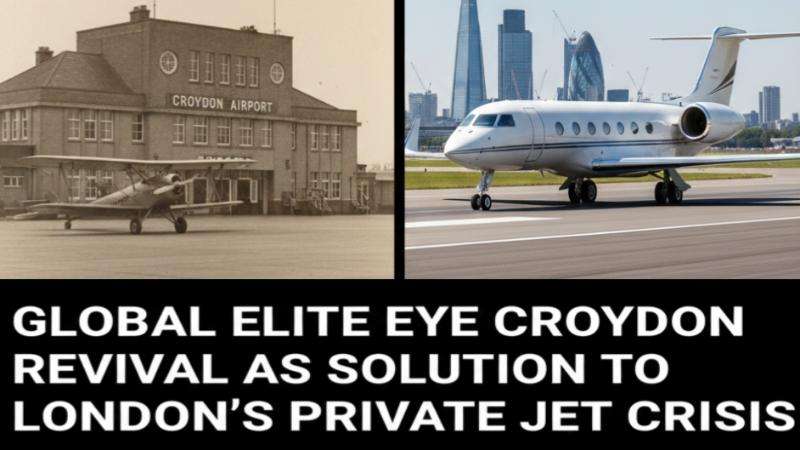
The shifting landscape of British aviation has sparked a provocative debate among urban planners and industry leaders: could the birthplace of air traffic control reclaim its crown? As Farnborough Airport in Hampshire battles a wave of local fury over plans to increase weekend flights to 13,500 per year, the historic Croydon Airport is being increasingly cited as the logical, high-octane solution to London's capacity crisis. While Farnborough residents complain of "posh little planes" and "fuel smells" ruining their gardens, proponents of a Croydon revival argue that the South London site is uniquely positioned to become Britain’s premier private jet capital, injecting life-saving capital into a local economy currently fighting for its survival, Daily Dazzling Dawn understands.
Farnborough, currently the preferred hub for billionaires like Kim Kardashian and Tom Cruise, is operating near its breaking point. Its bid to nearly double weekend movements has met fierce resistance from groups like the Farnborough Noise Group, who cite environmental damage and a disconnect from local needs. Critics argue that while the elite jet off to Nice for beach days, the local Hampshire community reaps only noise and pollution. This tension has opened a strategic window for Croydon. Unlike the Hampshire countryside, Croydon sits in the heart of London’s infrastructure, offering an unbeatable geographic advantage that could shave hours off the commute for the world’s most influential power players.
The economic argument for transforming the old Croydon site into a modern executive hub is overwhelming. Croydon Council recently signed an Economic Growth Charter, noting that airport-related activity already generates over £265 million for the borough and supports 3,600 jobs. However, a full-scale aviation revival would dwarf these figures. Transforming the site into a dedicated VIP terminal would create a high-value ecosystem of luxury engineering, concierge services, and high-end hospitality, providing a "once-in-a-generation" boost to a town centre currently undergoing a £40 million Levelling Up regeneration.
A Croydon-based private jet capital would provide the "missing link" in London’s global competitiveness. While London City Airport remains constrained by its short runway and dense residential surroundings, the historic Croydon site offers the heritage and space to create a world-class FBO (Fixed Base Operator) facility. The influx of international investment would not only revitalize the Purley Way corridor but also create thousands of skilled apprenticeships for the borough’s young population—the youngest in London. Rather than the "dust and dirt" complained of by Farnborough locals, Croydon could leverage this revival to fund public realm improvements, modernizing the town’s image from a struggling suburb to a global business destination.
The contrast in sentiment is stark. In Hampshire, residents view private aviation as a nuisance of the "super-rich." In Croydon, a borough hungry for investment and prestige, the return of the aviation industry represents a homecoming of prosperity. Industry analysts suggest that by diverting the "weekend rush" of elite travelers from Hampshire to South London, the UK could better manage its airspace while simultaneously solving Croydon’s economic stagnation. As the world’s elite seek more efficient ways to reach the capital, the old Croydon Airport stands ready to transform from a relic of the past into the engine of London’s future.