





.svg)
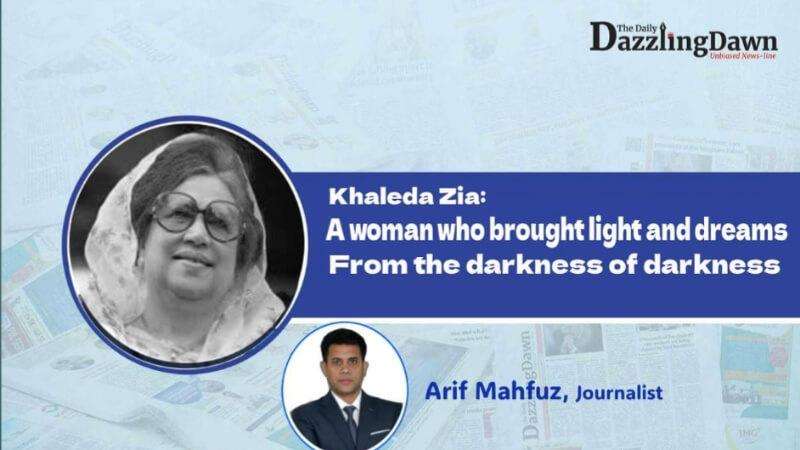
The landscape of modern politics is often a treacherous terrain, marked by shifting alliances and the constant threat of moral compromise. Yet, amidst the complex equations of power, Begum Khaleda Zia emerged as a singular force of nature—a living symbol of uncompromising resolve. From the quiet life of a homemaker to the highest seat of power, her journey remains a testament to the power of a woman who refused to bow before the iron grip of autocracy. As the first female Prime Minister of Bangladesh and only the second in the Muslim world following Benazir Bhutto, her legacy is etched into the very soil of the nation.
Her entry into the political arena was not a choice of ambition but a mandate of history. Following the tragic martyrdom of her husband, President Ziaur Rahman, in 1981, and the subsequent military takeover by General Ershad, the Bangladesh Nationalist Party (BNP) stood on the brink of collapse. On January 3, 1982, Khaleda Zia stepped into the void, trading the sanctity of her home for a road paved with the glass shards of state repression. She did not merely join a party; she breathed life into a movement that would eventually dismantle a dictatorship.
The struggle against the Ershad regime was a grueling marathon that tested the limits of human endurance. While others faltered or sought convenience in compromise, Khaleda Zia remained the anchor of the opposition. Even when political alliances fractured—most notably in 1986 when the Awami League broke its pledge to boycott elections under the military ruler—she stood her ground. Her refusal to legitimize a puppet parliament through participation solidified her image as the "uncompromising leader." For eight long years, through three arrests and countless hours on the heated streets of Dhaka, she led the Seven-Party Alliance until the autocracy finally crumbled on December 6, 1990.
The dawn of the 1991 elections marked a pivotal shift in the nation’s destiny. Under her leadership, the BNP secured a historic victory, and in a move that showcased her dedication to the people’s voice, she transitioned the country back to a parliamentary system. This era of governance from 1991 to 1996 saw Bangladesh garner international attention for its developmental strides. However, the path of a reformer is rarely smooth, and by 2007, she found herself once again in the crosshairs of political upheaval.
The years that followed were defined by a systematic attempt to erase her influence. From the caretaker government's intervention to the subsequent decade of legal battles, Khaleda Zia faced unprecedented state pressure. Even as she was sentenced in 2018 and confined to an abandoned prison, her spirit remained unbroken. The physical toll was immense; she was evicted from her long-term residence and denied the medical care she desperately needed as her health declined. Yet, when offered the chance to leave the country in exchange for her silence, her response was a masterclass in patriotism: "I have no address outside this country. I was born here, and I will die here."
Khaleda Zia’s legacy is not found in the titles she held, but in the defiance she modeled. She stood as a bulwark against imperialism and a fierce protector of national sovereignty, famously declaring that while others might hold the chains of slavery, her people would always hold the flag of independence. Today, as the nation reflects on her forty-three years of political service, it sees a leader who guided them from the darkness of oppression toward the light of democratic hope. Though her physical presence may fade from the streets, her message of unwavering courage remains the North Star for every generation that dares to dream of a free Bangladesh.

.jpg)