





.svg)
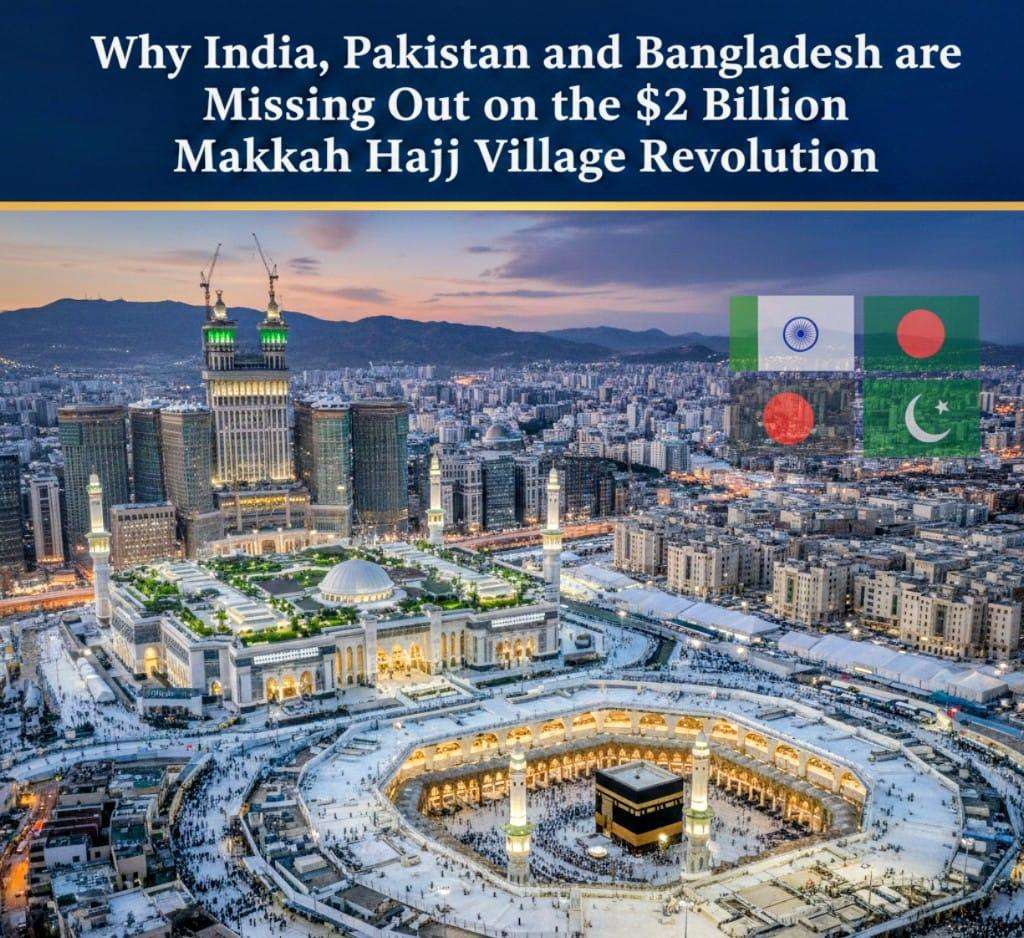
As Indonesia moves forward with its groundbreaking $2 billion "Hajj Village" in Makkah, a sharp contrast has emerged across South Asia. While Jakarta secures 4.4 hectares of prime real estate to house 22,000 pilgrims, the trio of India, Pakistan, and Bangladesh—which collectively send nearly half a million pilgrims for Hajj and millions more for Umrah annually—remains on the sidelines without a unified or permanent infrastructure plan in the Holy Kingdom.
The Massive South Asian Footprint in Makkah
Every year, the sheer volume of pilgrims from India, Pakistan, and Bangladesh dominates the streets of Makkah and Madinah. For the 2025 Hajj season, Pakistan leads the trio with a quota of 179,000, followed closely by India at 175,025, and Bangladesh at 127,198. Combined, these three nations account for over 481,000 Hajj pilgrims. The Umrah figures are even more staggering; India alone sent a record-breaking 1.8 million Umrah pilgrims in 2023, while Pakistan and Bangladesh contribute millions more, making the South Asian diaspora the largest consistent consumer of Saudi hospitality and logistics services.
Why South Asia Lacks a Sovereign Hajj Strategy
The absence of an "Indian Village" or a "Pakistani Complex" in Makkah is not due to a lack of demand, but rather a lack of financial vehicle and diplomatic synergy. Indonesia’s project is funded by Danantara, its sovereign wealth fund, which treats the Hajj Village as a strategic investment that generates returns through hotel stays and shopping centers. In contrast, India, Pakistan, and Bangladesh manage Hajj through government committees or ministries of religious affairs, which operate on a seasonal, non-profit basis rather than a long-term investment model. Political volatility and economic constraints, particularly in Pakistan and Bangladesh, have historically prevented the massive upfront capital commitment required—such as Indonesia’s $500 million acquisition of the Novotel Makkah. Furthermore, there is currently no "interactive" or joint initiative between these three nations due to complex regional geopolitics, which prevents the pooling of resources for a shared "South Asian Hub" that could drastically lower costs.
The Missing Interactive Initiative
Fact-checking into regional cooperation reveals that while Saudi Arabia has integrated these countries into the "Makkah Route Initiative"—which streamlines pre-departure immigration—there is zero high-level dialogue between New Delhi, Islamabad, and Dhaka regarding shared infrastructure in Saudi Arabia. This lack of interaction forces each country to negotiate separately with private Saudi hotel groups every year. Because they do not own their accommodations, they are subject to the fluctuating prices of the Makkah real estate market, which has seen costs skyrocket following the implementation of the "Nusuk" platform requirements.
The Multi-Billion Dollar Benefit of a Joint Initiative
If India, Pakistan, and Bangladesh were to launch a combined initiative, the benefits to pilgrims would be transformative. A shared Hajj complex would allow for "economies of scale," reducing the average package cost by an estimated 20% to 30%. Currently, South Asian pilgrims often stay in "Batha" or "Aziziyah" areas, kilometers away from the Masjid al-Haram, requiring exhausting commutes. A dedicated complex would provide standardized medical care, familiar food catering, and localized administrative support in Urdu, Hindi, and Bengali under one roof. Economically, it would stop the massive "capital flight" where billions of dollars in pilgrimage fees flow entirely to foreign hotel chains, instead allowing South Asian funds to earn dividends that could be reinvested into making Hajj even cheaper for future generations.
Statistical Comparison and Global Precedents
Indonesia’s $2 billion bet is the gold standard, but other nations are watching. Malaysia’s Tabung Haji has long been the model for organized pilgrimage, though even they do not yet own a "village" of this scale in Makkah. Indonesia’s new complex will house 10% of its contingent by 2029, creating 7,500 jobs and generating approximately $150 million in annual economic value. For the South Asian trio, the data suggests that a similar investment could yield even higher returns given their combined 2.3 million annual travelers (Hajj and Umrah combined). Without a shift from "seasonal spending" to "sovereign investing," pilgrims from India, Pakistan, and Bangladesh will continue to pay a premium for temporary lodgings while Indonesia builds a permanent home in the heart of Islam.

.jpg)