.jpg)





.svg)
Prime Minister Andy Burnham has promised that his government will continue working relentlessly to reduce the number of people crossing the English Channel in small boats to reach the UK.
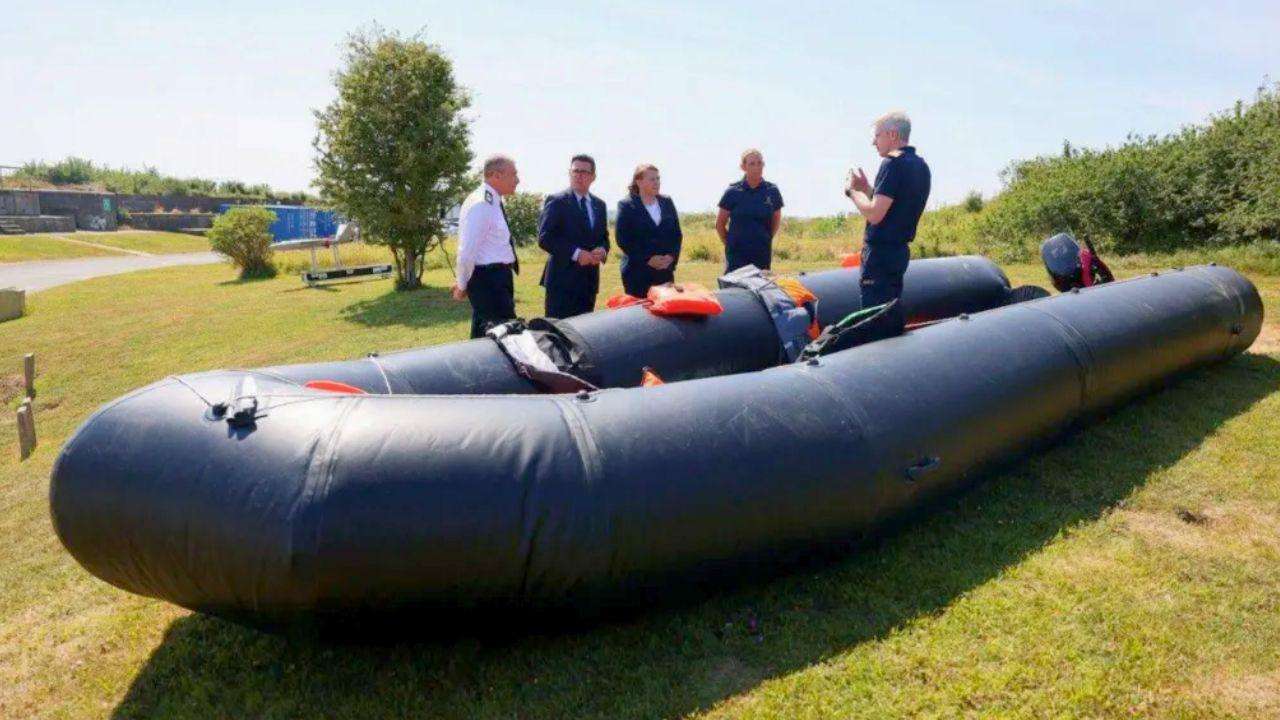
Speaking during a visit to Dover, Burnham said progress had already been made and that the government was taking a new approach to tackling illegal migration. He said the number of enforcement officers targeting people-smuggling gangs had doubled on both the UK and French sides of the Channel.
Burnham said the public expects the government to deal with the issue effectively. At the same time, he stressed the importance of creating safe and legal routes for people who genuinely need protection, arguing that such pathways would reduce the influence and profits of criminal smuggling networks.
The Conservatives accused Labour of failing to deliver on its migration promises, while Reform UK said it would use the Royal Navy to stop migrant boats from crossing the Channel if it came to power.
The debate over illegal migration has intensified following the recent arrival of tens of thousands of migrants in the Spanish enclave of Ceuta. Burnham pointed out that around 98% of those who swam into the territory had already been returned to Morocco, describing it as an example of swift action to address the immediate crisis.
However, he said the wider issue involves the Schengen Area and Britain's relationship with European countries. Burnham added that he wanted to maintain regular discussions with the European Union on border security and migration challenges.
His comments came shortly after the Home Office announced that the number of National Crime Agency (NCA) officers investigating people-smuggling gangs had increased from 376 at the beginning of 2025 to nearly 800. Burnham also said France had similarly doubled the number of officers involved in tackling smuggling operations.
When asked whether he wanted to change the tone of the debate, Burnham said his priority was solving the problem rather than turning it into a political argument. He said people want confidence that the UK's borders are properly controlled while also ensuring support is available for those who genuinely require asylum.
The Home Office also reported that nearly 300 suspected smuggling gang members were arrested last year and more than 1,100 small boats and boat engines were seized. Officials claimed that, if those boats had been used, they could have enabled about 72,000 more people to enter the UK illegally, although the BBC said it had not independently verified that estimate.
Burnham acknowledged that progress had been made but said the government would not become complacent in its efforts.
Reform UK's shadow home secretary, Zia Yusuf, said his party would order the Royal Navy to turn migrant boats back to France, describing it as the biggest military operation in the English Channel since the Second World War.
However, international maritime law allows countries to rescue people in danger at sea but does not permit them to transport rescued individuals to another country without that country's agreement.
A Labour Party spokesperson dismissed Reform UK's proposal, saying it was an attempt to divert attention from questions surrounding the party's finances.
Shadow Home Secretary Chris Philp repeated Conservative calls for the UK to leave the European Convention on Human Rights. He argued that doing so would allow illegal migrants to be deported within a week, either to their country of origin or to a safe third country such as Rwanda, creating a stronger deterrent against Channel crossings.
Liberal Democrat immigration spokesperson Will Forster said the government should strengthen cooperation with European partners while continuing efforts to reduce the backlog of asylum applications.
Since Burnham became prime minister two weeks ago, more than 2,000 migrants have crossed the English Channel in small boats, including 326 people who arrived on Saturday.
Crossings typically increase during the summer because of calmer weather. Despite that seasonal rise, Home Office figures show that small boat arrivals this year are around 43% lower than during the same period in 2025.
Small boats have been the main method of illegal entry into the UK since 2020, making the issue one of the country's most significant political and immigration challenges. Home Office data also shows that Channel crossings have generally declined since reaching a record high in 2022.
In May, the Office for National Statistics reported that net migration to the UK fell to 171,000 last year, almost half the level recorded in 2024 when Labour came to power and the lowest figure since 2012. The decline was mainly linked to fewer people arriving from outside the European Union for work and study.


_1.jpg)