





.svg)
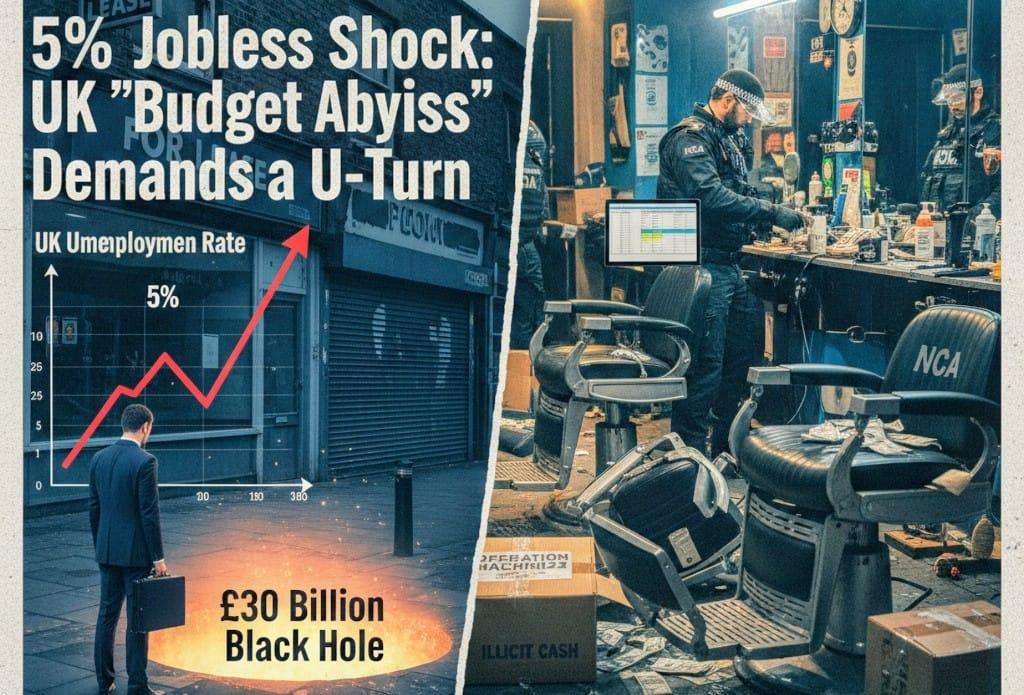
The United Kingdom's economic outlook has been significantly clouded following the release of official figures showing the unemployment rate has climbed to 5% for the three months to September, a level not witnessed since late 2020. The increase from 4.8% the previous month signals a definite weakening of the labour market, a trend exacerbated by a 32,000 decline in payrolled employment during October, according to ONS data. Men, in particular, were noted by the Office for National Statistics (ONS) as being the worst affected by this shift.
What’s the Reason Behind the Economic Slowdown?
The current economic turbulence is rooted in a confluence of domestic policy decisions and powerful global headwinds.
The primary domestic factor critics point to is the £25 billion tax raid on employers introduced in Chancellor Rachel Reeves's first budget in April. Hikes to minimum pay and employer national insurance contributions have been fiercely criticised by opposition parties, who argue the measures have "killed jobs" and damaged private sector investment sentiment. The Liberal Democrats have been particularly vocal, urging the government to immediately reverse the National Insurance hike, arguing the current trend is the direct "proof" that forcing small businesses to pay more for employing people harms job opportunities.
Internationally, the Chancellor herself has cited the continued effects of Brexit and peak US trade war uncertainty, specifically mentioning the ramping up of tariffs by Donald Trump, as key external pressures on the UK’s financial health.
Compounding these issues is a deep structural challenge: the government is staring down a fiscal "black hole" believed to be in the region of £30 billion. This deficit is forcing the Chancellor to prepare for a painful series of measures in the upcoming November 26 budget, leading her to signal a potential break from Labour's manifesto tax pledge by indicating that increases to income tax, national insurance, or VAT are now on the table.
When Could the UK Economy Get Better? Is Recovery Imminent?
While the immediate outlook is challenging, there are two key factors that offer a sliver of hope for a future turnaround, though the timeline is not imminent and remains heavily reliant on external pressures easing.
First, the slowing pace of wage growth in the private sector combined with the weakening jobs market should bolster the case for an interest rate cut by the Bank of England (BoE) next month. A BoE rate cut, assuming inflationary pressures continue to ease, would lower borrowing costs for businesses and consumers, injecting much-needed stimulus into the economy and potentially kickstarting investment.
Second, the government is actively attempting to mitigate one factor of the UK’s financial malaise: illicit finance. The National Crime Agency's (NCA) Operation Machinize, the largest-ever crackdown on high street money laundering, offers a long-term benefit. In just a month, the operation targeted 2,734 cash-rich businesses—including barbershops, minimarts, and vape shops—which are often used as fronts for laundering an estimated £12 billion in cash each year from crimes like drug sales. The operation saw 924 arrests and the seizure of over £10.7 million in cash and criminal assets, a necessary step to curb the "poly-criminality" that undercuts legitimate businesses and corrodes the UK's financial system.
The government maintains that its plan, which has already seen over 329,000 more people move into work this year, is designed to "Get Britain Working" through ambitious employment reforms and by backing businesses with red tape cuts and trade deals. However, for a broad-based recovery to take hold, economists suggest a sustained period of global stability and a clearer path on domestic tax policy are essential. Therefore, a significant economic turnaround is unlikely to be evident until well into the second half of 2026 or 2027, following the impact of the Chancellor’s forthcoming budget and assuming the BoE can successfully manage inflation and borrowing costs.
The immediate future hinges on the November 26 budget. While Ms. Reeves is expected to announce some measures to keep Labour MPs onside, such as potentially lifting the two-child benefit cap to help an estimated 350,000 children out of poverty, the focus remains on closing the massive funding gap, which will inevitably involve further financial pain for businesses or taxpayers.