


.jpg)



.svg)
Britain is witnessing a historic shift in domestic life as the traditional leap into independent living becomes an impossible luxury for millions of young adults.
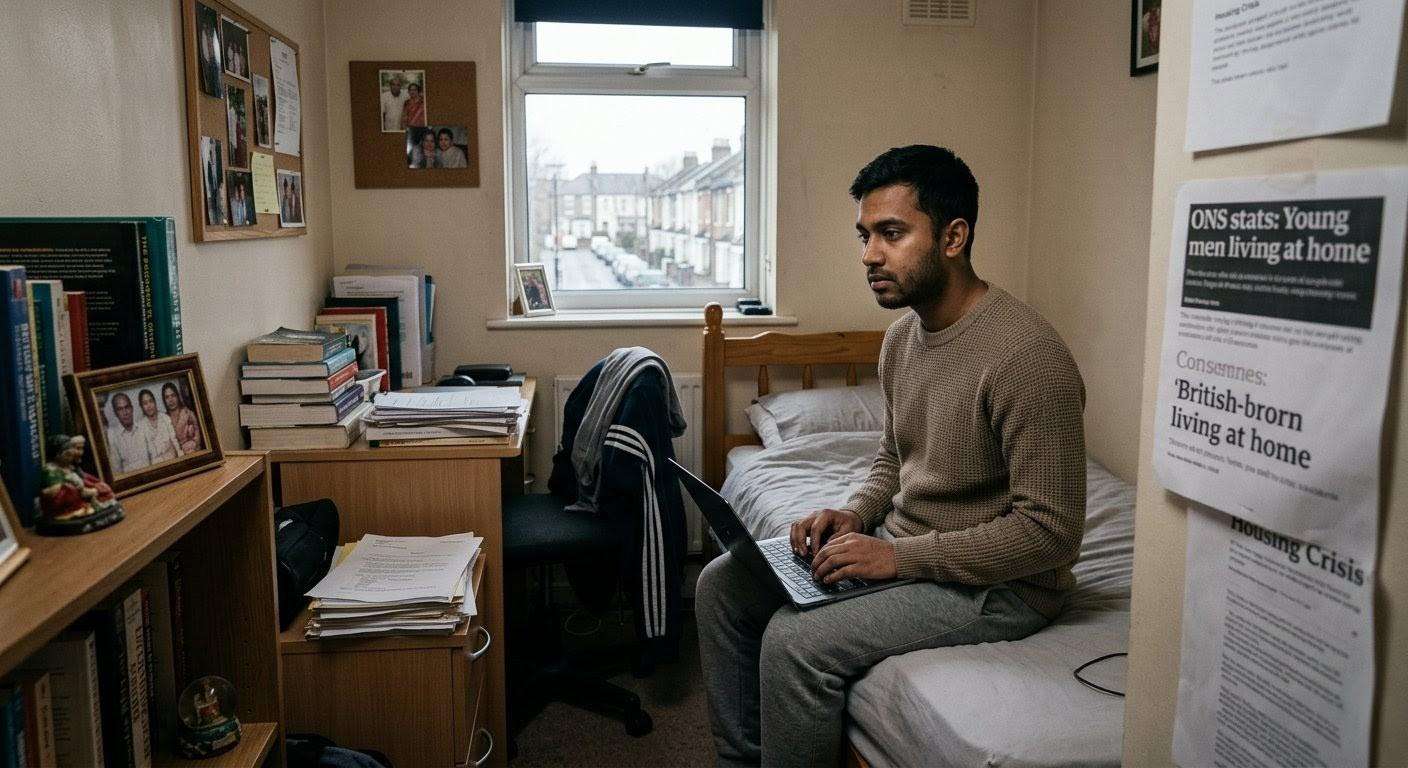
The latest figures from the Office for National Statistics (ONS) confirm a deepening "stay-at-home" crisis that is increasingly gendered and ethnically concentrated. In 2025, the number of men aged 20 to 34 living in their family home hit a record 2.3 million, a significant jump from 2.2 million in 2024. This means 35% of all young men in the UK are still in their childhood bedrooms, compared to just 1.4 million, or 22%, of women. The disparity widens sharply with age; by 34, a man is nearly four times more likely to be living with his parents than a woman of the same age.
The Cultural and Economic Divide
While the national average of 20 to 34-year-olds living at home sits at 29%, a granular look at the data reveals that British South Asian communities are navigating a unique intersection of cultural tradition and economic pressure. Statistics indicate that British Pakistani and British Bangladeshi men are significantly more likely to live in multi-generational households compared to their white British counterparts. Current estimates suggest that over 55% of young British Bangladeshi and Pakistani men remain in the family home well into their late 20s. This is driven not only by a cultural emphasis on family cohesion but also by the acute impact of the cost-of-living crisis on urban communities where these groups are densely populated.
The Education and Employment Gap
Experts point to a divergence in life paths as a primary reason why women are "escaping" the family nest faster than men. Women are now significantly more likely to attend university, which acts as a structured transition into independent living. Conversely, the rise of the "NEET" (Not in Education, Employment, or Training) population is skewed toward men. With 510,000 young men currently classed as NEET compared to 448,000 women, a lack of financial autonomy is anchoring a generation of males to their parents' homes. A senior economist told a journalist that the alternative—the private rental sector—is simply too hostile, with the average young person expected to sacrifice 40% of their income for a roof in London.
What Happens Next
The long-term implications of this trend extend far beyond housing. Analysts warn that this domestic stagnation is a lead indicator for a further decline in UK fertility rates, which hit record lows in 2024. As one researcher told a journalist, "When you are living under the same roof as your parents, the logistics of forming a relationship and starting a family become exponentially more difficult." Looking ahead, the government is expected to face mounting pressure to reform the rental market and address the "empty nester" imbalance, where over-60s now own more than half of UK properties while the workforce of the future remains "boxed in" by £1,374 average monthly rents.



.jpg)