

.svg)
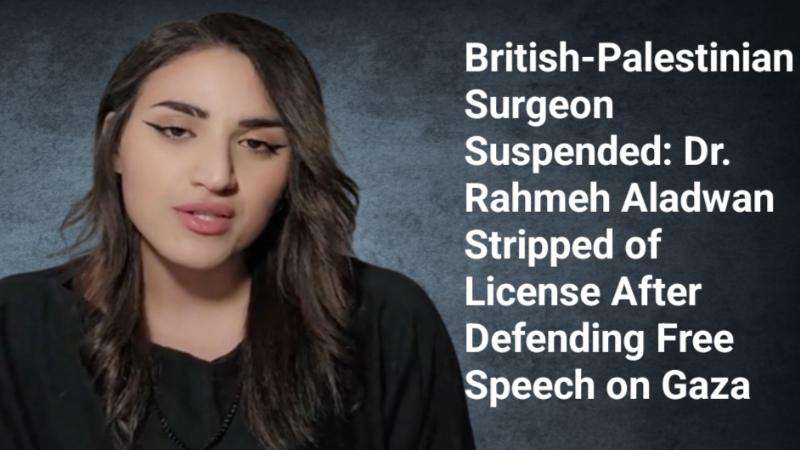
A prominent British-Palestinian surgeon has been barred from practicing medicine for 15 months following a contentious battle over freedom of expression and political advocacy within the National Health Service. Dr. Rahmeh Aladwan, a 31-year-old trainee surgeon with what her legal counsel describes as an impeccable medical record, was handed the suspension by the Medical Practitioners Tribunal Service (MPTS) this week pending a full investigation. The decision marks a significant reversal from a ruling just two months prior, raising serious questions about the growing pressure on medical professionals who speak out against the humanitarian crisis in Gaza.
The controversy centers on a series of impassioned social media posts made by Dr. Aladwan regarding the ongoing conflict. While her supporters view her digital footprint as a desperate plea for human rights and a condemnation of the violence in her ancestral homeland, critics and regulatory bodies have branded the comments as inflammatory. The suspension comes after a protracted period of scrutiny where Dr. Aladwan sought to defend her right to political speech in the face of what her defense team has termed "lawfare" driven by external lobbyists.
Only in September, Dr. Aladwan had successfully fought for her right to continue treating patients. In that earlier fitness-to-practise tribunal, the panel upheld her right to freedom of expression, concluding that the complaints against her were insufficient to establish a real risk to patient safety. However, the political climate shifted rapidly following that victory. Health Secretary Wes Streeting publicly intervened, stating he had "no confidence" in the regulatory system that allowed her to remain, declaring that action was needed to root out such sentiments from the NHS. Following this high-level political pressure, the regulator has now moved to suspend her, citing a risk to public confidence in the profession.
The campaign against the doctor escalated dramatically in October when she was arrested by the Metropolitan Police. The investigation involves suspicions of misusing a public communications network and stirring up racial hatred, allegations that have intensified the legal peril she faces. During the recent hearing in Manchester, the General Medical Council (GMC) introduced evidence from the police regarding this arrest, arguing that her continued presence in the medical field undermined the profession. Legal counsel for the GMC, Emma Gilsenan, referenced posts where Dr. Aladwan criticized the ideology of "Jewish supremacy" and expressed support for armed resistance against occupation, framing these as dangerous rhetoric rather than political critique.
In her defense, Dr. Aladwan’s lawyer, Kevin Saunders, argued that the tribunal was witnessing a draconian shift in policy. He told the panel that the proceedings were an abuse of process and that the doctor was herself a victim of the intergenerational trauma associated with genocide and dispossession. Saunders emphasized that Dr. Aladwan was exercising her fundamental right to speak out against crimes identified by international bodies, including the United Nations. He characterized the doctor’s comments as "political speech, not hate speech," and suggested that the sudden push for suspension was a result of the "clamour and intrinsic pressure" placed on the regulator by pro-Israel lobbyists and government officials.
The tribunal heard details of the posts in question, which included harsh criticisms of the state of Israel and its military actions since October 7. In one instance, she challenged the narrative surrounding the conflict by stating she would not condemn the armed resistance to occupation, though she clarified she condemned the state of Israel rather than the Jewish faith itself. Despite her defense asserting that her anger was directed at a political ideology and military action rather than a religious group, the panel concluded that the risk of repetition was high and that her views could damage trust in the NHS.
Dr. Aladwan now faces an uncertain future. While she has been removed from her duties for the next 15 months, the GMC is continuing its investigation, which could ultimately lead to her being struck off the medical register permanently. For her supporters, Dr. Aladwan has become a symbol of the shrinking space for pro-Palestinian advocacy in the West, a doctor penalized for bringing her political conscience into the public sphere. Her legal team maintains that she is a dedicated physician caught in a political crossfire, punished for refusing to stay silent on what she perceives asa genocide.