





.svg)
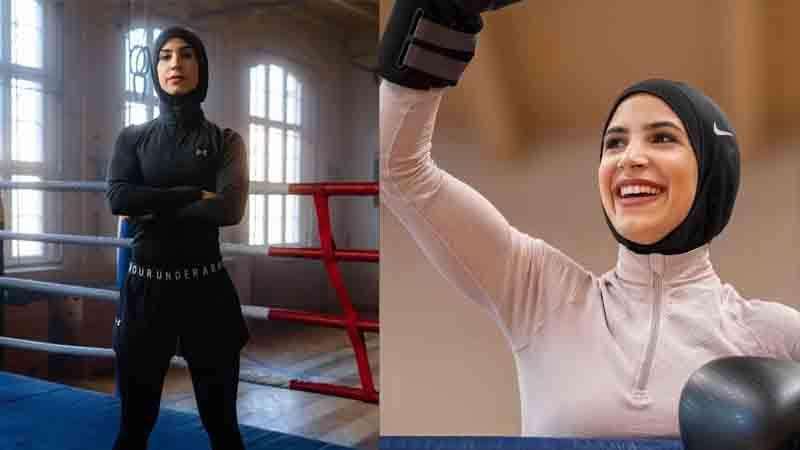
In the world of boxing, fights are usually won with fists, speed, and agility. But for Zeina Nassar, the most important victory of her career was won without throwing a single punch. It was won in a boardroom, fueled by an unshakeable devotion to her Islamic faith. Nassar is the woman who forced the boxing world to change its definition of what a fighter looks like, overturning the international ban on hijabs and opening the ring to millions of Muslim women worldwide.
Born in 1998 in Berlin to Lebanese parents, Nassar grew up in the culturally rich district of Kreuzberg. Her journey into the ring began at age 13, sparked not by a local gym, but by a YouTube video of female boxers. Captivated by their discipline and strength, she found a sport that mirrored her own inner resilience. However, she quickly collided with a barrier that no amount of training could overcome: the International Boxing Association (IBA) strictly prohibited religious headwear, citing safety concerns.
For Nassar, removing her hijab was never an option. "I didn't want to take off my headscarf," she has repeatedly stated to the press. "It is part of me." Driven by a profound love and respect for Islam, she viewed her hijab not as a hindrance, but as a source of spiritual power. She was forced to face a choice that no athlete should have to make: abandon her sport or compromise her religion. Nassar chose a third option. She decided to change the rules.
Her advocacy began at the grassroots level in Germany. With the support of her father and mother, who instilled in her a deep pride in her Lebanese ethnic identity and Shiite Muslim heritage, she petitioned the German Boxing Association. Her persistence paid off in 2013 when national rules were amended to allow long sleeves and headscarves. But Nassar’s vision was global. She set her sights on the Olympics, a dream that remained legally impossible under international regulations.
Nassar’s fight for inclusion was relentless. She partnered with major athletic brands like Nike to normalize the "Pro Hijab" and lobbied officials with a maturity far beyond her years. Her breakthrough finally came in February 2019, when the IBA executive committee voted to amend the rules. The ban was lifted, allowing female boxers to wear hijabs and full-body coverage in international competition. It was a historic knockout for equality, ensuring that future generations of Muslim girls would never have to choose between their faith and their passion.
Outside the ring, Nassar defies the one-dimensional stereotypes often forced upon athletes. She is a true scholar-athlete, studying Sociology and Educational Science at the University of Potsdam. A scholarship holder and an ambassador for "Visions for Children," she is as committed to her intellectual growth as she is to her athletic physical conditioning. Her multifaceted career even extends to the stage, where she has performed as an actress in theater productions in Berlin, showcasing a creative side that balances her combative profession.
Despite her public profile, Nassar guards her personal life with the same defense she uses in the ring. While often confused in search engines with the equestrian Nayel Nassar (who is married to Jennifer Gates), Zeina Nassar has carved out her own distinct legacy. She is currently unmarried and does not have children, dedicating her twenties entirely to her dual careers in advocacy, academia, and athletics. Her "family" remains her parents and siblings in Berlin, whose unwavering support allowed a daughter of Lebanese immigrants to rewrite the history of a male-dominated sport.
Zeina Nassar’s legacy is now written in the rulebooks of boxing. Every time a woman steps into an Olympic ring wearing a hijab, she is standing on the ground Nassar fought to clear. She proved that modesty and modern sport are not incompatible, and that sometimes, the greatest fight is simply for the right to exist as you are.

_3.jpg)