






.svg)
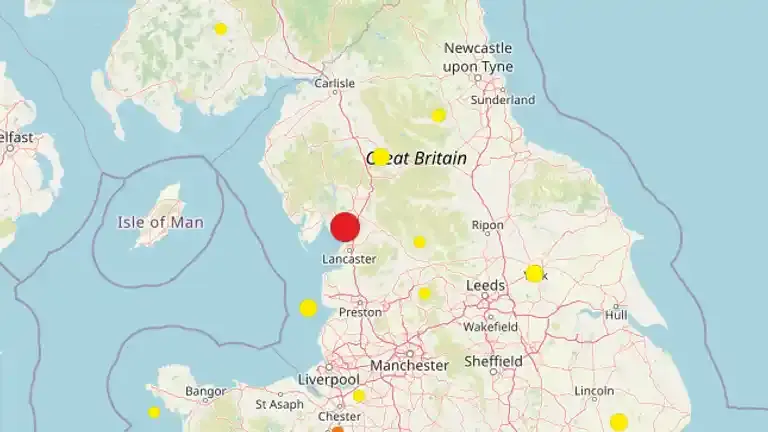
A 3.3-magnitude earthquake rattled parts of north-west England late Wednesday, according to the British Geological Survey (BGS).
The tremor occurred shortly after 11:23pm and was felt throughout Lancashire and the southern Lake District, including Kendal and Ulverston, both located within roughly 12 miles of the quake’s epicentre.
Preliminary data indicates the earthquake originated just off the Silverdale coast in Lancashire at a shallow depth of around 1.86 miles.
Residents reported the shaking to the BGS, describing the event as resembling “an underground explosion” and strong enough that “the whole house shook”.
Volcano Discovery, a platform that also tracks seismic activity, received over 1,100 user reports from people in the region, most of whom described the tremor as producing “light” or “weak” shaking.
The UK typically records between 200 and 300 earthquakes annually, though only 20 to 30 are usually strong enough to be noticed by people. Most remain undetected except by seismic instruments, and very few result in any damage.
The last quake stronger than Wednesday’s—above 3.3 magnitude—was felt across parts of Perth and Kinross on October 20. According to the BGS, that event struck at 7:25am with an epicentre near Pubil in the Glen Lyon area.