

.jpg)
.jpg)


.svg)
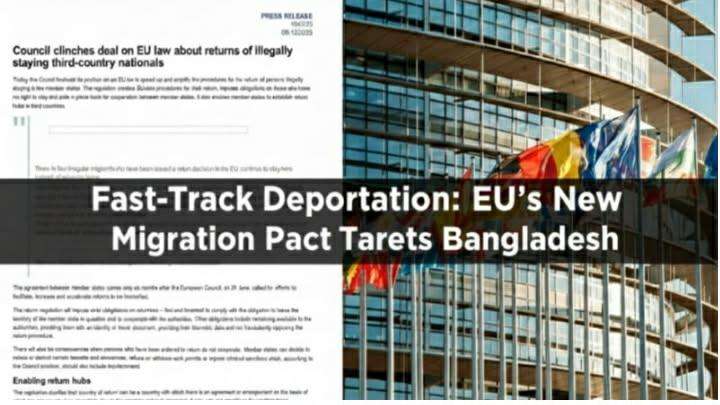
The European Union is poised to usher in a new, stringent era of migration management following the finalization of a critical position by the European Council. The new framework is designed to drastically accelerate the return of irregular migrants and expedite the rejection of asylum applications deemed inadmissible. At the heart of this comprehensive overhaul is the unprecedented creation of a joint EU "safe country" list, a roster that now includes Bangladesh. This designation is expected to create the most challenging situation yet for future Bangladeshi applicants seeking international protection in Europe, Daily Dazzling Dawn understands.
Council Finalizes Key Return and Asylum Positions-On Monday, December 8 (The provided date in the original news, December 8, 2025, aligns with the context of a news report, however, for real-time reporting, the date should reflect the current day unless the original article specifies the publication date), the EU Council officially adopted its position on a key piece of EU legislation aimed at streamlining and accelerating the return process for individuals residing irregularly in member states. This pivotal decision, agreed upon by the Interior Ministers of the 27 EU nations, marks a significant step towards reforming the bloc's asylum system.
A major component of this reform is the authorization to establish management centers outside of European borders. These external centers are intended to house migrants whose asylum applications have been rejected, serving as temporary holding facilities before their deportation. This measure is part of a broader legal package that introduces severe penalties for those who refuse to leave European territory following a rejection. It must be noted that these measures are still pending a vote and final approval by the European Parliament in the coming months, with potential full implementation slated for 2026.
Fast-Track Rejections and Curtailment of Rights-The Council’s statement underscores that the new policy will allow any member state to swiftly and preliminarily reject an asylum application if the applicant originates from a country the EU considers ‘safe.’ For Bangladeshi asylum seekers, this means the previous opportunity for a lengthy and detailed explanation of their circumstances will be severely curtailed.
Asylum lawyers are voicing serious concerns, arguing that this policy effectively narrows the scope of the right to international protection. The designation of a country as "safe" dramatically reduces the member state’s obligation to conduct an extensive review of the applicant's claims, paving the way for applications to be considered "manifestly unfounded" from the outset.
The European Return Order and External 'Return Hubs'-The new Return Regulation establishes not only a fast-track rejection process but also strict mechanisms for deportation. Irregular migrants will face mandatory cooperation with authorities, including providing identification documents and biometric data. Disobeying a return order could lead to the revocation of work permits and financial benefits, and even the risk of imprisonment. Furthermore, individuals deemed a security risk could face entry bans to Europe for over ten years, or indefinitely.
A crucial development is the introduction of the European Return Order (ERO). Once a return order is issued in one EU country, it will be automatically enforced across all EU member states, preventing migrants from simply crossing a border to evade deportation.
Perhaps the most alarming element for humanitarian organizations is the formal opening of the path to transfer rejected asylum seekers to third countries. The new policy explicitly permits the EU or any member state to establish agreements with non-EU countries to set up "Return Hubs." These hubs will temporarily house irregular or rejected migrants before their return to their country of origin or another third country, a mechanism that is expected to make the return process drastically faster and more effective.
Controversy Over Bangladesh's 'Safe' Status-Bangladesh has been listed alongside countries such as Colombia, Egypt, India, Kosovo, Morocco, and Tunisia, as well as EU-candidate countries, on the first-ever joint ‘safe country’ list.
While the EU asserts that the new rule will help reduce irregular migration and safeguard those genuinely at risk, the designation of Bangladesh as a "safe country" has been met with surprise and strong criticism. International bodies have long expressed concern over the reality in Bangladesh, citing issues like political instability, alleged suppression of opposition, documented human rights violations, and restrictions on freedom of expression. Critics argue that the designation is driven by political considerations and a strategy to reduce migration to Europe, rather than an objective assessment of the country's ground reality. Consequently, those facing genuine threats may be easily rejected at the preliminary stage.
Human rights organizations fear that sending applicants to these external countries could expose them to risks of extrajudicial proceedings, discrimination, or uncertain conditions. While the EU maintains that human rights safeguards will be respected in all agreements, the practical enforcement of these protections remains a major point of contention.
With the entire legal package now awaiting crucial discussion and a vote in the European Parliament, its potential implementation in 2026 is set to bring about a revolutionary change to Europe’s migration system. For Bangladeshi asylum seekers, the road ahead is fraught with increased risk, uncertainty, and the near certainty of rapid deportation.
Commenting on the matter, London-based barrister Salahuddin Sumon told Daily Dazzling Dawn, "Undoubtedly, this is devastating news for Bangladeshi asylum seekers."