



.jpg)


.svg)
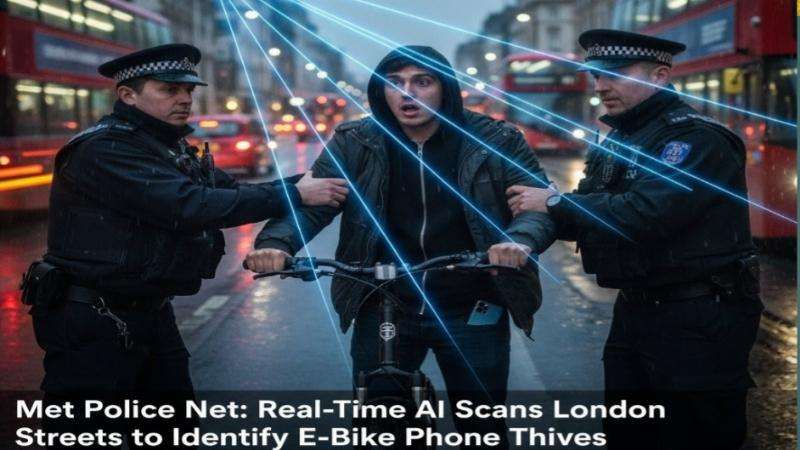
The Metropolitan Police Service (MPS) is forging ahead with the widespread deployment of Live Facial Recognition (LFR) technology across London boroughs, a significant escalation in its strategic response to the surge in criminal activity linked to e-bikes, particularly mobile phone theft and the dangerous use of illegally modified vehicles. This move, part of the second phase of the "A New Met For London" plan, fundamentally reframes policing in the capital, shifting the focus towards preemptive, high-tech surveillance in crime hotspots, Daily Dazzling Dawn understands.
The Anti-Crime Imperative: Precision Policing in a High-Speed Era-The core benefit of LFR for law enforcement is its ability to deliver near-instant identification of wanted individuals in real-time, effectively transforming public CCTV networks into a powerful, automated dragnet. Met Commissioner Sir Mark Rowley has championed the technology, calling it one of the biggest crime-fighting innovations in decades, a tool capable of quickly scanning the faces of riders engaged in criminal acts, leading to rapid interception and apprehension.
Recent updates from the MPS underscore this operational success: a recent annual report highlighted that LFR deployments led to 962 arrests in the year leading up to September 2025, not only for high-volume crimes like phone theft but also for serious offences, including violence against women and girls, and sex crimes. The force proudly cites an exceptionally low false alert rate of just 0.0003% from millions of faces scanned, arguing the technology is both effective and highly accurate.
For the targeted e-bike epidemic, LFR promises a game-changing edge. Officers can add known offenders—such as prolific phone thieves—to a dynamic watchlist. When a match is detected as the individual speeds through a public area, police are alerted, allowing them to intercept both the criminal and the often-illegal vehicle before further harm is caused. This proactive approach is critical in tackling the secondary, but highly dangerous, threat of illegally modified e-bikes, which can travel at excessive speeds and are also a significant fire risk due to unregulated batteries. The Met’s seizure of over 2,500 illegal e-bikes and e-scooters this year demonstrates the scale of this problem, which is disproportionately impacting areas like Tower Hamlets, the borough with the highest number of e-bike-related fires over the last five years.
The Disadvantages: An Unregulated Threat to Privacy and Equality-While the Met promotes LFR as a surgical tool for crime reduction, a powerful counter-narrative from civil liberties groups and data watchdogs frames the mass rollout as a profound threat to fundamental rights. The central disadvantage is the chilling effect of mass surveillance on the public, where every citizen is potentially treated as a suspect simply by walking past a camera. As Councillor Zoë Garbett from Hackney noted, the success of the technology should not be measured by the number of arrests, but by its proportional and non-intrusive use, arguing that watching millions to catch a few is an unacceptable intrusion.
Furthermore, the technology faces serious, ongoing legal and ethical challenges regarding algorithmic bias. Studies and reports—including one acknowledged by the government—indicate that facial recognition systems can exhibit a statistically significant bias, being less accurate when identifying women, young people, and members of ethnic minority groups. The police successfully lobbied to use a retrospective system known to exhibit bias, leading to heightened concerns that increased LFR deployment will disproportionately target and misidentify communities of colour, especially in ethnically diverse areas where it is often deployed, such as around the Notting Hill Carnival.
Crucially, critics argue that the legal and regulatory framework surrounding LFR in the UK remains a “Wild West,” lacking clear, independently mandated standards for deployment, watchlist creation, and data handling. The intrusive nature of LFR, which processes biometric data in public spaces without explicit consent, is viewed as undermining the right to privacy and freedom of expression, potentially leading to self-censorship for fear of police intervention. Despite the Met’s claims of rapid data deletion for unmatched faces, the mere collection and processing of biometric information on this scale remains a flashpoint for human rights advocates who demand greater transparency and external judicial oversight for every deployment.



.jpg)