






.svg)
The National Health Service (NHS) has today issued a stark warning, confirming that the service is grappling with a "worst-case scenario" this December as a virulent "super flu" strain drives hospital admissions to record-breaking levels for this time of year.
The latest performance figures released by NHS England paint a profoundly troubling picture of a system under immense and escalating pressure, even before the typical winter peak. The dominant strain has been identified by officials as a new "super flu" variant, known as A(H3N2) – or subclade K, which is proving particularly aggressive.
The Critical Figures Driving the Crisis
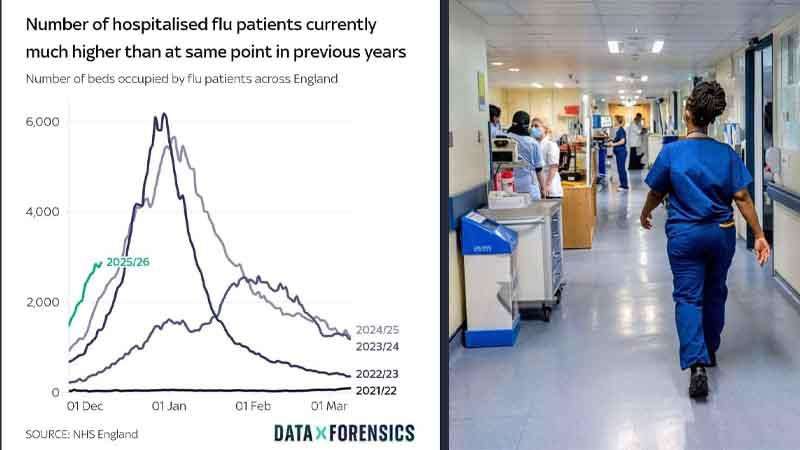
The most alarming statistic reveals that the average number of patients in hospital with flu in England surged by an unprecedented 55 per cent in the last week, settling at a daily average of 2,660. This is the highest figure ever recorded for early December, a total which health leaders warn is already on the rise since the data was compiled, with no peak yet in sight.
The pressure is acutely felt in critical care, where flu patients requiring intensive support reached 106 last week, up from 69 the week prior—a significant increase that further strains already limited high-dependency capacity.
Beyond influenza, the impact of other circulating winter viruses is also mounting. The number of patients in hospital with norovirus-like symptoms has risen by 35 per cent to an average of 354 daily admissions.
The relentless demand is also reflected in emergency care waiting times. More than one in four A&E patients are still waiting longer than the four-hour NHS target, while ambulance response times for heart attack and stroke patients (Category 2 emergencies) still average more than 30 minutes.
Vaccination and Workforce Challenges
While efforts to boost immunity have been substantial, vaccination uptake remains a concern. The total number of people who have received their flu jab in England stands at just over 17.4 million. Although slightly higher than the total at this point last year, the overall uptake rate is down approximately nine per cent compared to 2022 figures for the same period. Positively, over 60,000 more frontline NHS staff have secured their vaccination this year compared to last, a testament to the service's internal drive to protect the workforce.
System Collapse Feared Amid Doctor Strikes
Professor Meghana Pandit, NHS national medical director, warned that the "unprecedented wave of super flu is leaving the NHS facing a worst-case scenario for this time of year – with staff being pushed to the limit."
The growing clinical crisis is set to collide directly with looming industrial action. Thousands of resident doctors are scheduled to begin a five-day strike shortly, threatening to precipitate major disruption across both planned and urgent care services just weeks before the Christmas period.
The Royal College of Nursing (RCN) has warned that this "surging flu virus" threatens to "overwhelm" hospitals, calling on the government to deliver fresh investment to boost staffing and bed capacity. The RCN stressed that the sight of patients receiving care in corridors and non-clinical areas is becoming "rife" and is not an acceptable response to the mounting emergency.
What Happens Next: The Dire Forecast
The current figures suggest that the NHS is far from the seasonal peak, meaning the crisis is poised to deepen significantly over the coming weeks. The convergence of soaring admissions from flu and norovirus, record-breaking A&E demand, and the planned withdrawal of key medical staff due to the resident doctor strike is predicted to push the health service to its operational limit.
Hospital trusts will likely be forced to cancel an increasing number of planned operations and appointments to free up staff and bed capacity for critically ill patients. Health officials are now urgently calling on the public to help manage the "tidal wave" of infection by observing basic infection control measures, including wearing face masks in public if symptomatic, and ensuring all eligible individuals receive their flu vaccination as a matter of immediate priority. The severity of the current strain, combined with stretched capacity, means the safety and dignity of patients face an existential threat in the weeks ahead.



.jpg)

