.jpg)





.svg)
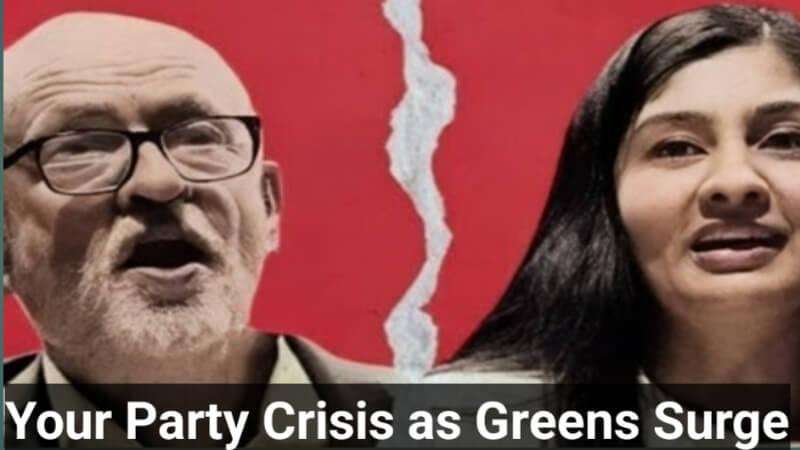
The British political landscape is bracing for a definitive transformation this February as 'Your Party' prepares to elect a new leadership collective. Following a contentious decision at the party’s inaugural conference in Liverpool, co-founders Jeremy Corbyn and Zarah Sultana have been formally barred from standing for the top executive roles under a new "member-led" constitution. This shift toward a collective leadership model, which narrowly defeated a traditional single-leader structure by 51.6% to 48.4%, aims to move the movement away from "personality icons" and toward a grassroots committee. However, the transition is being met with a sharp migration of supporters toward the Green Party, raising urgent questions about Your Party's long-term survival ahead of the critical May local government elections, Daily Dazzling Dawn realized.
Internal Power Struggles and the Corbyn-Sultana Divide-Despite public calls for unity, Your Party has been rocked by high-profile departures and internal friction that have dampened its initial momentum. Jeremy Corbyn, in his latest New Year message, urged supporters to embrace a "radical, socialist alternative," yet the infrastructure of his new political home remains fragile. The recent exit of MPs Iqbal Mohamed and Adnan Hussain—citing "toxic culture," "factionalism," and "veiled prejudice"—has exposed deep-seated rifts within the party’s inner grouping.
Zarah Sultana’s decision to boycott the opening of the party conference in protest of what she described as a "witch hunt" by faceless bureaucrats highlights a growing disconnect between the party's two most recognizable figures. While Corbyn continues to champion a "broad tent" approach, Sultana’s allies have pushed for a more disciplined, member-centric organization. This "proxy war" for the soul of the party has left many early adopters feeling disillusioned, leading to a measurable "mindset change" among the left-wing base.
The Green Party Surge and the May Election Litmus Test-As Your Party grapples with internal management, the Green Party is successfully positioning itself as the primary beneficiary of left-wing frustration. Recent polling data indicates a historic surge for the Greens, who have now overtaken Labour among voters aged 18 to 24, reaching 34% support in that demographic. Crucially for Your Party, YouGov data reveals that 85% of people considering a vote for Corbyn’s movement are also open to voting Green. The "interest overlap" is turning into a full-scale defection; support for Your Party among former Green voters has plummeted from 58% in mid-2025 to just 30% today.
The upcoming local government elections in May 2026 are widely viewed as the ultimate survival test. With Your Party opting not to field its own candidates in many areas—instead backing "community independents"—the Green Party is poised to cross Your Party’s influence in nearly every major metropolitan hub. Political analysts suggest that if the Greens achieve their goal of supplanting Labour in key London wards, Your Party may find itself marginalized before it even establishes a permanent leadership.
Seismic Shifts in East London and the South Asian Community-The battle for influence is most visible in East London, particularly within the British Muslim, British Bangladeshi, and South Asian communities. In boroughs like Tower Hamlets, the political vacuum created by dissatisfaction with the mainstream parties is being filled by a complex mix of Lutfur Rahman’s Aspire Party, the Greens, and independent socialists. While Your Party has traditionally relied on its stance on Gaza and international justice to secure South Asian support, the Green Party’s consistent "anti-establishment" messaging is proving highly effective.
In Tower Hamlets, where the 2026 Mayoral election will be held under new "First Past the Post" rules, the Green Party has already confirmed Nathalie Bienfait as a major challenger. The South Asian community’s shift is backed by statistics showing a move toward parties with established local legacies. With Your Party’s internal disputes over gender-critical beliefs and "sexist boys' club" allegations circulating in the media, the Green Party’s disciplined focus on local services and climate justice is winning over the influential East London electorate.
A Radical Alternative or a Fading Movement-The end of February will bring the announcement of the new Your Party chair and deputy chair, but the new leaders will inherit a movement at a crossroads. The strategy of supporting "community independents" in May is a high-risk gamble; it avoids a direct electoral defeat for the Your Party brand but risks making the organization invisible at a time when the Greens are achieving "stunning victories" in former Labour heartlands.
The data suggests a clear trend: the left-wing electorate is consolidating. If Your Party cannot resolve its internal culture and present a unified front that goes beyond the personalities of Corbyn and Sultana, the May elections will likely confirm the Green Party as the undisputed home of the radical left in Britain. For Your Party, the choice is now between rapid professionalization or becoming a mere footnote in the 2026 political realignment.