




.svg)
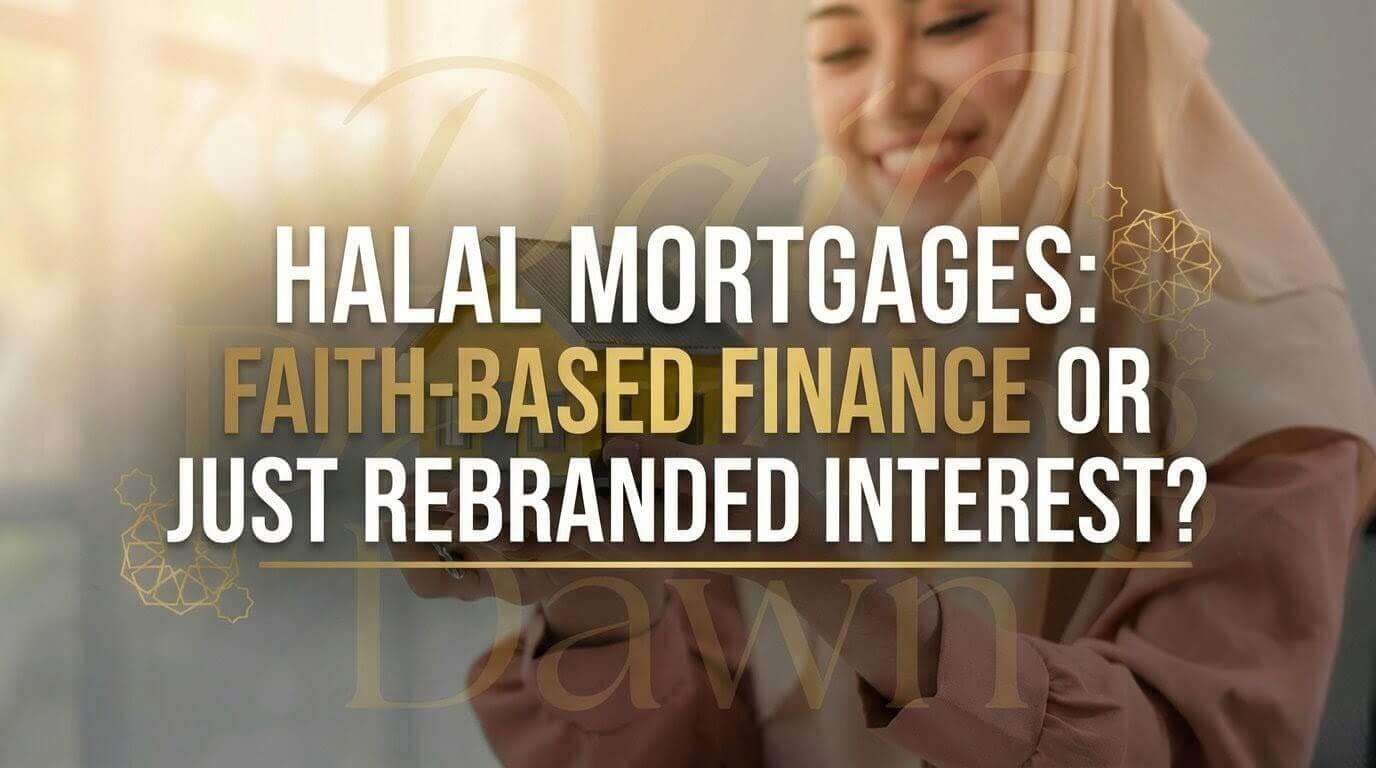
Is Islamic Mortgage Halal? Expert Analysis of Riba vs Diminishing Musharakah in UK Housing 2026
The Divine Command: Why the Search for 'Halal' Finance is Rising-In a global financial landscape built on the foundations of debt, a growing segment of the UK’s 4 million-strong Muslim population is seeking an exit from the conventional interest-based system. The drive is rooted in the uncompromising language of the Quran, where riba (usury/interest) is not merely discouraged but described as a spiritual transgression of the highest order.
As Surah Al-Baqarah (2:275) explicitly states, "Allah has permitted trade and has forbidden interest." This divine distinction serves as the bedrock for the Islamic finance industry, which has surged into a £6 billion market in the UK. However, as the model moves from niche to mainstream, a Dazzling Dawn special analysis reveals a mounting tension: is the "Halal" label a true paradigm shift, or merely a sophisticated rebranding of the same old debt?
Read more: Shiny Mosques, Empty Pulpits: Behind the British Imam Crisis
The Diminishing Musharakah: A Model Under the Microscope-The most prevalent structure in UK Islamic housing finance today is Diminishing Musharakah. On paper, this is a co-ownership agreement rather than a loan. The bank and the client purchase the property together; the client lives in the home and pays "rent" on the bank’s share while simultaneously buying back units of that share over time.
The Conflict Between Contract and Cash Flow-Experts and PhD researchers in the field are increasingly highlighting what is known as the "theory-practice gap." While the contractual terminology replaces "principal" with "unit buy-out" and "interest" with "ijarah" (rent), the mathematical reality often mirrors conventional amortization perfectly.
The core of the controversy lies in the 5th screenshot of recent academic discourse: in practice, both Islamic and conventional banks often use the same amortization structures. If the monthly repayment to an Islamic bank is calculated using benchmarks like the Bank of England base rate or SONIA—the same benchmarks used for conventional interest—it raises the question: is the "rent" truly reflecting the rental market, or is it just interest by another name?
The Ownership Risk: Who Truly Bears the Burden? A fundamental principle of Islamic finance is risk-sharing. For a transaction to be truly halal, the financier must assume a portion of the ownership risk. However, critical analysis of current UK Islamic mortgages suggests this risk is frequently transferred back to the consumer through clever legal clauses.
Maintenance and Repairs: In a true landlord-tenant relationship (Ijarah), the landlord is responsible for structural maintenance. Yet, many Islamic mortgage contracts mandate the "tenant" (the homeowner) to cover all costs, from plumbing to structural damage.
The Insurance Loophole: While banks utilize Takaful (Islamic insurance), these costs are often adjusted within the client’s monthly installment, effectively insulating the bank from any loss.
Natural Disasters: If a building is destroyed, Shariah theory suggests the loss should be shared according to ownership percentages. In practice, extensive risk-mitigation clauses often ensure the bank’s capital remains protected, leaving the "theory-practice gap" wider than ever.
Is the Current Banking System Truly Halal?The uncomfortable truth for many scholars and consumers is that Islamic banks operate within a global fiat system that is inherently interest-based. Because Islamic banks must remain competitive and comply with FCA (Financial Conduct Authority) regulations, they often adopt "ruses" or legal stratagems (hila) to ensure their products "look" like trade while functioning like credit.
Critically, if an Islamic bank assumes no real ownership risk and the cost of the "rent" is tied to interest rate fluctuations rather than local property rental values, the "halal" status becomes a matter of intense academic and theological debate. As Dr. Mohamed Rahman noted in recent professional discussions, if the bank acts as a landlord but refuses the responsibilities of a landlord—such as repairing plumbing or bearing the cost of capital loss—the "rent" model may be legally compliant but ethically questionable.
The Business of Faith: Concept or Conviction? Is the Islamic mortgage just a business concept? Deeper analysis suggests that for many institutions, it is a strategic product designed to capture a "captured market"—a demographic that cannot, by conscience, use conventional banks.
According to Hadith, "Every loan that draws a profit is Riba." If the "co-ownership" is structured such that the bank is guaranteed its principal plus a fixed return regardless of the property's fate, it begins to look less like the "partnership" (Musharakah) envisioned in Islamic jurisprudence and more like a collateralized loan.
Final Verdict: A Step Forward or a Side-Step? For the UK consumer, Islamic mortgages remain a vital tool for social inclusion, allowing families to enter the housing market without the "war against Allah and His Messenger" (Quran 2:278-279) associated with direct interest. However, the industry stands at a crossroads. As researchers and professors call for more "authentic" risk-sharing models, the "Halal" status of these products continues to rest on a delicate balance of contractual technicality versus economic reality.

_3.jpg)