



.svg)
The landscape of Bangladeshi migration in the United Kingdom has been fundamentally altered following the seismic results of the general election held on February 12, 2026. The landslide victory of the Bangladesh Nationalist Party (BNP) and the historic rise of Jamaat-e-Islami as the second-largest party and official parliamentary opposition have created a legal paradox for thousands of asylum seekers. With Mr. Tarique Rahman set to be sworn in as Prime Minister within forty-eight hours after seventeen years of exile in London, the British Home Office is moving to reassess the status of those who claimed they could not return to Bangladesh due to political affiliation. For nearly two decades, activists argued that their lives were at risk under the previous regime; however, with their own political parties now controlling the state apparatus and the opposition benches, the legal "well-founded fear of persecution" has effectively evaporated overnight.
The Collapse of Legal Protection Under Paragraph 339A
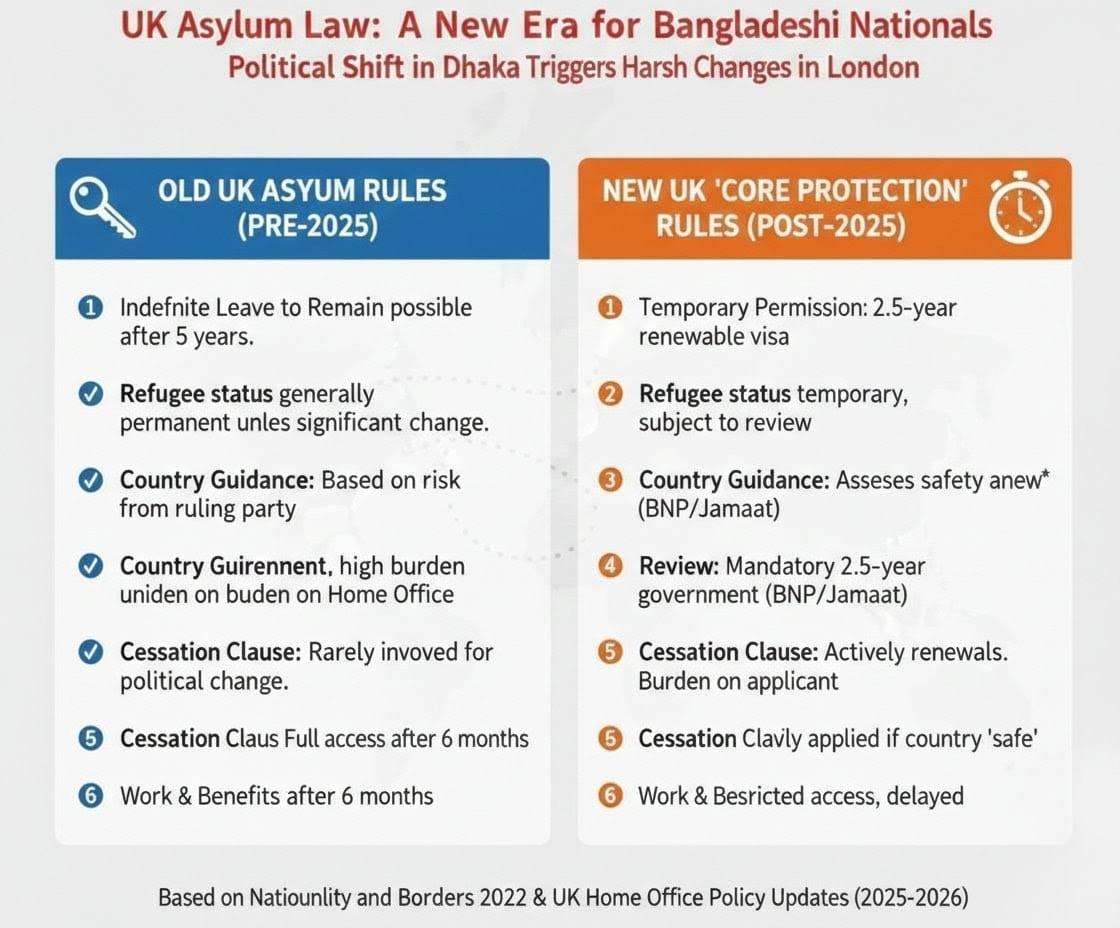
The primary threat to Bangladeshi residents in the UK lies in Paragraph 339A of the UK Immigration Rules and Article 1C(5) of the 1951 Refugee Convention, known as the "Ceased Circumstances" clause. These regulations state that refugee status can be revoked if the conditions that necessitated protection have undergone a fundamental and durable change. Legal experts point out that since the "persecutor" is no longer in power and the "persecuted" party now leads the government, the UK state no longer views Bangladesh as an unsafe destination for these individuals. This change in country conditions allows the Home Office to argue that the state is now a source of protection rather than a source of threat, leading to the potential revocation of existing refugee status and the summary rejection of pending claims.
Tarique Rahman’s Crackdown on Immigration Fraud
During his long residency in London, BNP Acting Chairman Tarique Rahman remained exceptionally vigilant regarding the misuse of the party’s name for immigration purposes. He repeatedly issued public warnings against fraudulent asylum claims, instructing the party’s UK branch to cease issuing recommendation letters to those using politics as a convenient narrative for residency. Now, as he transitions from a political refugee in the UK to the head of the Bangladeshi government, his administration is expected to cooperate with international authorities to facilitate the return of citizens. This shift effectively removes the informal support network that many asylum seekers relied upon, as the new government seeks to establish international legitimacy by demonstrating that Bangladesh is now a safe, democratic nation for all its supporters.
Nationality and Borders Act 2022 and the 2.5 Year Review

The precariousness of these asylum seekers is further exacerbated by the UK’s Nationality and Borders Act 2022, which transitioned refugee status from a permanent fixture to a temporary "Core Protection" track. Under this framework, status must be renewed every 2.5 years, during which the Home Office conducts a mandatory review of the claimant’s home country. With Bangladesh now categorized as a nation where the previously "oppressed" parties hold the majority of parliamentary seats—BNP in power and Jamaat-e-Islami as the official opposition—the UK government has the clear legal pathway to refuse renewals. Estimates suggest that up to 20,000 individuals who entered the UK on student or work visas before claiming asylum as activists are now at the top of the list for potential repatriation programs.
Legal Expert Warning on Credibility and Deportation Risk
London-based prominent lawyer Barrister Salah Uddin Suman told to Daily Dazzling Dawn that the credibility of asylum seekers will now face an impossible hurdle in the courts. He explained that when a claimant's top party leader becomes the Prime Minister, the argument of "state-sponsored persecution" becomes legally indefensible. The Home Office is expected to utilize the current political stability to argue that any remaining threats are localized or personal rather than political, which does not typically qualify for refugee status. This shift is not limited to Britain; reports indicate that Germany, France, and Italy are preparing similar reviews, as the high volume of Bangladeshi applications—which accounted for a significant percentage of European claims in 2025—now lacks the foundational evidence of state hostility.
High Court Precedents and the Future of Repatriation
The difficulty of maintaining asylum status in this new era is underscored by recent judicial scrutiny of "bogus" charges. While some high-profile cases, such as one recently highlighted by The Telegraph, saw individuals avoid deportation by claiming 20-year prison sentences were politically motivated, these defenses are weakening. As the BNP and Jamaat-e-Islami take control of the judiciary and law enforcement in Dhaka, the UK Home Office will likely argue that any legitimate legal issues can be resolved fairly within the new Bangladeshi system. Consequently, the "safety net" that existed for seventeen years has vanished, leaving thousands of families in the UK and across Europe facing the very real prospect of being returned to a country that is now, ironically, governed by their own political leaders.