






.svg)
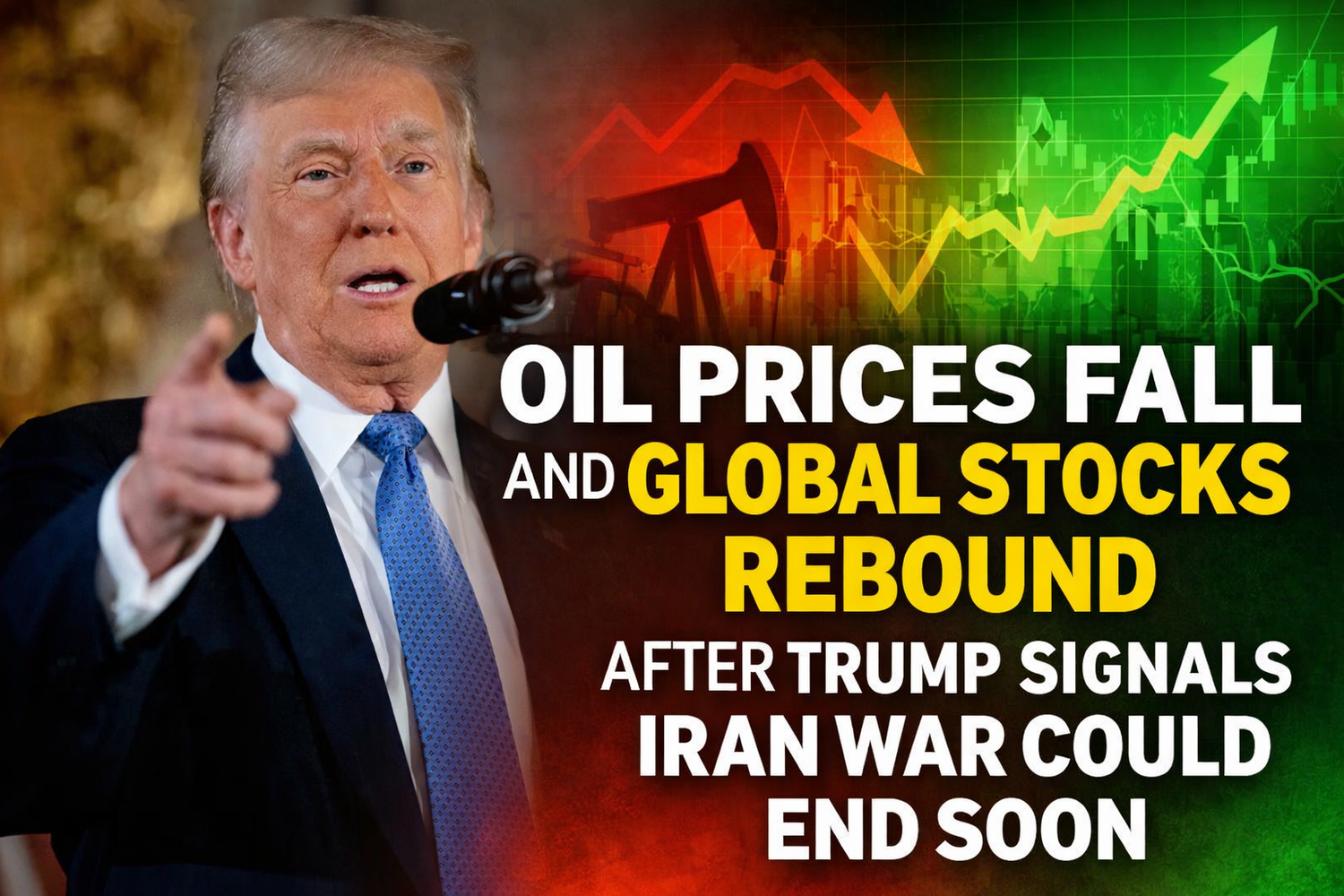
Global oil prices dropped sharply after reaching a four-year high, easing pressure on financial markets as investors reacted to comments from former U.S. President Donald Trump suggesting the ongoing US-Israel conflict with Iran could end soon.
Brent crude, the international oil benchmark, surged to nearly $119.50 per barrel on Monday as escalating tensions in the Middle East triggered fears of a major disruption to global energy supplies. The spike reflected growing concerns that the conflict could impact the flow of oil through critical shipping routes in the region.
However, oil prices quickly reversed course later in the day. Brent crude fell to around $91.70 per barrel after Trump said in an interview with CBS News that the conflict was “very complete, pretty much,” signaling that the fighting could soon wind down. His comments reassured investors who had been bracing for a prolonged geopolitical crisis.
Financial markets reacted positively to the shift in tone. Britain’s FTSE 100 index rose by about 1.4% in early trading on Tuesday, while European stocks also moved higher. The Stoxx Europe 600, which tracks major companies across the continent, climbed 1.5%.
Analysts said the sudden drop in oil prices helped ease concerns about inflation and rising energy costs. Matt Britzman, senior equity analyst at Hargreaves Lansdown, said markets were relieved that what initially appeared to be a continuous surge in energy prices was beginning to stabilize.
Asian markets also experienced a strong rebound overnight. Japan’s Nikkei 225 jumped 2.5%, South Korea’s Kospi surged 6%, and Hong Kong’s Hang Seng ended the day 2% higher as investors welcomed the easing pressure on global energy prices.
Despite the market optimism, Trump also hinted that the conflict was not fully over. He warned that if Iran attempts to block oil shipments through the Strait of Hormuz, the United States would respond with far stronger military action.
The Strait of Hormuz remains one of the world’s most important energy routes, with nearly 20% of global oil shipments and large volumes of seaborne natural gas passing through the narrow waterway. The route has reportedly faced disruptions for nearly a week due to the escalating conflict.
Iran has responded with its own warnings. According to Iranian state media, a spokesperson for the Revolutionary Guards said Tehran would prevent any oil exports from the region if US and Israeli attacks continue.
Meanwhile, French President Emmanuel Macron suggested that several countries may send naval ships to escort commercial vessels and oil tankers once the most intense phase of the conflict subsides, in an effort to secure the crucial maritime route.
Trump also indicated that Washington might temporarily ease certain oil-related sanctions to help stabilize global supplies. Although he did not specifically name Russia, the comments came shortly after a conversation with Russian President Vladimir Putin, raising speculation that sanctions relief could involve Moscow. Such a move could complicate ongoing efforts to pressure Russia over its war in Ukraine.
For now, global markets appear to be cautiously optimistic, with investors closely monitoring developments in the Middle East and the future stability of global energy supplies.
Speaking to reporters, Donald Trump said the United States may temporarily remove certain oil-related sanctions on some countries in order to stabilize global energy supplies while the situation in the Strait of Hormuz remains tense.
“We have sanctions on some countries,” Trump said. “We’re going to lift those sanctions until the strait is fully operational again.”
The Trump administration recently allowed Indian oil refiners to resume purchasing Russian crude for a limited 30-day period. The decision came only weeks after Trump claimed that India had agreed to stop buying Russian oil, a move he previously argued would weaken Moscow financially and help bring an end to the war in Ukraine.
Although oil prices have fallen from the dramatic peak seen earlier this week, global crude prices remain significantly higher than before the conflict began. Current prices are still about 25% above the levels recorded just a few weeks ago, reflecting ongoing concerns about supply disruptions.
Market analysts warn that uncertainty continues to weigh heavily on investors. Susannah Streeter, chief investment strategist at Wealth Club, said financial markets are still facing considerable anxiety.
“Worry is still circulating in the markets,” she said. “Until a long-term solution is reached, both businesses and consumers are likely to feel the financial impact of the US and Israeli strikes on Iran.”
Concerns about rising fuel costs and potential supply shortages have already pushed several governments to take preventive measures. Countries including Croatia, Hungary, South Korea, and Thailand have introduced temporary fuel price caps in recent days to limit the impact on consumers and avoid possible shortages.
Other nations have implemented energy-saving measures. In the Philippines, the government has ordered public officials to reduce air-conditioning use and cut back on travel in order to conserve fuel and electricity.
Meanwhile, Bangladesh has also taken emergency steps to reduce energy consumption. Authorities announced the temporary closure of all universities and moved forward the Eid-ul-Fitr holidays, aiming to lower electricity demand and conserve fuel resources during the ongoing global energy uncertainty.
Despite the recent drop in oil prices, analysts say markets will continue to closely monitor developments in the Middle East, particularly around the Strait of Hormuz, which remains one of the world’s most critical routes for global energy shipments.

.jpg)