


.svg)
One.
Driven by a failure to meet the expectations of the populace and a period of prolonged political paralysis, public mistrust has shifted beyond the ruling Labour Party to encompass the entire political establishment. Should this trend persist into the upcoming general election, at least two of the four sitting British-Bangladeshi MPs face a legitimate risk of unseating.
Fueled by resentment toward mainstream platforms, hundreds of thousands within the community—including the immigrant population—are actively seeking alternatives. This shift has already benefited the Green Party across the UK. Public indignation regarding the government’s stance on domestic and international issues is increasingly manifesting as "protest votes," a phenomenon evidenced in recent by-elections.
In the Bangladeshi-majority enclaves of East London, however, Labour remains the dominant brand. Yet, voter behavior here is nuanced: while supporters may back Labour’s Rushanara Ali or Apsana Begum for Parliament, they frequently adopt an "enemy of my enemy" doctrine for the Mayoralty, backing rival candidates. For Council seats, they often pivot to a third candidate viewed as a local "one of our own." This fragmentation is particularly visible among active Labour members in Tower Hamlets, where internal strife has reached a fever pitch.
Decades of infighting have resulted in a party split into pro- and anti-Helal Abbas factions. Allegations against the veteran leader suggest that, for the past decade, his priority has shifted from seeking office to acting as a kingmaker—deciding who is embraced and who is purged. Critics point to Abbas as a primary catalyst for current Mayor Lutfur Rahman’s original departure from the party. In the current cycle, since the Labour candidate is a close associate of Abbas, his loyalists are campaigning vigorously. Conversely, those previously marginalized by Abbas, or passed over for the current nomination, are campaigning with deep-seated grievances. While social media provides documented evidence of their participation, the reality is far more volatile; opposition to Bangladeshi Labour council candidates has occasionally turned violent, necessitating arbitration by party leadership.
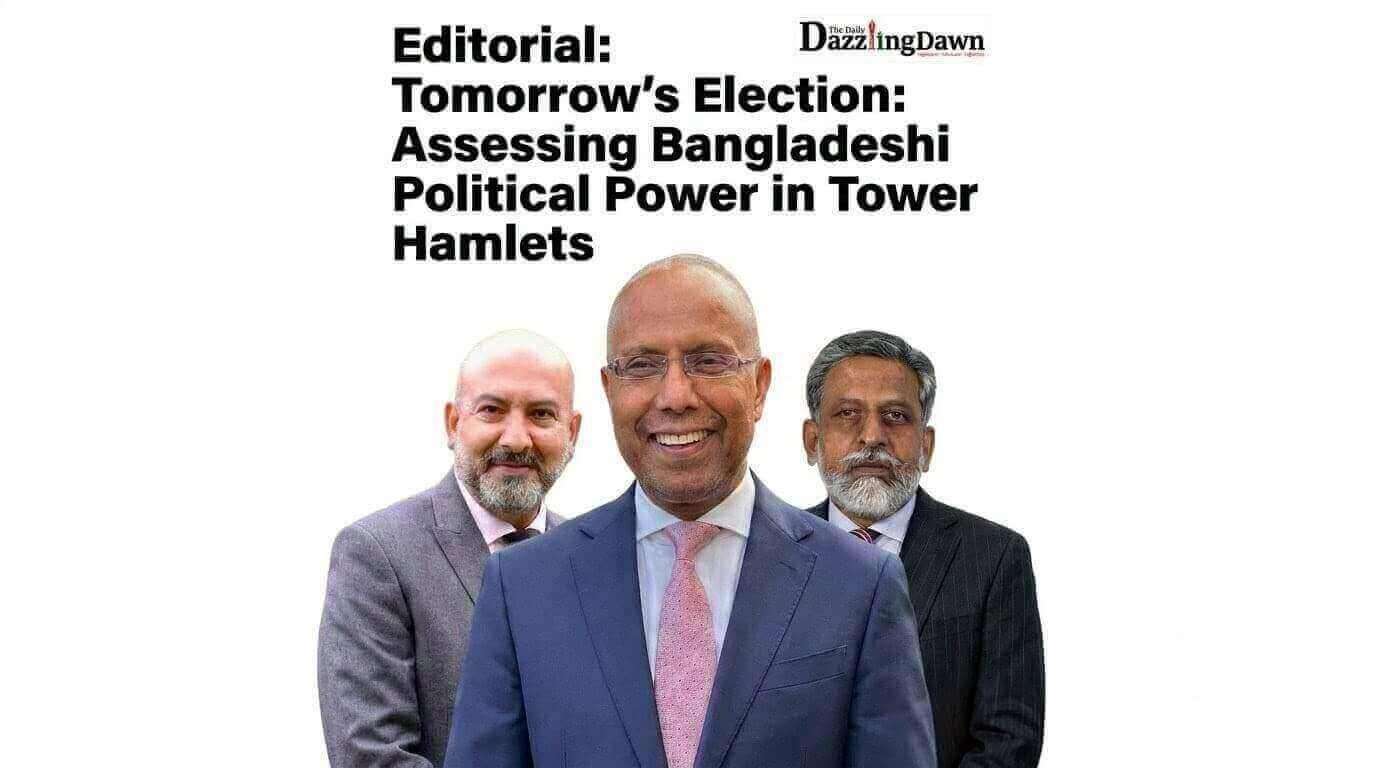
Labour’s mayoral hopeful, Sirajul Islam, is a veteran councillor, yet his campaign has struggled to match the personal brand or strategic machinery of Lutfur Rahman. As of Wednesday evening, the leadership of local mosques and various Islamic organizations have once again consolidated their support behind Rahman. Notably, this election features four Bangladeshi candidates among the top seven contenders—including representatives from Labour and the Liberal Democrats—marking a significant milestone for community representation.
Two
The breadth of Lutfur Rahman’s coalition is striking. Senior figures from the UK BNP, office-bearers of the UK Awami League, and leaders of various Bangladeshi left-wing parties have openly rallied to his cause. Despite the UK Awami League’s traditional alignment with figures like Rushanara Ali or Tulip Siddique, their current field operations favor Rahman—a testament to his strategic reach. In contrast, while Barrister Zami Ali enjoys backing from certain Jamaat-e-Islami and BNP leaders, Thursday’s results will likely reveal their inability to direct their base toward a nominated alternative.
Rahman’s disciplined approach is legendary; he famously avoids even drinking water during the campaign trail to maximize every minute of engagement. This focused, multi-pronged strategy stands in stark contrast to the campaigns of his rivals, which often failed to evolve beyond Facebook photography. Furthermore, a last-minute proxy-voting controversy involving an "Independent" party leader has seemingly worked in Rahman’s favor. In this year’s election, the campaign machinery behind Barrister Zami is almost exclusively composed of individuals who served as Lutfur Rahman’s workers in the previous election.
Whether this team has truly mastered the strategic nuances of their former leader—or if they have failed to capture his political formula entirely—is a question that remains unanswered. Ultimately, the true measure of their efficacy will be laid bare in the court of public opinion when the election results are delivered. The final verdict will determine whether his opponents have done enough to dismantle the trust Rahman has cultivated.
Three
Our most latest assessments suggest Zami Ali’s primary struggle is moving from fifth to fourth place, having squandered a clear opportunity to secure third. This looming defeat will serve as an indictment of the strategic failures of those who championed his candidacy. Such a result would inevitably spark a crisis of political relevance and moral standing for his backers.
Ironically, Lutfur Rahman’s success is fueled by those who defected from his circle and the systemic failures of the local Labour Party. However, Rahman himself is not without scrutiny. Opponents question his perceived arrogance, his tendency to ignore the community outside of election cycles, and a governance style that critics claim favors sycophants over qualified professionals.
Digital platforms—ranging from Facebook pages masquerading as TV channels to business interests seeking influence—continue to engage in "view-driven" journalism, yet they rarely challenge those in power. Winning the propaganda war has become an exercise in funding loyalist circles. Those who raise concerns regarding council transparency, procurement commissions, or government observations on mismanagement are swiftly labeled by paid surrogates as "anti-Palestine" or "Labour agents." When one has benefited so extensively from the current power structure, the capacity for genuine oversight vanishes, leaving questions about housing allocations and planning permissions unanswered.
Four
A spontaneous turnout from white voters remains unlikely this cycle. Consequently, Rahman appears poised not only for a personal victory but for a party majority in the council.
History is being made elsewhere as well; Farhad Hossain, Labour’s candidate in Newham, stands a strong chance of becoming the next Bangladeshi mayor. With nearly 350 Bangladeshis contesting council seats across Britain, participation is at an all-time high. Yet, when compared to the British-Pakistani or British-Indian communities—who arrived during the same era—Bangladeshis remain statistically behind.
The cause appears to be internal. The community is plagued by candidates who abandon ideology for personal gain, form vanity parties, or oppose fellow community members out of sheer personal enmity. Lutfur Rahman, the most successful independent vote-getter in Tower Hamlets' history, has faced criticism for failing to cultivate a successor. His cabinet is notably devoid of peers with comparable qualifications, and 90% of his former colleagues are now his most vocal critics.
During his court-mandated hiatus from office, Rahman notably declined to support his own party’s candidates, leading to their defeat. Critics argue this was a calculated move to ensure no successor—such as Ahid Ahmed or Rabina Khan—could solidify a base that might block his eventual return. Furthermore, questions persist as to why Rahman prefers the Mayoralty over a seat in Parliament. In Westminster, he could champion the rights of immigrants and Muslims on a national stage with a significantly larger platform. Instead, he remains focused on a role where executive powers have been curtailed, leading many to ask: is there no other way for him to serve the community? Why has Lutfur Rahman never challenged the long-standing controversies surrounding his administration—the massive budgets, soaring allocations, the creation of new expenditure heads, and the persistent allegations of patronage and hiring irregularities—by standing for Parliament? Had he transitioned to the national stage as an MP, would he not have gained a significantly larger platform to advocate for the oppressed people of Palestine? One must ask: what is so enchanting about the Mayoral chair that it outweighs the opportunity to influence national policy and speak from a position of true legislative power?
Rumors suggest that even if victorious, Rahman may face challenges completing his term. Speculation is rising that he may eventually run for the Bethnal Green & Stepney parliamentary seat under a Jeremy Corbyn-aligned banner. When questioned by Daily Dazzling Dawn on his future intentions, Rahman remained characteristically non-committal. The central question remains: has he prepared anyone to fill the void he will eventually leave?
Five
The practice of gatekeeping political power from the British-born next generation must end. It is a natural aspiration to see a British-Bangladeshi reach the heights of Sadiq Khan or Rishi Sunak. In the Pakistani and Indian communities, there is often a cross-party consensus to support a community candidate for the greater good. Among Bangladeshis, however, the tendency remains to "cut off one's nose to spite one's face." For the community to progress, this culture of internal sabotage must be relegated to the past.