



.svg)
A sophisticated shift in municipal unrest has seen coordinated digital tracking networks deployed across social media platforms, systematically mapping multi-occupancy residences and displacing dozens of families amid escalating public disorder in Belfast.
The introduction of localized targeting marks a highly coordinated phase in the unrest, which was initially incited on Monday following a stabbing incident involving an asylum seeker. By Tuesday evening, the unrest translated into physical incursions within the Tiger's Bay area of North Belfast and the Donegal Road corridor, forcing statutory interventions to rescue vulnerable residents.
A prominent community lead in South Belfast, Paul Doherty, detailed the acute human cost of this digital escalation to journalists. He recounted an encounter with a mother who sought sanctuary at a community hub on Wednesday evening. "It was a mother and she was just in hysterics crying," Doherty told journalists. "I looked in the back of her car and there was three kids and they were crying in the car and she said that their house had been listed on a social media post."
Doherty further explained that the children had discovered the digital address list themselves, precipitating a refusal to return home due to vehicles observed circling their immediate neighborhood.
The geographical reach of the disruption has uniquely impacted the city's established South Asian diaspora. Reports confirmed by Daily Dazzling Dawn reveal that the operations forced the emergency evacuation of at least three Bangladeshi families—comprising 11 individuals, including young children—from the Tiger’s Bay enclave. Masked groups descended on the properties at approximately 9:00 PM on Tuesday, executing systematic property damage that necessitated an immediate police extraction. These families remain in secure, undisclosed temporary government accommodation, unable to retrieve essential personal effects or legal documentation.
The economic repercussions have reverberated across the commercial sector, paralyzing minority-owned enterprises. Business operations along Sandy Row and surrounding commercial sectors remain suspended as proprietors mitigate security risks. For established figures within the community, the current climate represents a profound departure from historical norms. Speaking to journalists, long-term resident Sadikur Rahman noted that the city had maintained a peaceful reputation for nearly two decades, making the targeted nature of these recent disruptions unprecedented.
Statutory emergency services have faced significant operational strain attempting to contain simultaneous flashpoints. In Glengormley, police units successfully cordoned off an asylum accommodation facility on Wednesday, redirecting a large crowd into adjacent residential streets where prolonged stand-offs occurred. The containment strategy, while preventing direct structural breaches to the facility, resulted in secondary arson attacks on surrounding vehicles and commercial premises.
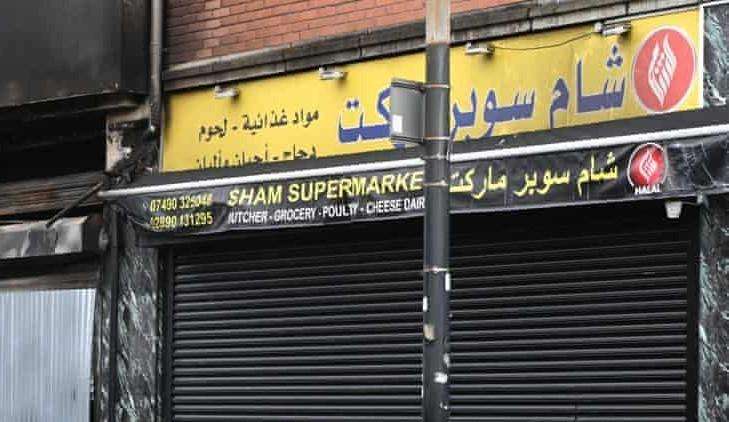
The structural impact on independent retail has left families stripped of their livelihoods. Mohammad, a Syrian national who manages a supermarket in a predominantly loyalist district, stood outside the charred remnants of his business on the Donegal Road. The structural fire on Tuesday night obliterated his entire inventory, compounding the trauma of his family who fled conflict a decade prior. "At home it’s very bad. My kids are crying. We don’t sleep, actually," Mohammad told journalists, describing how his young son refused to attend school out of fear. "We are looking just only for a new life."
Sultan, whose family owns the destroyed supermarket enterprise, watched the destruction unfold via broadcast media, noting that emergency services were severely hindered by the volume of concurrent public disorder. "We knew it was gone," Sultan told journalists. "There’s nothing more you can do. It’s wrong. It’s all happened to the innocent people. The shop’s burned. There’s a few houses burned as well."
The disruption extended into multi-storey residential units above the commercial arcades on Sandy Row. Kfloum Tekly Kassa, an industrial food sector worker, was abruptly evacuated from his flat alongside his wife and their two-month-old daughter as smoke from the ground-floor fires compromised the building. "It’s very hard," Kassa told journalists. "My wife was very afraid. This is not humanity."
The current crisis highlights a broader demographic friction within Northern Ireland, where official statistics indicate that racially motivated incidents now outpace traditional sectarian friction. Analytical insights suggest these events are part of a compounding trend monitored by community organizations since August 2024.
Kashif Akram, representing the Belfast Islamic Centre, told journalists that the escalation reflects an ongoing normalization of hostility, driven by digital vigilantism and political rhetoric that legitimizes the intimidation of migrant populations.
Similarly, Tim Magowan, executive director of the 174 Trust, observed that the underlying social divisions have been quietly intensifying beneath the surface for a considerable period. Magowan emphasized that with minority ethnic individuals comprising just 3% of the local population, the region continues to navigate the psychological and structural challenges of transitioning into a multi-ethnic society, often relying on historically segregated mindsets.
Police Service of Northern Ireland (PSNI) detachments have intensified patrols across high-risk sectors, utilizing closed-circuit television (CCTV) footage to systematically identify and apprehend key orchestrators of the violence. While political leaders have collectively condemned the disturbances and appealed for calm, community advocates continue to press statutory agencies for permanent security frameworks and expedited rehousing strategies for the displaced families. The immediate focus shifts to the judicial processing of detained individuals and the stabilization of commercial districts ahead of the weekend.