






.svg)
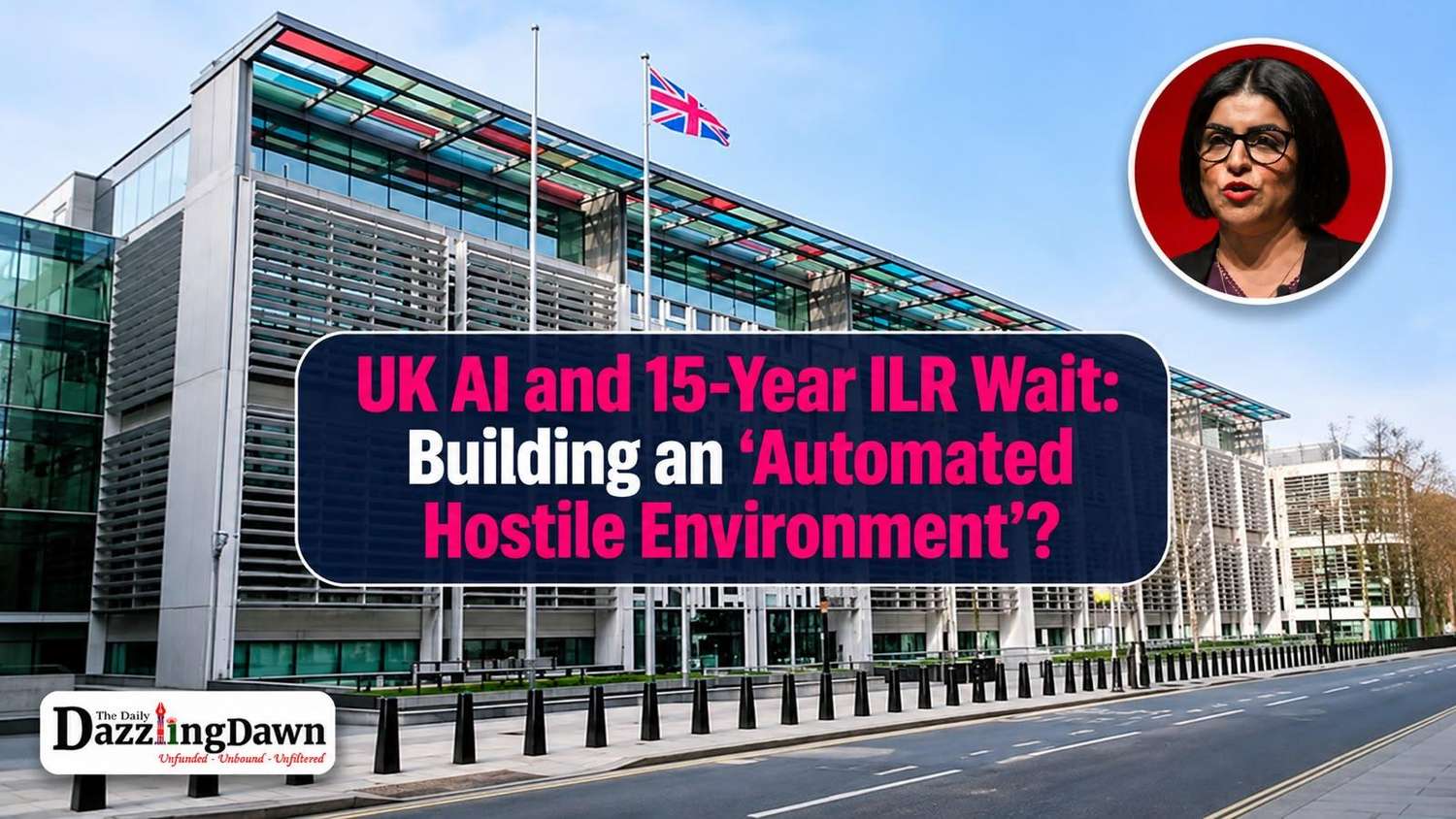
The Home Office's accelerating deployment of artificial intelligence across the UK immigration system is creating an "automated hostile environment" for migrants, the Open Rights Group (ORG) has warned in a 105-page report published on 28 October 2026, as Shabana Mahmood's controversial plan to extend the wait for indefinite leave to remain (ILR) from five to 15 years faces mounting opposition from trade unions and senior Labour figures.
The report, Automated Discrimination: Unpacking the Digital Hostile Environment, authored by Fabio Chiusi, documents a wide array of AI tools either trialled or in active use, including systems for estimating the age of asylum seekers, summarising asylum interviews and immigration policies, helping prioritise asylum claims, searching mobile phones for evidence of suspected immigration offences, and automatically flagging potentially "sham" marriages. ORG also describes a shift towards more proactive enforcement, with live facial recognition trialled at the Port of Holyhead to identify people subject to deportation orders, alongside predictive analytics and risk assessment tools such as the Home Office's Cerberus project, intended to identify potential threats.
Chiusi said the UK's rush towards AI adoption in immigration was "a textbook example of technological solutionism," adding that it "can only reinforce the illusion that immigration is a technological bug at the heart of British society — one that only technologies of discrimination and control can fix." Daily Dazzling Dawn understands the report's central charge is that deep learning algorithms "reveal and reinforce societal power imbalances by identifying and generating patterns from datasets that contain hostile narratives about migration," turning the technology into "a political instrument that both implements and shapes immigration and border procedures." ORG argues that successive UK governments, including the current Labour administration, have increasingly treated migration as a technical problem amenable to technological solutions, and notes that the Government's framing of the UK as a technology "adoption nation" obscures "a dark side made of bias, discrimination, entrenched privilege, and locked-in surveillance technologies," citing AI-informed mass deportations under the Trump administration in the United States.
Transparency emerges as a foundational concern. ORG says the systems "operate in near-total secrecy," with Freedom of Information responses curtailed by national security exemptions, leaving significant gaps in public understanding of how AI systems are used, what safeguards exist and how they affect decisions. The report asks how the public can determine whether Anduril towers deployed in the Channel "actually contribute to saving lives or ending them" when their existence is shrouded in secrecy, and how it can judge whether automated risk assessments by Cerberus amount to racial profiling "when we cannot even know whether it is based on rules or machine learning algorithms." The use of generative AI to summarise asylum interviews is flagged as particularly problematic, with warnings that such tools can produce inaccurate summaries or introduce information absent from the original material, potentially affecting the assessment of claims. ORG also highlights reliance on private contractors, including firms based in the United States and Israel.
The AI findings land amid fierce political contention over the Home Secretary's immigration package. Under the proposals, announced in March 2026 and still subject to consultation, the qualifying period before foreign workers can claim ILR would rise from five to 15 years, applying retrospectively to those already living in Britain who have not yet crossed the threshold. Mahmood has defended the reforms as entirely consistent with "Labour values," warning at the party's Liverpool conference that Labour's future would be "in jeopardy" without controls on immigration, while indicating she would announce a compromise "fair" to tens of thousands of migrants already in the UK.
Lord Khan, the Labour Mayor of London, told BBC Radio 4's Today programme that while he recognised the need to control borders, "in our immigration policy, we need compassion as well," confirming he had responded to the consultation opposing retrospective changes and expressing confidence that Mahmood, whom he has known for many years and described as "somebody who does listen," would deliver a policy "we can all get behind." Andy Burnham said he supported the "principle" of reform but refused to back the 15-year threshold, noting a consultation had taken place and "we have to listen to what came forward," and is believed to favour a carve-out for care workers linked to his plans for a free-at-point-of-use social care system. Asked twice whether he supported the extension as laid out, the Prime Minister would say only that a plan would be set out "quite soon," attributing the problem to the "Boriswave" of 4.2 million migrants between 2021 and 2024, peaking at 944,000 in the year to March 2023, and saying settlement must be "a right to be earned." Housing Secretary Angela Rayner was the first Cabinet minister to attack the proposals, warning they would "change the goalposts" for foreign care workers who had "moved their lives here to look after our loved ones," while Energy Secretary Miatta Fahnbulleh refused 16 times to back the reform and had criticised the policy on her constituency website as threatening "the process of building cohesion."
The dispute escalated on 21 October when a planned meeting between Mahmood and Andrea Egan, general secretary of Unison since December 2025, was cancelled by the union after the Home Secretary refused a request for a migrant worker to join the discussion. Egan has described the plans as "politically foolish." Shadow home secretary Chris Philp has called on Mahmood to resign if she cannot pass the reforms through Parliament, promising in a letter that the Conservatives would back her plans if she did not water them down.
Separately, the House of Lords Secondary Legislation Scrutiny Committee published a report on 26 October welcoming a Home Office commitment, given by minister Lord Collins of Highbury, to notify Parliament whenever immigration policy changes are made through "published concessions" outside the Immigration Rules, and to publish concessions on GOV.UK. The Committee, however, branded the position "unsatisfactory," noting that in the absence of a formal mechanism "Parliament can do no more than 'press' for changes," and reiterated that generalised changes should subsequently be formalised in the Rules through the standard Statements of Changes procedure. Lord Collins said decisions on formalisation would depend on circumstances, confirmed officials would review all existing generalised concessions, and defended the power's use for the Ukraine schemes and to restore transit without a visa provisions after Appendix Visitor: Transit Without Visa Scheme was inadvertently deleted, calling both uses "clearly justified." The Committee questioned that justification, saying the department had cited the Supreme Court's 2012 Munir judgment without addressing its finding that the power was not unfettered, and said it "regret[s] that the Home Office's initial response did not refer to this part of the judgment." It has asked for an update on the concessions review by the end of March 2027, or sooner, and said the role of Parliament should be a central factor in formalisation decisions, with full reasons given where the department declines.
ORG sets out five recommendations: rejecting AI as a substitute for addressing the underlying causes of immigration policy problems; introducing stronger regulation of high-risk systems; improving transparency and public accountability; reducing dependence on powerful technology companies; and addressing the wider political and policy context in which AI is deployed. Daily Dazzling Dawn notes that with the consultation closed and speculation mounting that Mahmood will soften the retrospective element to stave off a backbench rebellion, both the technological architecture of immigration enforcement and the political architecture of settlement rights remain in flux.

.jpg)
.jpg)





 Near Durham.jpg)