_1.jpg)





.svg)
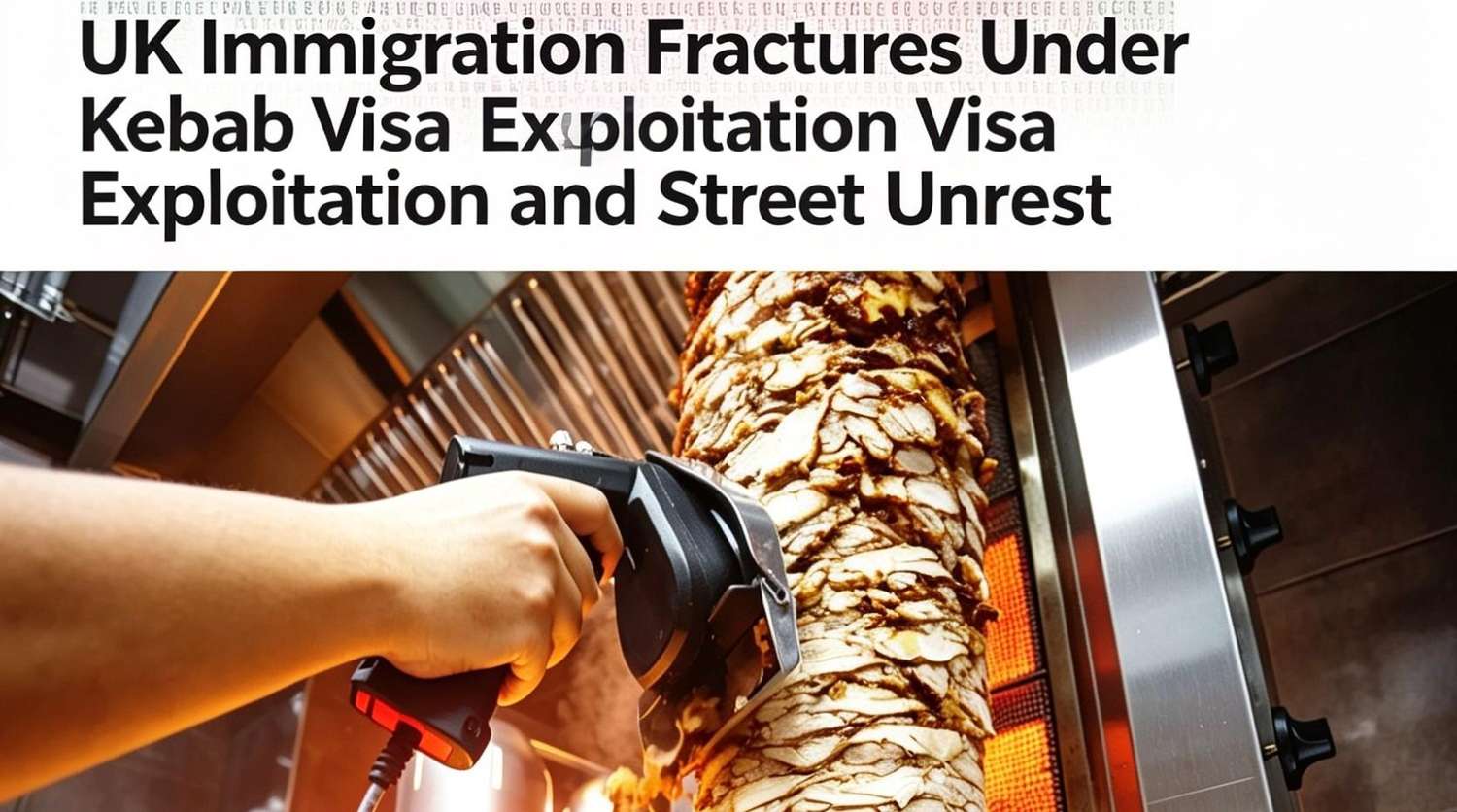
A series of parallel crises has exposed deep structural vulnerabilities in both the enforcement of British borders and the maintenance of domestic order, as executive data reveals how grassroots commerce has successfully bypassed highly publicised high-skilled immigration caps. While political discourse has focused on constitutional shifts in settlement timelines, an investigation by The Daily Dazzling Dawn shows that over 150 fast-food outlets, including 159 kebab houses, 79 vape shops, and 16 commercial car washes, have actively secured Home Office sponsorship licences to import overseas personnel under the Skilled Worker visa framework. This commercial exploitation of visa mechanisms has provided a highly effective rhetorical weapon for populist figures, complicating a febrile national landscape already destabilised by acute funding shortages in frontline policing and successive waves of localized civil unrest.
The revelation that relatively low-margin retail outlets can legitimately sponsor foreign cooks, who under existing frameworks are eligible to bring dependants to the UK, has ignited an intense political debate regarding the integrity of the sponsor register. Frontline records demonstrate that individual fast-food venues, such as East Ham’s Baba Kebabish, have successfully been allocated multiple visas for food service activities without any implication of fraudulent activity. Nevertheless, systemic oversight remains deeply flawed; between October and December 2025 alone, thirteen kebab establishments were hit with fines totaling up to £90,000 for employing unauthorized personnel, underscoring a broader, uncontrolled secondary market of visa exploitation that critics describe as a back-door route to economic migration.
Read More: Ministers Bypass Parliament on Ten-Year UK ILR Overhaul
"It is a disgrace," the Shadow Home Secretary Chris Philp told journalists when confronted with the figures. "Many sponsored workers won’t be highly skilled."
Echoing these legislative anxieties, prominent political figures have labeled the administrative oversight "absurd," telling journalists that a significant portion of what is classified as skilled corporate sponsorship has effectively devolved into a "fake-visa milling" operation. Migration policy institutes have gone further, explicitly telling journalists that the official sponsors' register has slipped entirely out of control. Although the executive has responded by trimming a hundred occupational roles from the eligible list and implementing a surge in enforcement, the historical volume of entries continues to fuel public anxieties regarding the state’s actual grip on its borders.
Policing Under Pressure
This mounting resentment regarding administrative border control has directly intersected with growing friction on the streets, where police forces are struggling against severe financial constraints. Criminologists and public policy experts have pointed out to journalists that mass violence in the United Kingdom is historically rare, typically requiring a volatile mixture of intense social anger and a visible deficit of police containment. Senior law enforcement representatives have repeatedly warned that the British police service is chronically underfunded, a reality laid bare during recent disturbances in Southampton and Belfast where under-staffed local units were temporarily overwhelmed by localized mobs.
The practical impact of these budgetary deficits has forced senior officers to resort to emergency operational workarounds. In Northern Ireland, where minor crowds of around 200 individuals engaged in targeted arson attacks and intimidation against minority residents, the Chief Constable of the Police Service of Northern Ireland, Jon Boutcher, was forced to activate the national "mutual aid" mechanism to pull in additional officers from Great Britain after twelve of his personnel were injured. Similarly, on the south coast of England, where over a thousand demonstrators clashed with police outside Southampton’s central station over misinformation surrounding a tragic student murder, local administrators acknowledged that the Hampshire constabulary remains one of the lowest-funded forces in England and Wales. Eleven officers and a police dog sustained injuries before order could be restored.
"White victimhood is a massively powerful mobilising grievance," Professor John Drury told journalists during an analysis of collective civil unrest. "There has been a normalisation of toxic anti-immigrant rhetoric in recent years... It's the problem of racists becoming empowered."
Exploitative Subtext
Legal proceedings overseeing the prosecution of individuals involved in the Southampton unrest have explicitly highlighted the toxic influence of digital misinformation and political grandstanding. In sentencing prominent instigators to multi-year custodial terms for attacking officers with commercial bins and projectiles, the judiciary described the incidents as hate crimes born out of a profound contempt for public services and fueled by deep-seated prejudice. Despite calls from far-right activists on international platforms for a coordinated domestic uprising—which were subsequently amplified by social media tech leaders—the disturbances remained localized and failed to spark a wider movement.
The deeper challenge facing Westminster lies in unpicking the populist narratives that thrive on these systemic failures. Populist leaders have consistently weaponised cases of high-profile violence or visa system loopholes to argue that public institutions have deprioritised the concerns of the majority. However, independent analysts point out to journalists that the empirical facts rarely support these simplistic arguments. For instance, despite intense anti-immigration rhetoric focused on Northern Ireland, official census data shows that the region remains overwhelmingly homogeneous, with less than three percent of the population identifying as non-white, and only a minimal fraction of the population consisting of asylum seekers receiving state support.
As the government moves forward with its broader plans to overhaul permanent residency tracks, the parallel crises of localized street violence and commercial visa exploitation suggest that structural anomalies within the Home Office are creating a dangerous credibility gap. While ministers possess the executive mechanisms to tighten rules from the top down, the persistence of low-wage sponsorship networks combined with under-resourced local police forces suggests that the stability of the UK's border architecture remains highly vulnerable to political and social shocks.




.jpg)