

.jpg)


.svg)
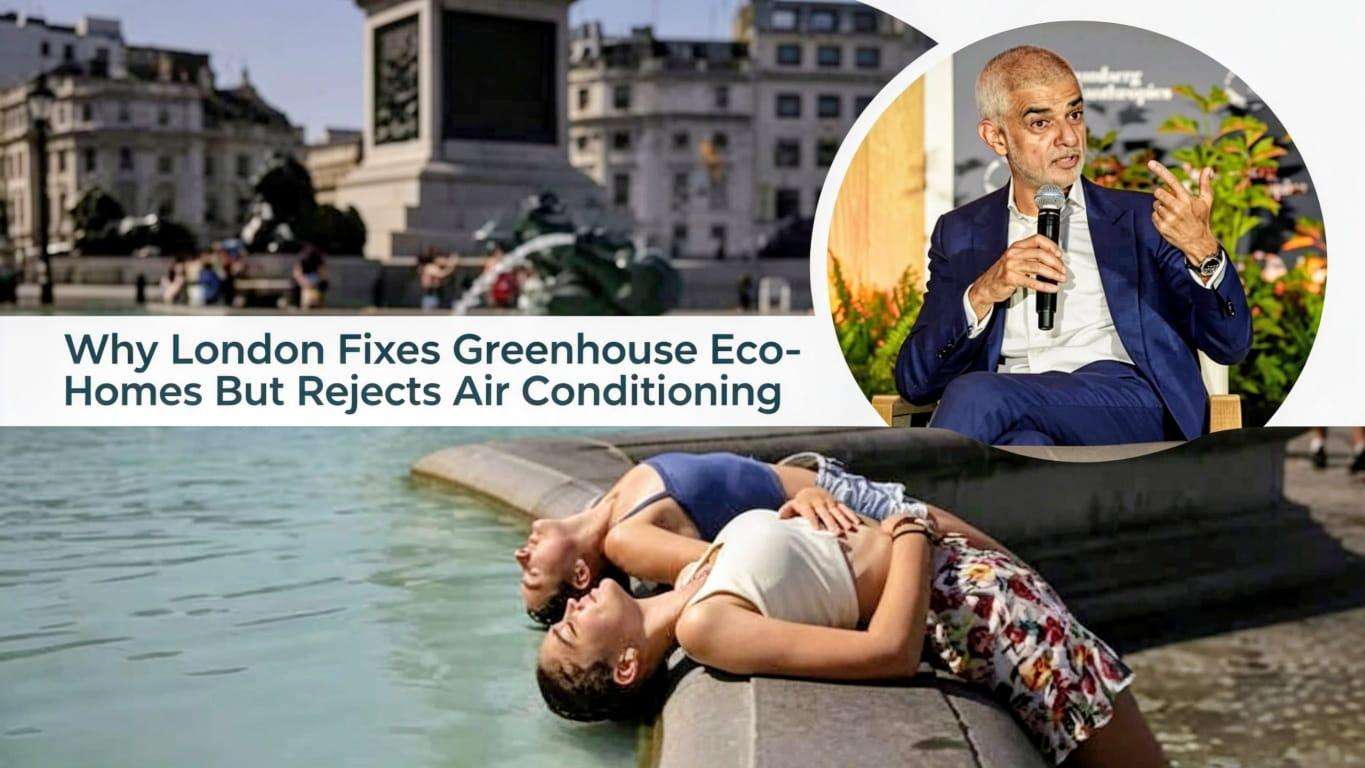
A record-shattering summer heatwave has exposed a systemic design flaw at the heart of London’s sustainable housing strategy, forcing City Hall into emergency interventions. An investigation by the Daily Dazzling Dawn reveals that thousands of flagship eco-homes, engineered to meet stringent climate targets by sealing in warmth, have effectively transformed into uninhabitable thermal traps. As indoor temperatures surpass dangerous thresholds, the Mayor of London has been forced to sanction emergency retrofitting trials, yet official policy continues to fiercely resist the adoption of mechanical air conditioning.
The crisis centers on developments like Chobham Manor in East London, the celebrated post-2012 Olympic legacy neighbourhood. Built under the statutory framework of Building Regulation Part L 2010, these properties prioritized heavy insulation and airtightness to reduce winter heating emissions. However, internal regulatory assessments acknowledged that these guidelines offered highly limited consideration of summertime overheating risks.
The consequences of this policy blind spot have fallen squarely on residents. When external temperatures reached peak levels this week, indoor environments spiked far higher. Local families have reported being driven from their properties due to unsafe conditions. Joe and Jess Halpin told journalists they incurred significant accommodation costs fleeing to a local hotel to protect their ten-week-old daughter.
"We moved on Tuesday because it has air conditioning and it’s just unsafe for her here," Mr Halpin told journalists. "It’ll be hotter in the flat than outside, and that’s just too hot for a baby." Ms Halpin added that the flat operated like a greenhouse, remaining unsafe even when ambient outside temperatures settled in the twenties.
Other residents have noted the stark contrast between UK building design and international standards. Suzzie Hamilton, a local resident, told journalists she had been forced to leave her balcony doors open since spring to find relief, questioning why structural precautions were not integrated originally.
For many residents, the administrative hurdles to achieving comfort are as rigid as the physical architecture. Bach Pham told journalists that structural regulations prevent the installation of permanent, fixed air conditioning units because it would alter the designated design of the block. To circumvent this, he resorted to an internal portable cooling unit.
I think we are now getting to the point where London is as hot as a tropical island in the summer," Mr Pham told journalists. "We need air-con in the summer as much as we need heating in the winter, so it would only be fair for residents to be allowed to install it.
Industry experts argue that the planning gridlock stems from an obsolete understanding of cooling technology. Savva Zacharia, managing director of Cool You Ltd, told journalists that modern apartments with expansive glazing regularly exceed thirty-five to forty degrees Celsius. He emphasized that traditional passive solutions, such as opening windows, are frequently unviable due to noise pollution, security concerns, or flight paths, and can inadvertently introduce hotter outdoor air.
Mr Zacharia noted that the planning debate remains fixated on traditional external condensers, failing to recognize how significantly inverter-driven heat pump technology has evolved. He argued that comfort, public health, and sustainability do not have to be competing priorities if cooling is delivered efficiently.
Behind closed doors, the scale of the emergency is vastly greater than a single pilot scheme. The Greater London Authority has quietly admitted that the retrofitting challenge is not isolated to thousands of properties, but instead extends to more than one million existing homes across the capital.
Internal testimony from Dan Bicknell, the Climate Adaptation Manager at the Greater London Authority, confirmed to the London Assembly that City Hall is in the incredibly early days of addressing this massive vulnerability. Officials face a substantial funding gap, meaning any heat-adaptation retrofit must be strategically bundled with existing winter insulation upgrades to remain financially viable.
To manage the escalating political fallout, the Mayor's office has launched its first comprehensive framework, the Heat Ready London strategy. While the initiative establishes designated indoor cool spaces across the boroughs, the underlying policy relies strictly on a cooling hierarchy. This legal directive forces developers and landlords to maximize passive measures, such as external shading, shutters, and reflective materials, before active mechanical cooling can even be considered.
A spokesperson for the London Legacy Development Corporation confirmed they are actively collaborating with the Mayor’s office to enhance long-term climate resilience. However, as independent analysts warn that standard climate assumptions no longer hold true, the tension between statutory decarbonization targets and immediate public health demands is set to become the defining municipal battle of the decade.