






.svg)
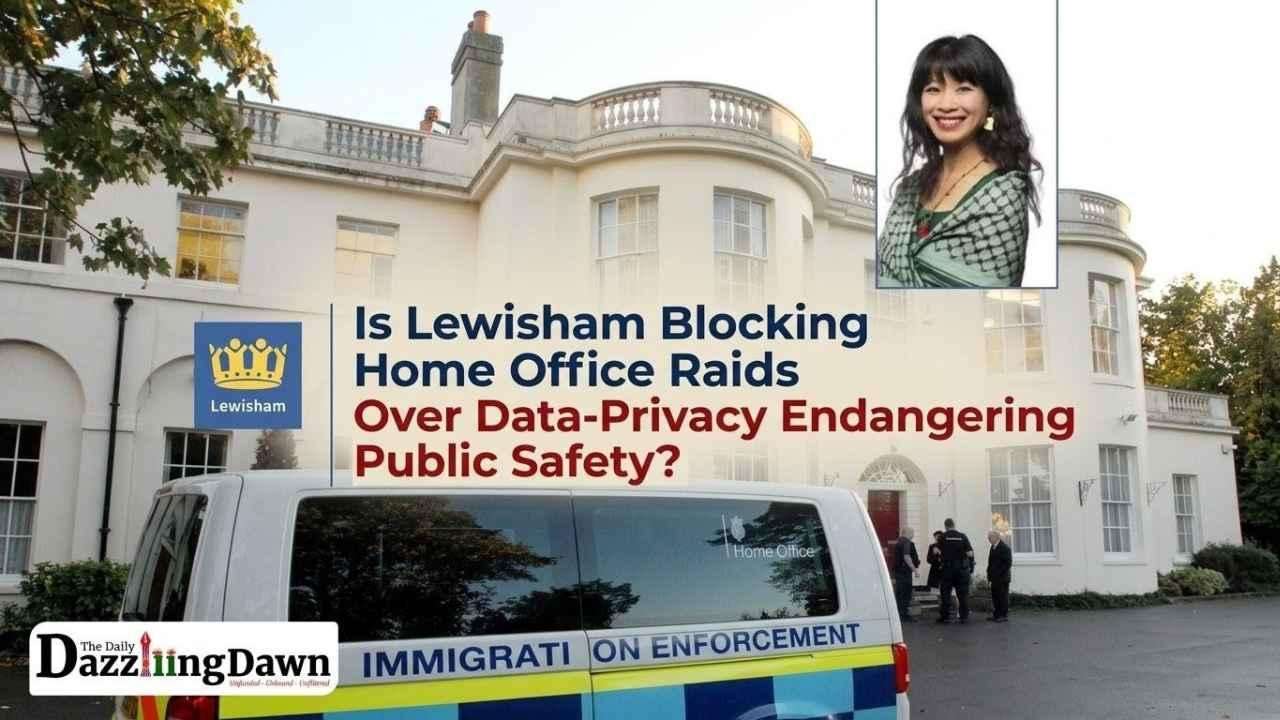
In an unprecedented national precedent, Lewisham Council has formally enacted a historic measure committing the local authority to review all internal infrastructure with the explicit aim of severing operational assistance to Home Office immigration enforcement teams. The landmark decision, passed at a Full Council meeting on Wednesday, 22 July 2026, marks the first instance of a British municipal government taking structural action to erect a legal and operational firewall against government deportation raids within its administrative borders.
An investigation conducted by Daily Dazzling Dawn reveals that the policy initiative gained momentum after council officials uncovered internal correspondence indicating that Home Office officials sought access to local environmental health databases to identify and target workers across commercial establishments. The discovery catalyzed an immediate political push to safeguard municipal data streams, leading to a vote by the full council to dismantle any structural mechanisms that facilitate non-mandatory intelligence sharing.
Proposed by the Green administration, the motion commits the local authority to a comprehensive, system-wide overhaul across all council departments. Rather than relying on symbolic declarations, municipal leaders are systematically auditing data-sharing protocols, procurement streams, and service-level agreements to ensure public funds and municipal information systems are not utilized to assist enforcement visits wherever "legally possible."
Crucially, the scope of the internal review extends to third-party contractors and community service partners. Service agreements with external entities, including homelessness support organizations, are facing rigorous scrutiny to verify that sensitive information regarding vulnerable populations remains strictly protected from external surveillance. Local officials argue that without an absolute operational firewall, frontline council services risk losing the trust of vulnerable residents who require public support, health protection, and labor rights. Mayor Liam Shrivastava emphasized that immigration raids do not build safety in communities, but rather spread fear and make it harder for victims of human trafficking and modern slavery to seek protection.
The decision highlights a growing administrative rift between local municipal governance and central enforcement strategies. Freedom of Information data obtained by grassroots organization Lewisham Anti-Raids reveals that 177 raids occurred in the SE13 area during 2025 alone, contributing to 2,715 illegal working visits across London that year. While central authorities maintain that joint operational visits are essential intelligence-led actions designed to dismantle illegal working networks, local representatives contend that high-profile enforcement operations often result in minimal criminal captures while causing severe disruption and intimidation within migrant communities.
A spokesperson for the Home Office told journalists that while enforcement visits remain intelligence-led, authorities make no apology for collaborating with local authorities to share information and target criminal networks. Central enforcement figures show an 83 percent rise in illegal working arrests alongside a 77 percent rise in raids between July 2024 and December 2025.
In contrast, council figures emphasize the human and economic cost of aggressive tactics. Addressing the council chamber, Cabinet Member for Communities, Sanctuary and Healing, Cllr Hau-Yu Tam, detailed an operation in January 2026 where enforcement officers, accompanied by the Immigration Minister and a film crew, raided a Catford nail bar and a Brockley car wash, resulting in only two arrests who were later released on bail. When the nail bar was raided again weeks later, Chinese women workers were handcuffed and filmed without being arrested. Cllr Tam told journalists that such operations represent a "theatre of cruelty" that fails to make communities safer.
Seconding the measure, Cllr Wellington Gil, the borough's first Migrant Champion, told journalists that targeting business owners and workers based on background or appearance represents deeply discriminatory practices that undermine foundational civil rights.
Looking ahead, Lewisham's move—building on its status as the UK's first "Borough of Sanctuary" recognized in 2021—represents the initial phase of a broader multi-borough strategy. The council is actively joining forces with neighbouring authorities, including Lambeth Council, to establish an interconnected "Sanctuary Corridor" stretching across South London. This initiative aims to align data-privacy safeguards, legal defense networks, and community education protocols across municipal boundaries.
Cabinet Member for Safer, Thriving Neighbourhoods at Lambeth Council, Cllr Jonathan Bartley, told journalists that establishing trust is essential for protecting vulnerable individuals who are frequently subjected to severe landlord exploitation or dangerous working conditions. He emphasized that when residents fear municipal agencies might quietly transfer personal records to enforcement teams, victims of severe abuse are rendered completely unable to seek safety or justice.
As the policy review moves forward, the council will collaborate closely with grassroots legal teams, the Joint Council for the Welfare of Immigrants, and local anti-raid advocacy groups to inform small business owners and workers of their precise statutory rights during workplace inspections. While central authorities continue to push for tighter enforcement integration, London's expanding sanctuary corridor signals a major constitutional test regarding the limits of local government cooperation in federal enforcement policy.



.jpg)