






.svg)
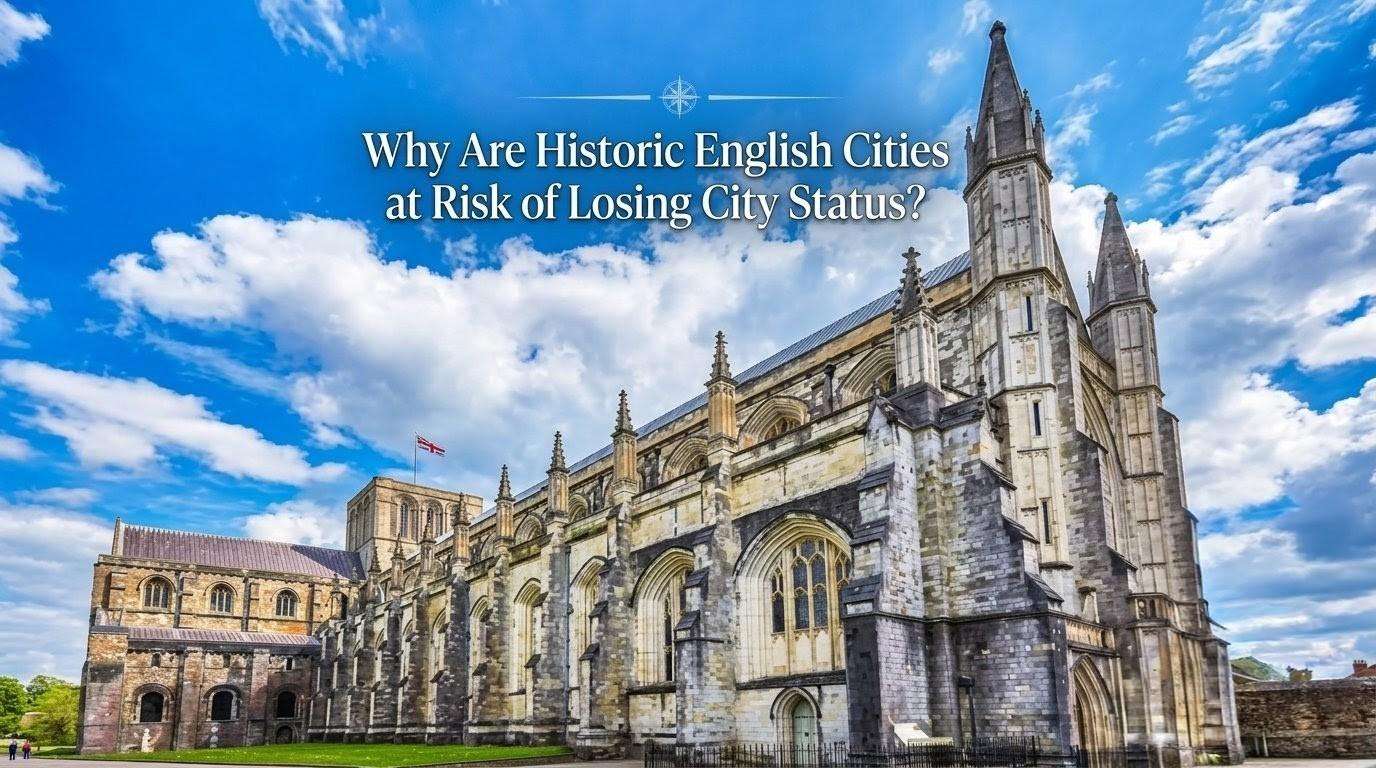
Winchester, Canterbury, and several other prominent English settlements face the unintended prospect of forfeiting their historic city status under local government structural reforms proposed by the Deputy Prime Minister and Secretary of State for Housing, Communities and Local Government, Angela Rayner. Scheduled to take effect in 2028, the planned abolition of traditional two-tier county and district administrations in favour of all-purpose unitary authorities creates a significant constitutional loophole. Unless outgoing civic administrations establish specialized corporate bodies known as charter trustees or parish structures to legally inherit the Letters Patent and civic regalia, the civic honours attached to the abolished administrative entities will automatically lapse.
The administrative upheaval directly threatens historic settlements that have preserved royal recognition across centuries. Winchester, the ancient capital of Wessex and early Anglo-Saxon England, and Canterbury, home to the mother church of the worldwide Anglican Communion with civic charters dating to 1448, are both slated to be absorbed into broad regional bodies. Under the draft boundaries, Winchester would merge into a proposed Mid Hampshire authority, whilst Canterbury is earmarked for integration into an expansive East Kent administration. Because royal charters are granted strictly to distinct local corporations rather than geographical landmasses, the statutory dissolution of those municipal councils leaves the title of city without a legal repository.
The regulatory threat extends well beyond the ancient heartlands of southern England. Industrial and coastal centres including Stoke-on-Trent, Chelmsford, and Southend-on-Sea face identical administrative barriers. Stoke-on-Trent, granted city status by King George V in 1925, is scheduled to merge into a wider North Staffordshire authority, whilst Chelmsford is set to be folded into Mid Essex. Southend-on-Sea, which was granted city status by Queen Elizabeth II in 2022 to honour the memory of its murdered Member of Parliament Sir David Amess, risks seeing its hard-won royal patent dissolved upon absorption into South East Essex unless formal preservation steps are completed.
Daily Dazzling Dawn understands that local authorities across England are examining the logistical and financial burdens required to navigate the transition. To retain ceremonial privileges, mayoral insignia, and heraldic coats of arms, outgoing authorities must formally institute bodies of charter trustees composed of the newly elected unitary councillors who represent the historic civic area. However, legal advisers have cautioned that establishing these custodial bodies requires substantial legal outlays and necessitates raising separate local council tax precepts, which can add between £2 and £18 annually to household Band D bills to fund mayoral transport, ceremonial functions, and civic administration.
Municipal leaders have raised acute concerns regarding the complexity of the transition. Winchester City Council leader Martin Tod told journalists that the city has enjoyed its status for as long as royal recognition has existed and intends to preserve it, yet highlighted that boundary overlapping and existing parish rules make the statutory route fraught with complexity. Similar warnings have been voiced by civic officers in Stoke-on-Trent, who confirmed that municipal reorganisations risk creating temporary lapses in royal status alongside significant bureaucratic expenditure.
The present dilemma mirrors the administrative oversight that befell Rochester in 1998. Following local government reorganisation that created Medway Council, the former city council failed to appoint charter trustees, resulting in the accidental and permanent forfeiture of a city charter Rochester had held since the reign of King Henry III in 1211. Historians and architectural scholars, speaking to Daily Dazzling Dawn, have cautioned that administrative streamlining must not inadvertently sever the centuries-old civic heritage that defines English municipal identity.
The Ministry of Housing, Communities and Local Government maintained that central government acknowledges the profound historical identity of English cities and affirmed that ministers intend to work closely with local councils to safeguard royal honours as unitary reorganisations advance towards statutory implementation.