


.svg)
A new exhibition at the Victoria and Albert Museum’s V&A East Storehouse in London is using large textile artworks to explore Muslim life, migration, belonging and the long history of Islamic culture in Europe.
Titled “I Was Born Here,” the project by British artist, architect and academic Shahed Saleem brings together three large tapestries beneath the museum’s historic Torrijos ceiling. The exhibition connects contemporary experiences of Britain’s Muslim and migrant communities with centuries-old histories of cultural exchange, exclusion and religious conflict in Europe.
The display is part of V&A East’s New Work: Making East London programme and is currently open at V&A East Storehouse. According to the museum, the exhibition will remain on display until October 18, 2026, with free admission.
The setting itself is an important part of the exhibition. The Torrijos ceiling is a carved and gilded wooden structure measuring about 6 metres by 6 metres. It was made in Spain in the late 15th century and originally formed part of a palace in Torrijos, near Toledo. The V&A says the ceiling reflects the influence of Islamic artistic traditions on European architecture during a period when Islamic, Christian and Jewish cultures interacted across the Iberian Peninsula.
Saleem uses that historical setting to ask how ideas about ethnic and cultural identity from the past continue to influence political language and social attitudes today.
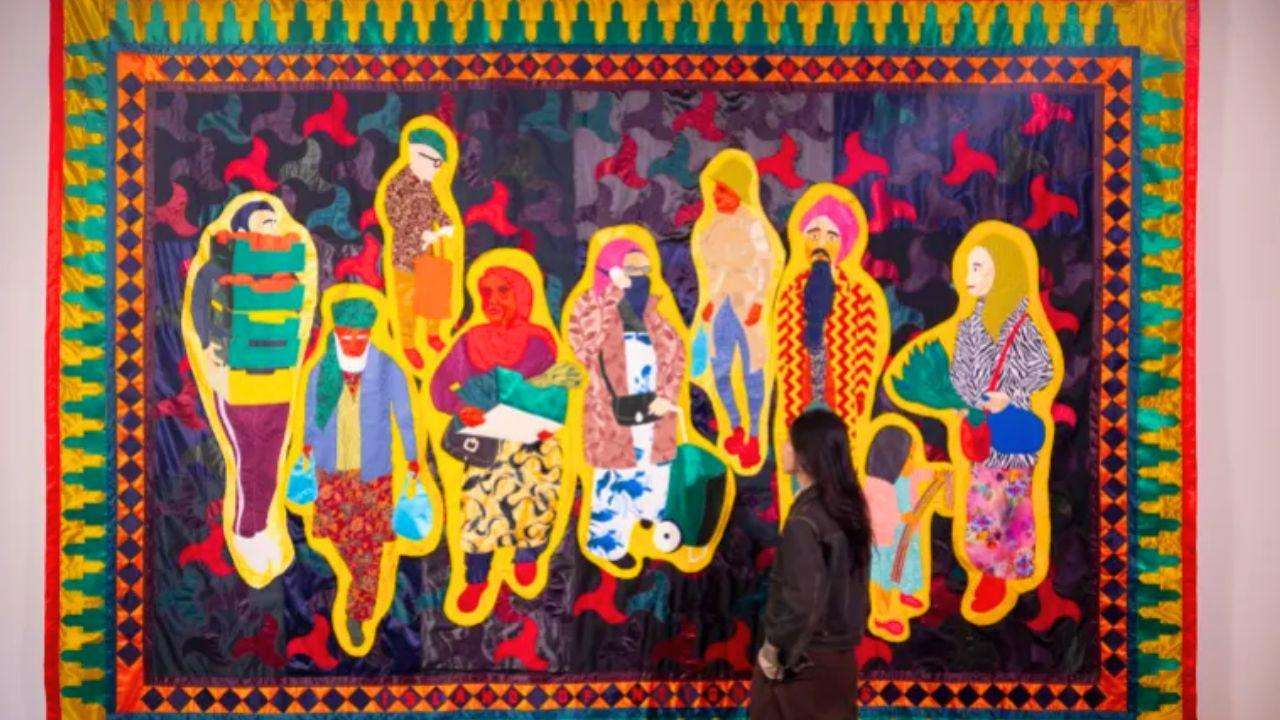
The three tapestries approach the subject from different perspectives. The first, “Queen’s Market,” celebrates the diversity, creativity and commercial life of Newham’s Queen’s Market in east London. The second, “Home Office,” refers to the controversial 2013 Home Office campaign in which vans displayed messages aimed at undocumented migrants, including the phrase “Go home or face arrest.” The third work, “For God and Gold,” links political and religious developments in late 15th-century Spain with racialised experiences and struggles in modern east London.
The Home Office campaign referenced by Saleem was a short pilot that operated in six London boroughs in July 2013. Parliamentary records confirm that two advertising vans were used in areas including Ealing, Hounslow, Brent, Barnet, Redbridge, and Barking and Dagenham. The campaign later faced criticism over its approach and the accuracy of some of the claims displayed on the vans.
Another important figure represented in the exhibition is Altab Ali, a young Bangladeshi textile worker who was murdered in a racially motivated attack in London in 1978. His story connects the exhibition to the experiences of Britain’s Bangladeshi community and the wider history of racism faced by migrant communities in London.
Saleem deliberately brings these different histories together rather than treating them as separate events. The exhibition places modern debates over immigration, identity and race alongside the artistic legacy of Islamic Europe, encouraging visitors to consider how ideas of belonging have changed — and how some patterns of exclusion continue.
The artist has described the project as a reflection on migration and belonging. His work challenges the idea that Muslims and other migrant communities are somehow outsiders in Britain, particularly when many members of those communities were born and raised in the country.
The title “I Was Born Here” itself carries that message. It refers to the experience of people who feel repeatedly pressured to prove that they belong in Britain, despite having deep personal, family and cultural connections to the country.
The exhibition also reflects on the history represented by the Torrijos ceiling. The V&A explains that the ceiling was created in the late 15th century, when Spain was undergoing major political and religious transformation. Islamic artistic techniques were incorporated into European architectural traditions even as political developments were increasingly shaped by ideas of religious and ethnic uniformity.
That contrast is central to Saleem’s installation. The ceiling demonstrates how deeply Islamic artistic traditions became embedded in European culture, while the tapestries examine the exclusion and hostility experienced by Muslim and migrant communities in contemporary Britain.
The University of Westminster, where Saleem is a Reader in Architecture, says the project explores current anti-immigration policies and language in relation to longer histories of exclusion. The university also confirms that the three tapestries were created specifically for the V&A East Storehouse installation beneath the Torrijos ceiling.
The exhibition also draws attention to the multicultural character of east London. Queen’s Market, featured prominently in one of the tapestries, represents a place where different communities meet through trade, work and everyday life. For Saleem, the market reflects the diversity and creativity of a city shaped by generations of migration.
This focus on ordinary people is important to the artist’s wider message. Rather than presenting migration only as a political issue, the exhibition looks at the workers, families, traders and communities whose lives have helped shape London.
The installation therefore moves between personal memory, political history and European art history. Images of migration and contemporary London appear alongside references to Spain, colonial expansion, religious conflict and the development of Islamic artistic traditions in Europe.
For visitors, the result is an exhibition that asks a simple but challenging question: Who gets to claim a place in Britain, and who is made to feel that they must justify their belonging?
By placing the words, images and stories of contemporary Muslim and migrant communities beneath a centuries-old Spanish ceiling influenced by Islamic design, Saleem creates a visual connection between the past and present.
“I Was Born Here” is not simply an exhibition about migration. It is also an attempt to preserve a record of the present — a moment when debates over immigration, identity, race and Islamophobia remain highly visible in British public life.
The V&A describes the commission as part of its wider effort to explore how art and design intersect with everyday life in east London. The exhibition will remain at V&A East Storehouse until October 18, 2026, giving visitors an opportunity to experience Saleem’s work alongside one of the museum’s most significant historic architectural objects.