





.svg)
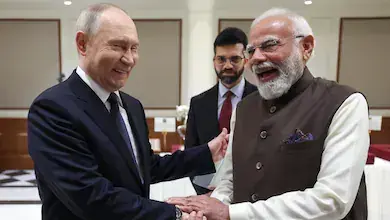
As New Delhi rolls out the red carpet for Vladimir Putin’s state visit, Western capitals are watching closely — and with growing unease. The optics of handshakes, lavish dinners and even the launch of an Indian edition of Russia’s state-run RT channel underline a troubling question: Is India drifting too far from its democratic partners in the West?
Only weeks have passed since Sir Keir Starmer received a warm welcome in Mumbai as both sides pursued a landmark free-trade deal. During that visit, Sir Keir made a pointed – if diplomatic – remark: unlike Narendra Modi, he would never publicly wish the Russian president a happy birthday. The comment reflected a broader Western discomfort over India’s steady tilt toward Moscow since Russia’s invasion of Ukraine.
India’s Oil Deals Undermining Western Sanctions
India’s decision to purchase huge quantities of discounted Russian oil has weakened collective Western efforts to constrain the Kremlin’s war machine. Before the Ukraine war, Russian crude accounted for barely 2.5% of India’s imports; last year it spiked to 35%, much of it carried by Moscow’s “shadow fleet” designed to bypass sanctions.
But in doing so, India has knowingly softened the impact of Western economic pressure on Russia. Recent sanctions on Rosneft and Lukoil, alongside Donald Trump’s 25% additional tariff on Indian exports, have forced New Delhi to scale back somewhat. Still, the Kremlin insists this reduction is “temporary,” signalling its intention to keep using India as an economic and geopolitical safety valve.
Defence Cooperation: A Double Game
The mixed signals extend to defence. Although Mr Modi has signed significant deals with Western partners — from France’s £5.5bn Rafale jets to recent US contracts involving Javelin and Excalibur missiles — India continues to deepen military cooperation with Russia.
On Friday, New Delhi approved a new £1.5bn agreement to lease a Russian nuclear submarine. This comes on top of decades of heavy reliance on Moscow: roughly 60% of India’s military hardware originates from Russia, and much of it requires continuous Russian maintenance.
High on the agenda are additional purchases for the S-400 air defence system and discussions over the next-generation S-500. These moves risk placing India at odds with the very Western nations now helping it to modernise its forces and counter threats from Pakistan and China.
A Strategic Balancing Act — or a Strategic Risk?
India insists its approach is “multi-aligned,” but Western officials increasingly question whether New Delhi’s actions amount to tacit support for a regime actively destabilising Europe. Every public embrace of Putin provides the Kremlin with valuable geopolitical cover, enabling Moscow to claim it is not isolated despite its invasion of a sovereign democratic nation.
By pushing closer to Russia, Mr Modi risks undermining trust with the West at a crucial moment. Should India tilt too far towards Moscow, Washington, London and Brussels may be forced to reconsider the scale and nature of their defence cooperation — partnerships that India relies upon to maintain strategic stability in South Asia.
A Crucial Test of India’s Democratic Credentials
As Modi and Putin sit down for talks in New Delhi, Western leaders see more than just bilateral diplomacy. They see a test of India’s commitment to the democratic values it claims to uphold. The choices Mr Modi makes will determine whether India is truly a reliable partner for the West — or a swing state whose ambiguous loyalties weaken the global response to authoritarian aggression.


.jpg)


.jpg)