





.svg)
Britain's strategic defence and intelligence establishment today sounded a unified and urgent alarm over the "acute threat" posed by an "aggressive, expansionist and revisionist Russia," with the nation's new spy chief demanding a radical technological overhaul of the Secret Intelligence Service (MI6), Daily Dazzling Dawn realized.
Read more-Blaise Metreweli Becomes First Woman to Lead MI6
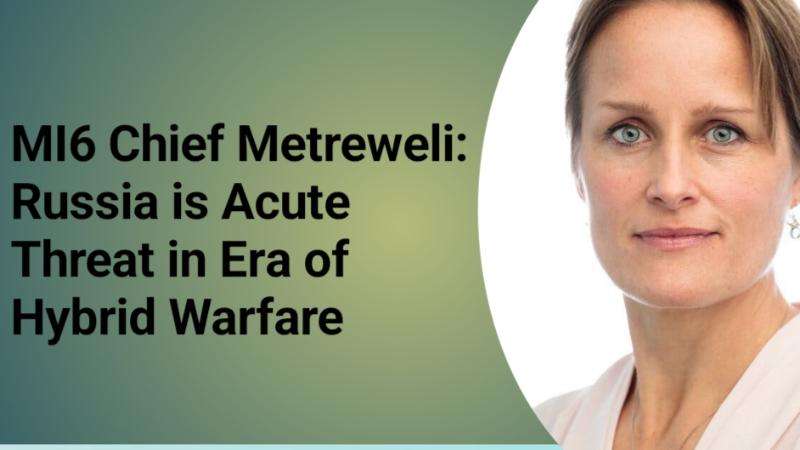
In her first major public address since taking office on 1 October, Blaise Metreweli, the first woman to lead the overseas spy agency, laid out a doctrine of modern espionage centred on digital mastery, making clear that the future of UK security depends as much on lines of computer code as on traditional human intelligence.
The New Face of Espionage: Blaise Metreweli, ‘C’-Blaise Metreweli, a forty-eight-year-old career intelligence officer, is a significant departure from her predecessors, bringing a deep specialisation in technology to the top role—known internally as 'C'. She joined the Service in 1999 after studying Anthropology at Pembroke College, Cambridge. Her extensive operational career has primarily focused on the volatile geopolitical theatres of the Middle East and Europe, including senior counter-terrorism roles during the conflicts in Afghanistan and Iraq.
Prior to her historic appointment, announced in June, Metreweli served as the Director General for Technology and Innovation, or 'Q'—a real-life division named after the fictional MI6 quartermaster in the James Bond novels. This background makes her one of the agency’s foremost thinkers on integrating high-tech solutions into field tradecraft. She is also a veteran of the domestic security agency, having held director-level roles at MI5, including a stint as the Head of Hostile States Counterintelligence.
In her speech, Metreweli called on all intelligence officers to become comfortable with a new dual-capability: "We must be as comfortable with lines of code as we are with human sources, as fluent in Python as we are in multiple languages." This focus on the Python programming language, a three-decade-old but versatile tool, underscores her intent to embed advanced computing skills at the very heart of the agency’s operations, a necessity in an age where biometric scanning and pervasive data collection threaten to unmask agents at a moment's notice.
Russia’s Hybrid Threat Demands Sustained Pressure-The core of her warning was directed squarely at the Kremlin. Metreweli highlighted Russia’s engagement in "hybrid warfare," a strategy that weaponises non-military tactics such as indiscriminate cyber attacks, information warfare, and the use of suspected Russian proxies deploying drones near critical infrastructure. She insisted that despite sanctions having demonstrably damaged Russia’s economy, driving exports towards China and India, they have failed to curb President Vladimir Putin's determination to wage war on Ukraine.
The new Chief vowed Britain would "be keeping up the pressure on President Vladimir Putin on Ukraine's behalf," pointing to the recent sanctioning of Russian entities engaged in information warfare, alongside two China-based companies penalised for "indiscriminate cyber activities against the UK and its allies."
A 'Whole of Society Approach' to National Resilience-The intelligence chief's stark warning was immediately reinforced by a parallel address from the Chief of the Defence Staff, Sir Richard Knighton, who called for a "whole of society approach" to building national resilience. Speaking at the Royal United Services Institute (RUSI), Sir Richard declared the current situation "more dangerous than I have known during my entire career."
He argued that countering Russia’s clear wish to "challenge, limit, divide and ultimately destroy Nato" requires a response that extends far beyond simply strengthening the armed forces. Deterrence, the Chief of Defence Staff explained, must harness the entirety of the UK's national power—from universities and industry to critical infrastructure like the rail network and the NHS.
Sir Richard’s call for a new era of defence where "our whole nation [steps] up" included an announcement of an immediate £50 million investment for new defence technical excellence colleges, a move designed to address a critical skills gap in engineering and technology. The speeches collectively underscore a pivotal moment for the UK security community, signalling a shift to a comprehensive, technologically-driven, and civilian-inclusive defence posture to meet an increasingly uncertain and aggressively hostile global landscape.