




.svg)
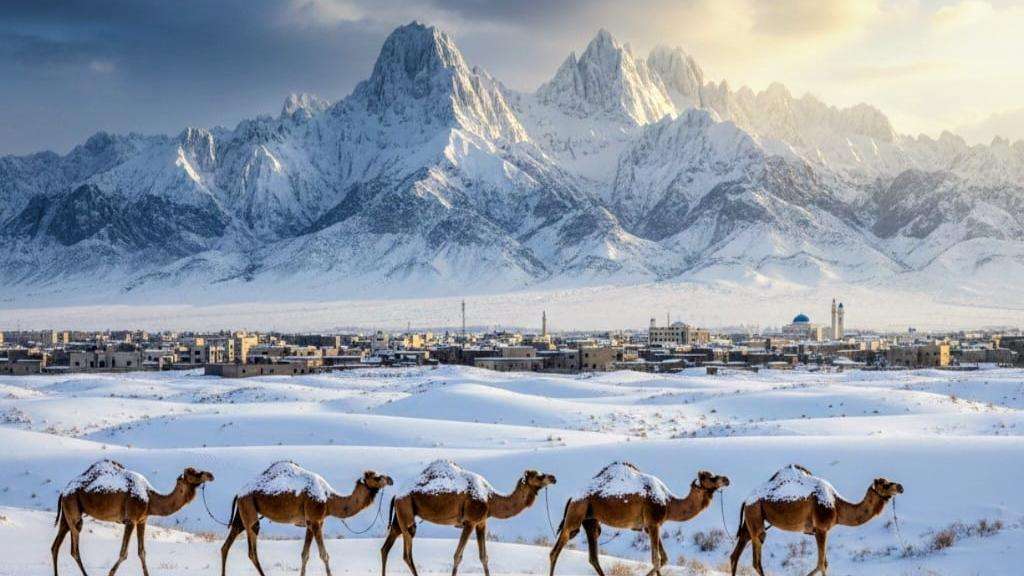
The silhouette of the Arabian Peninsula is shifting from the fiery hues of the Nafūd Desert to an ethereal, crystalline white. As a powerful polar weather system sweeps across the Kingdom this week, the National Center for Meteorology (NCM) has confirmed that snowfall is not just a possibility, but a reality for the highlands of Tabuk, Hail, and—most notably—the Qassim region. While the sight of camels navigating through snowdrifts often goes viral as a "once-in-a-lifetime" miracle, meteorologists and climate historians are pointing to a much more complex and rhythmic atmospheric story.
For those wondering if this is a historical first, the answer is a nuanced blend of geography and altitude. While a rare dusting of snow in the low-lying Al-Jawf desert in late 2024 was considered a historic anomaly, snowfall in the northern mountains is a recurring winter guest. In regions like Jabal Al Lawz, Alaqan, and Al Dhahr, snow has been recorded almost every two to three years over the last decade. However, the current 2025 system is significant because of its reach, pushing freezing isotherms further south into Qassim and the northern reaches of Riyadh, areas that typically experience heavy rain rather than frozen precipitation.
Experts are stressing that these events, while visually jarring, are "not unusual" when viewed through the lens of global pressure systems. The phenomenon is driven by the southward extension of the Siberian High—the largest high-pressure system in the Northern Hemisphere—colliding with moisture-rich low-pressure troughs from the Mediterranean and the Red Sea. When these freezing, dry Siberian winds meet the humid tropical air, the result is a rare but scientifically predictable "perfect storm" that lowers temperatures below zero degrees Celsius in the Kingdom's elevated north.
This week’s weather event follows a series of red alerts for Qassim, where intense rainfall and hailstorms initially sparked flooding concerns. As the mercury plummeted on Wednesday night, that rain transitioned into the heavy snowfall now carpeting the peaks of Hail and Tabuk. NCM spokesperson Hussein Al Qahtani noted that while the intensity of these storms is being closely monitored, the winter of 2025 is largely following the "Siberian rhythm" that defines the region's colder cycles.
For the residents of northern Saudi Arabia, the snow is less a climate crisis and more a seasonal celebration. The highlands of Trojena and the peaks of the Northern Borders Province are becoming established winter tourism hubs, drawing thousands of visitors eager to witness the "Winter Wonderland" of the Middle East. Despite the festive atmosphere, authorities remain on high alert, urging travelers to avoid mountain passes where black ice and reduced visibility pose significant risks. As the system moves toward the Eastern Province, the Kingdom remains a striking example of how traditional desert climates are interacting with broader, shifting atmospheric currents.