


.svg)
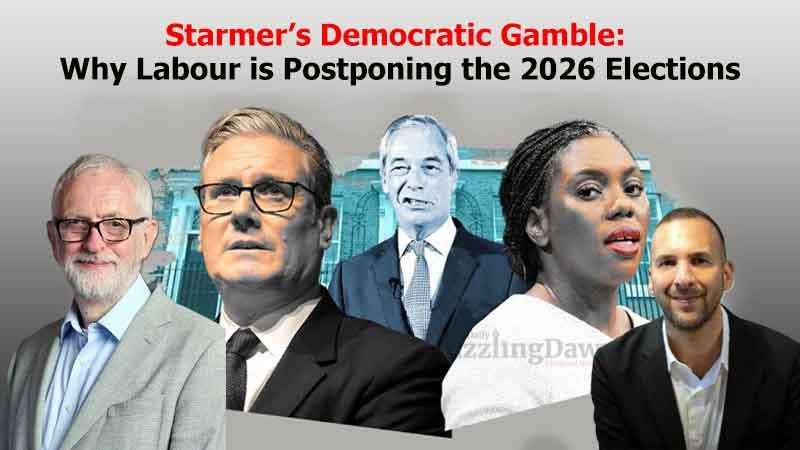
The British political landscape is currently weathering a seismic shift as the Labour government initiates what critics describe as a calculated suspension of democracy. By writing to 63 councils to propose the postponement of the May 2026 elections until 2027, and pushing mayoral contests as far back as 2028, Sir Keir Starmer has ignited a fierce debate over constitutional integrity and partisan survival. While the official narrative from Local Government Minister Alison McGovern cites the "resource-intensive" nature of transitioning from a two-tier system to unitary authorities, the underlying reality suggests a more complex struggle for control.
The motivation behind this delay is inherently structural yet deeply political. Why is Labour doing this? Officially, the government plans to abolish the wasteful two-tier system of district and county councils, creating a swathe of new local authorities responsible for all services by 2028. However, Westminster insiders suggest the move is a defensive wall. Recent data from December 2025 shows Labour’s lead narrowing significantly, with some trackers placing them neck-and-neck with a resurgent Conservative Party under Kemi Badenoch, while Reform UK continues to siphon off disillusioned working-class voters. By delaying the polls, Starmer aims to buy time for his "missions" to bear fruit before facing a public verdict that could currently result in a bloodbath of lost council seats.
The question of whether Labour can execute this plan by their own design remains open. While they have the parliamentary majority to push through restructuring, they are facing a pincer movement of legal and political challenges. Nigel Farage has branded the move the hallmark of a "banana republic," while Liberal Democrat leader Sir Ed Davey has accused Labour and the Conservatives of a "stitch-up" to avoid accountability. The Reform UK leader has already threatened legal action over the postponed mayoralties, suggesting that "turkeys don't vote for Christmas." This creates a volatile environment where the government’s plan for streamlined local government could be derailed by a series of high-profile judicial reviews or a rebellion from its own backbenchers who fear for their local power bases.
In the meantime, whispers of a leadership transition continue to simmer. While Sir Keir Starmer remains at the helm, the rise of Angela Rayner as a powerhouse within the party is palpable. As the Secretary of State for Housing, Communities and Local Government, Rayner is the architect physically overseeing this radical restructuring. If these reforms succeed in cutting red tape and empowering regions, she will be credited with modernizing the British state. If they fail and result in widespread disenfranchisement, she may find herself perfectly positioned to challenge Starmer by presenting a more "populist" and "authentic" alternative. Some analysts suggest a "managed transition" could see Rayner take power before the next General Election if Labour’s local government gambit backfires.
The electoral delay has created a unique vacuum for the smaller parties. Reform UK is currently topping some national polls, hitting between 20% and 30% in projected local seat shares, which Farage intends to use as a springboard. On the left, the battle between Jeremy Corbyn’s newly launched "Your Party" (Independent Alliance) and the Green Party is reaching a fever pitch. Current analysis suggests that the Green Party may actually benefit more from the delay than Corbyn’s movement. The Greens have a proven ability to build long-term local "strongholds" through incremental gains, whereas Corbyn’s "Your Party" currently faces internal strife and legal feuds between its founders, making a long delay potentially fatal to its early momentum.
The impact on London’s boroughs will be particularly acute. London often serves as the vanguard for national trends, and the delay in broader regional restructuring could see a consolidation of power in the capital. The biggest beneficiaries in the London landscape are likely to be the incumbent Labour councils in the inner boroughs, who avoid a mid-term referendum on issues like housing costs. However, the outer boroughs, where Reform UK and the Conservatives are targeting "squeezed middle" voters, will become pressure cookers of political resentment.
Public sentiment is increasingly hostile toward the move. Critics like P. Harvey argue that you do not fight political extremes by denying the right to vote, suggesting that Labour should instead challenge its opponents directly on their economic strategies. Meanwhile, voters like Paul Dagnan see the move as a blatant act of gerrymandering, noting that the Representation of the People Acts are being bypassed to save Labour from embarrassing losses. As the government prepares for a 2028 finish line for its new unitary authorities, the fundamental question remains: can a government maintain its legitimacy while simultaneously moving the goalposts of the democratic process? For now, the millions of voters in Essex, Norfolk, and Surrey remain in a state of democratic limbo, waiting to see if their voices will be heard or silenced by administrative convenience.