






.svg)
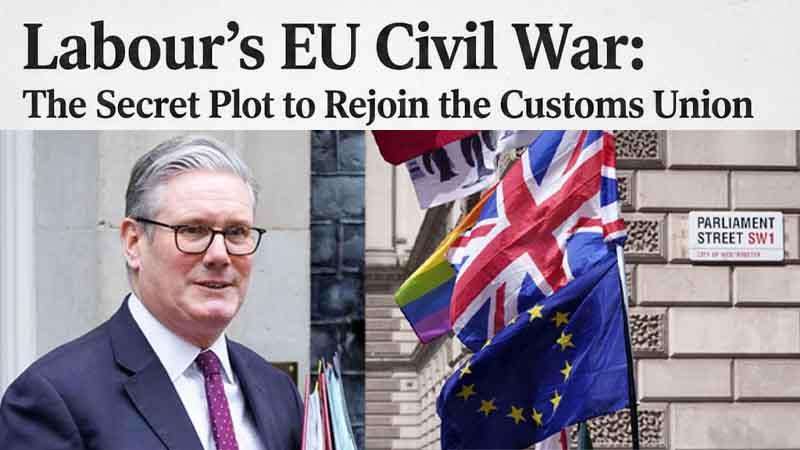
The surface of British politics is currently vibrating with a tension that feels both nostalgic and dangerously fresh. Just as the Christmas recess approaches, the Labour Party finds itself embroiled in a sophisticated internal tug-of-war over the one issue that was supposed to be "settled" during the general election: the United Kingdom’s relationship with the European Union. While Prime Minister Keir Starmer has spent the better part of late 2025 attempting to orchestrate a "pragmatic reset" with Brussels, the carefully maintained facade of Cabinet unity has begun to crack, revealing a party deeply divided between economic necessity and electoral promises.
The latest tremor came from Health Secretary Wes Streeting, whose recent suggestions that Britain should consider rejoining a customs union sent shockwaves through Downing Street. Streeting, widely viewed as a future leadership contender, argued that a "deeper trading relationship" is a strategic necessity to unlock the stagnant economic growth that has plagued the first year of this administration. This move was not merely a policy suggestion; it was a political flare sent up to the pro-European wing of the party, which remains significant and increasingly restless.
However, the blowback was immediate and came from the very top of the party’s traditionalist wing. Deputy Leader Lucy Powell issued an implicit but firm rebuke to Streeting via the BBC’s Newscast podcast, insisting that Labour must "stick to the manifesto." Powell’s intervention serves as a reminder that Starmer’s 2024 mandate was built on the explicit promise of "no return" to the single market, the customs union, or freedom of movement. For Powell and the No 10 inner circle, breaking this promise is not just a policy shift—it is a potential suicide note for the party’s hard-won trust in "Red Wall" seats.
The Prime Minister’s current strategy is a delicate dance of "alignment without accession." Starmer’s plan focuses on specific, technical wins: a new security pact, a veterinary agreement to slash border checks on food, and the recently announced return to the Erasmus+ student exchange program. By securing a 30% discount for the UK’s participation in Erasmus starting in 2027, the government hopes to demonstrate the benefits of a "closer, more mature" relationship without crossing the red lines of sovereignty that Nigel Farage’s Reform UK is so eager to exploit.
Yet, Starmer faces pressure not just from his Cabinet, but from a burgeoning movement of backbenchers and external power groups. On December 9, a group of 13 Labour MPs broke ranks to vote for a Liberal Democrat bill that would have mandated negotiations for a customs union. While the bill failed, the 100-100 tie in the Commons—buoyed by mass Labour abstentions—exposed a lack of appetite among the rank-and-file for Starmer’s "slow and steady" approach.
The political landscape is further complicated by the rise of a new Leftist bloc. Jeremy Corbyn and Zarah Sultana, now leading their new political vehicle "Your Party," have positioned themselves as the unapologetic voice for rejoining the EU. Their platform argues that the "Starmerite" middle ground is an economic failure that continues to punish the working class through high food prices and reduced opportunities. Similarly, the Green Party has doubled its membership under Carla Denyer and Adrian Ramsay, campaigning on a platform of full EU membership and the restoration of freedom of movement as a prerequisite for a green transition.
On the opposite flank, Reform UK has seized on every hint of a "reset" as a "shameful betrayal." Nigel Farage and Deputy Leader Richard Tice have framed the Erasmus deal and any potential veterinary alignment as "Brexit in name only." Their plan is a radical departure: a total decoupling from European regulations, including the potential withdrawal from the European Convention on Human Rights (ECHR) to facilitate more aggressive migration controls. For Reform, any move by Labour toward a customs union is a gift that allows them to claim they are the only party truly defending the 2016 referendum result.
This creates a pincer movement for Keir Starmer. To his left, the Greens and Corbyn’s "Your Party" are siphoning off young, pro-European voters who feel betrayed by the lack of ambition in the "reset." To his right, Reform UK stands ready to pounce on any perceived weakening of border controls or regulatory independence. Meanwhile, the Liberal Democrats have successfully reclaimed the title of the "party of Europe," using their parliamentary position to force uncomfortable votes that expose Labour’s internal fractures.
A deeper analysis of the Treasury’s current predicament suggests that the economic reality may eventually force Starmer’s hand. With exporters struggling under the weight of "non-tariff barriers" and the Office for Budget Responsibility continuing to highlight the long-term drag of Brexit on GDP, the pressure for a customs union will only grow. The promotion of Nick Thomas-Symonds to a full Cabinet rank as the lead EU negotiator indicates that Starmer is preparing for more intense talks in 2026. However, as Lucy Powell’s recent comments prove, the battle for the soul of the Labour Party’s European policy is far from over. Starmer is not just negotiating with Brussels; he is negotiating with a Cabinet and a country that remain as divided over Europe as they were a decade ago.




_2.jpg)