





.svg)
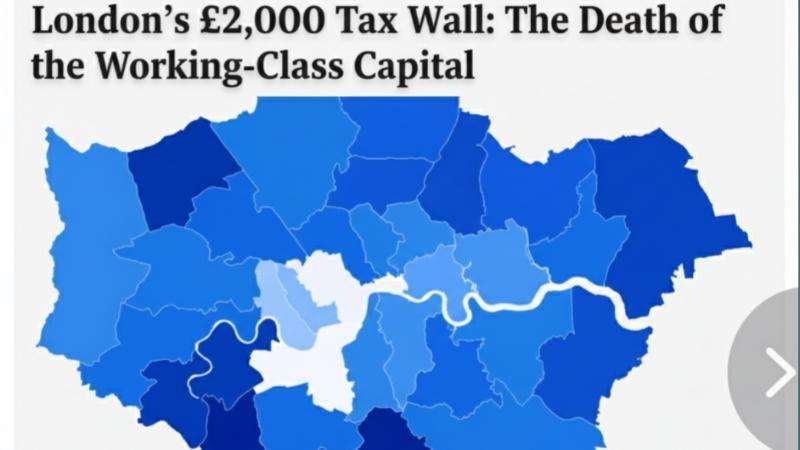
London is undergoing a radical social restructuring that is quietly erasing the full-time working-class family from its map. New analysis has confirmed that by April 2026, thousands of households across the capital will face annual council tax bills exceeding £2,000 for the first time. This fiscal milestone is more than just a budget adjustment; it is the final nail in the coffin for the "squeezed middle" in a city that is rapidly polarizing into a playground for billionaires and a survival zone for the state-supported, Daily Dazzling Dawn understands.
For the average resident in a Band D property, an annual levy increase of approximately £80 is expected as boroughs move to implement a 5% hike—the maximum allowed without a referendum. This surge is driven by a collective £1 billion budget shortfall across London’s town halls. Residents in Hackney, Hillingdon, and Lambeth are set to cross the £2,000 threshold, even before the Mayor of London, Sadiq Khan, confirms his City Hall precept. Last year, the Mayor’s share rose by nearly £19, and early indications suggest a similar upward trajectory for 2026 to fund the Metropolitan Police and Fire Brigade.
The mathematical reality for a minimum-wage family is now one of total impossibility. While the National Living Wage is set to rise to £12.71 per hour in April 2026, the voluntary London Living Wage has already climbed to £14.80 just to keep pace with the capital's unique inflation. A family earning the legal minimum is effectively "underpaid" by over £4,000 a year compared to what is needed to survive in London. When combined with average rents that now consume over 50% of take-home pay, the addition of a £2,000 tax bill forces a choice between basic utilities and debt.
This crisis has created a "doughnut effect" of wealth. London now hosts the highest concentration of dollar millionaires globally, with one in ten residents falling into this category. Meanwhile, over 2.5 million Londoners live in poverty. The city is becoming a dual-society: ultra-high-net-worth individuals occupying high-value Band G and H properties, and those on full benefits whose council tax is subsidized. The full-time worker, who earns too much for support but too little for the "London premium," is being squeezed out.
Compared to other global capitals, London’s hostility toward the working class is unique. In Paris and Berlin, though rents are rising, the total "cost-to-net-pay" ratio remains significantly more balanced due to lower localized tax burdens and stronger rent controls. In New York, while Manhattan remains expensive, the outer boroughs offer a more diverse range of cost-to-income ratios that still allow for a blue-collar middle class—a demographic that has almost entirely vanished from London’s Zone 1 and 2.
The financial instability of the boroughs themselves is accelerating this decline. Newham, currently facing a bankruptcy crisis, has warned of a possible 9% tax hike while simultaneously cutting essential services like children’s centers and street cleaning. Even the traditionally low-tax havens of Wandsworth and Westminster are under threat. While Wandsworth currently maintains the UK’s lowest bill at £990.07, the Institute for Fiscal Studies (IFS) warns that these areas could see eye-watering 75% increases in the coming years as central government funding is redistributed to more deprived regions.
As London’s town halls grapple with skyrocketing costs for temporary housing and social care, the burden is being shifted onto a workforce that is already at its breaking point. For the nurse, the bus driver, and the hospitality worker, the £2,000 tax bill is not just a bill—it is a signal that the capital no longer has room for those who keep it running.
Would you like me to create a borough-by-borough breakdown of the "survival gap" between the National Minimum Wage and the actual cost of livi
ng in 2026?