




.svg)
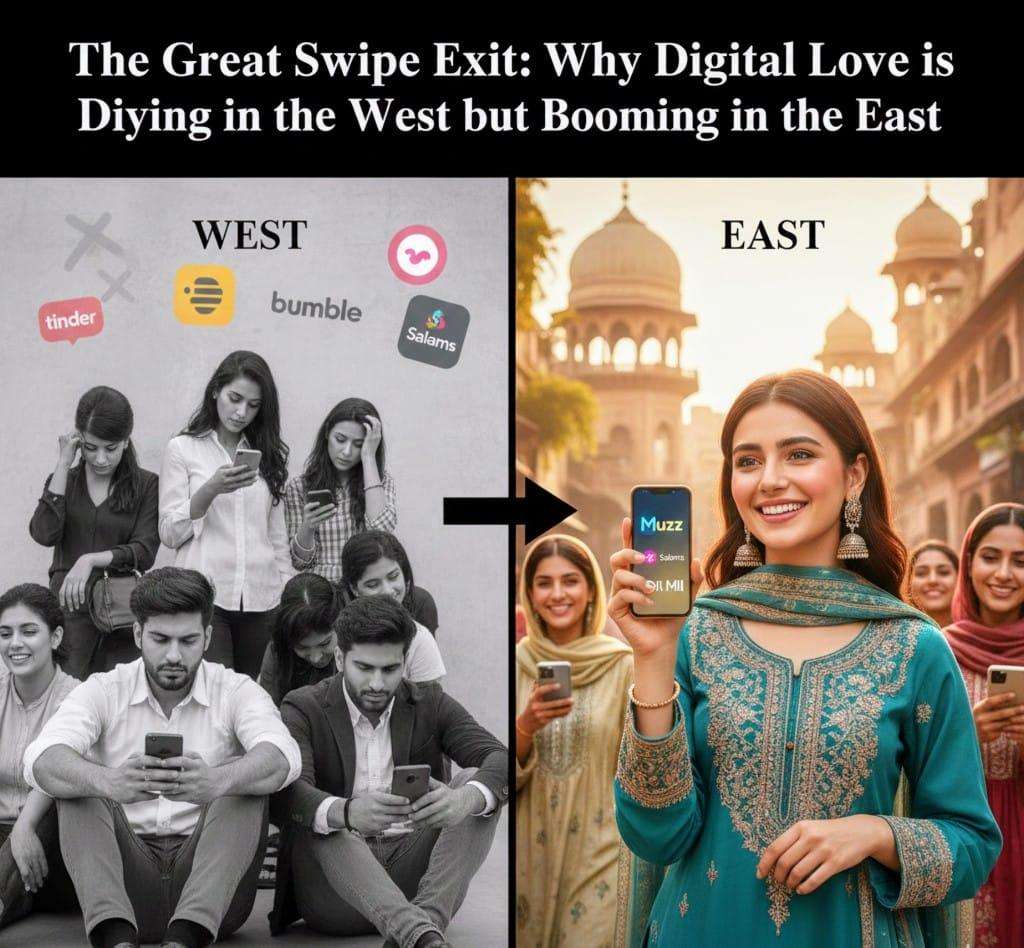
The digital romance landscape is undergoing a seismic shift as the "swipe-right" culture that once defined a generation in the West reaches a breaking point. While users in London, New York, and Toronto are deleting apps in record numbers due to "dating fatigue," a new frontier is opening across Asia and the Muslim world. From the bustling streets of Dhaka to the tech hubs of Karachi, the business of finding love—or a life partner—is no longer just a Western export; it is being reinvented by the Global South.
The Great Western Burnout and the Asian Pivot
For over a decade, giants like Tinder and Bumble dominated the market by gamifying romance. However, 2025 and 2026 data reveals a stark reality: Gen Z users in the UK and USA are increasingly disillusioned. A recent industry report indicates that only 26% of active dating app users now belong to Gen Z, a generation that increasingly views algorithmic matching as transactional and exhausting. In contrast, the Asia-Pacific region has emerged as the fastest-growing market globally, projected to reach a 13.48% compound annual growth rate (CAGR) through 2030.
Major players are following the money. Match Group, the parent company of Tinder, recently made waves by acquiring Salams, a religion-centric matrimonial platform, for an undisclosed sum in late 2025. This move signals a pivot away from casual dating in stagnant Western markets toward intentional, community-based matchmaking in high-growth regions like India, Pakistan, and Bangladesh. In these territories, digital dating is not seen as a game but as a modern solution to age-old cultural barriers.
The Halal Paradox: Marriage Apps or Secret Dating Portals?
The rise of "Halal" apps like Muzz (formerly Muzmatch) and Salams has bridged the gap between traditional arranged marriages and modern autonomy. With Muzz surpassing 15 million members and reporting over 600,000 successful weddings by early 2026, the scale is undeniable. However, a deeper look at user behavior reveals a complex trend. While these apps are marketed for "Marriage Only," a significant portion of the diaspora in Europe and the US, as well as young professionals in Muslim-majority countries, are using them as "Dating Lite."
Privacy features such as "blurred photos" and "wali (guardian) integration" provide a cultural safety net, yet data shows that engagement levels for "socializing" and "networking" features within these apps are skyrocketing. In Pakistan and Bangladesh, where traditional dating remains socially sensitive, these apps provide a "halal" excuse to explore romantic connections outside of family circles. The data suggests that nearly 40% of active users on these platforms engage in conversations for over six months before discussing formal marriage, effectively mirroring Western dating patterns under a matrimonial veneer.
Diversity in the Deeply Conservative: Transgender Apps in South Asia
Perhaps the most surprising trend in the 2026 dating landscape is the surge in popularity of niche and inclusive apps in conservative regions. Transgender-focused dating apps and LGBTQ+ platforms are seeing unprecedented downloads in Pakistan and Bangladesh. This phenomenon is driven by the search for safe spaces in societies where public visibility is often dangerous.
In Pakistan, despite legal challenges and periodic bans on "immoral content," the use of VPNs to access inclusive dating platforms has increased by 22% year-over-year. For the Khwaja Sira (transgender) community in South Asia, these apps represent more than just romance; they are essential tools for community building and finding partners who respect their identity in a landscape that often marginalizes them.
Daily Dazzling Dawn Fact Check: Are Dating Apps Banned or Booming?
The Claim: Major dating apps are failing in Muslim countries due to government bans.
The Verdict: Misleading.
While countries like Pakistan have historically banned Tinder and Grindr for "immoral content," the market has simply adapted rather than disappeared. Localized "Matrimonial" apps have filled the void, often with government-approved filters. Furthermore, the "ban" culture has birthed a massive secondary market for VPNs and localized clones. In 2025, India and Pakistan combined for over $1.1 billion in digital matchmaking revenue, proving that the demand for connection far outweighs regulatory hurdles.
Deeper Analysis: The Monetization of Intent
The shift from West to East is fundamentally about intent. In the West, dating apps became "lifestyle" apps—low-stakes and high-volume. In Asia and the Muslim world, apps are "utility" apps—high-stakes and high-value. This allows developers to charge premium prices for features that "guarantee" marriage or high-quality matches.
The "Asia Pivot" is the industry’s survival strategy. As Western users grow weary of the endless loop of "Hi" and "Ghost," the dating industry is anchoring its future in cultures where finding a partner is a family priority and a lifelong investment. The "Swipe" may be dying in London, but the "Nikah" is thriving in the digital clouds of the East.

_3.jpg)