






.svg)
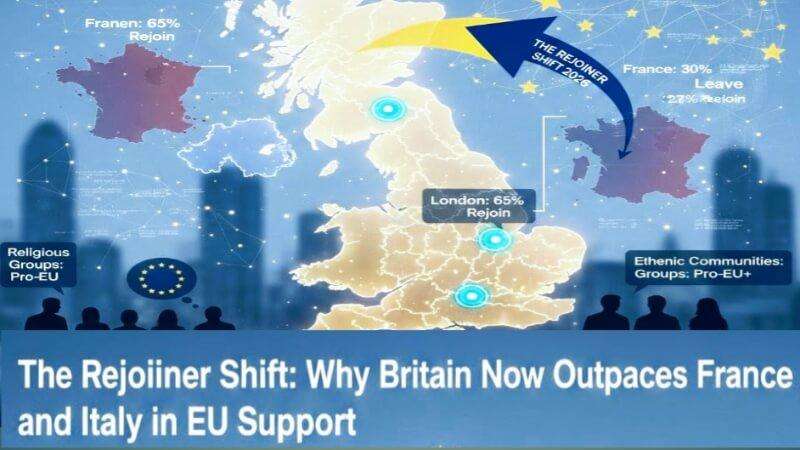
The geopolitical landscape of Europe has undergone a stunning inversion. While France and Italy—founding members of the European Union—grapple with a rising tide of domestic euroscepticism, the United Kingdom is experiencing a powerful "Bregret" movement. Recent 2025 and early 2026 data indicates that British public support for rejoining the EU has stabilized at approximately 54-56%, a figure that significantly outpaces the "enthusiasm" found in Paris or Rome. In France and Italy, while majorities still prefer to stay in the EU (around 49%), nearly 27-30% of their populations now express a desire to leave, fueled by concerns over sovereignty and the direction of the Union. Conversely, the UK has moved from a "50/50" nation to one where the desire for re-entry is the dominant, albeit complex, public sentiment, Daily Dazzling Dawn Analysis.
A Nation Divided by Geography: The Pro-EU Strongholds-The drive to rejoin the European Union is not uniform across the British Isles. London and Scotland remain the undisputed engines of pro-EU sentiment. In London, support for rejoining frequently peaks above 65%, driven by the city’s status as a global financial hub that has felt the friction of post-Brexit trade barriers most acutely. Scotland follows a similar trajectory, with polling consistently showing over 60% in favor of EU membership, often linking the issue to the broader debate over Scottish independence. However, the most innovative shift in 2026 is the "Blue Wall" transition in Southern England and parts of the Midlands. Former Leave-voting areas are seeing a "pragmatic pivot" as small business owners and farmers, once the backbone of Brexit, now cite the loss of the Single Market as a primary reason for their change of heart.
The Diversity Factor: Ethnic Communities Lead the Rejoin Charge-Demographic analysis reveals a stark contrast in how different communities view the UK’s European future. Data from late 2025 shows that British ethnic minority communities are significantly more likely to support rejoining the EU than the White British population. While support among White British voters hovers around 50%, it climbs to over 70% among Asian/Asian British and Black/Black British communities. This is largely attributed to a "civic" rather than "ethnic" vision of British identity. For many in these communities, the EU represents a framework of protected rights and internationalism that counters the more insular "ancestral" nationalism often associated with hardline Brexit rhetoric. Interestingly, recent studies show that 83% of British Muslims feel Britain is a better place to practice their faith than EU neighbors like France, yet they remain the most pro-EU religious demographic, viewing the bloc as a stabilizer for the UK economy.
Faith in the Union: Religious Perspectives on the EU-The religious landscape of the UK offers a nuanced look at the Rejoin movement. The 2026 data highlights a "secular-religious" divide that has shifted since the 2016 referendum. Those identifying as "No Religion" are the most consistently pro-EU group. Among faith-based communities, British Muslims and Hindus show the highest levels of support for re-entry, citing economic stability and global connectivity. In contrast, the Church of England (Anglican) remains the most divided, though even here, the staunch euroscepticism of a decade ago has softened. Roman Catholics in the UK, traditionally more pro-European due to the Church's transnational nature, have seen a resurgence in EU support, with over 55% now favoring re-entry, a notable increase from the 48% recorded during the original referendum.
Dazzling Dawn Analysis: The "Standard of Living" Catalyst-The "Dazzling Dawn" deeper analysis suggests that the UK's pro-EU surge compared to France and Italy is not necessarily a sudden love for Brussels bureaucracy, but a reaction to "Relative Deprivation." French and Italian voters, who have remained inside the bloc, often blame the EU for their local economic stagnation or migration challenges. In contrast, British voters have "tried the alternative" and found it wanting. The 2026 "Bregret" is fueled by a pragmatic comparison of the UK’s growth against its neighbors. While France and Italy look at the EU and see its flaws, the UK looks at the EU and sees a lost safety net. This has created a unique "Outsider’s Envy" that is currently absent in the founding member states.


_2.jpg)


.jpg)