




.svg)
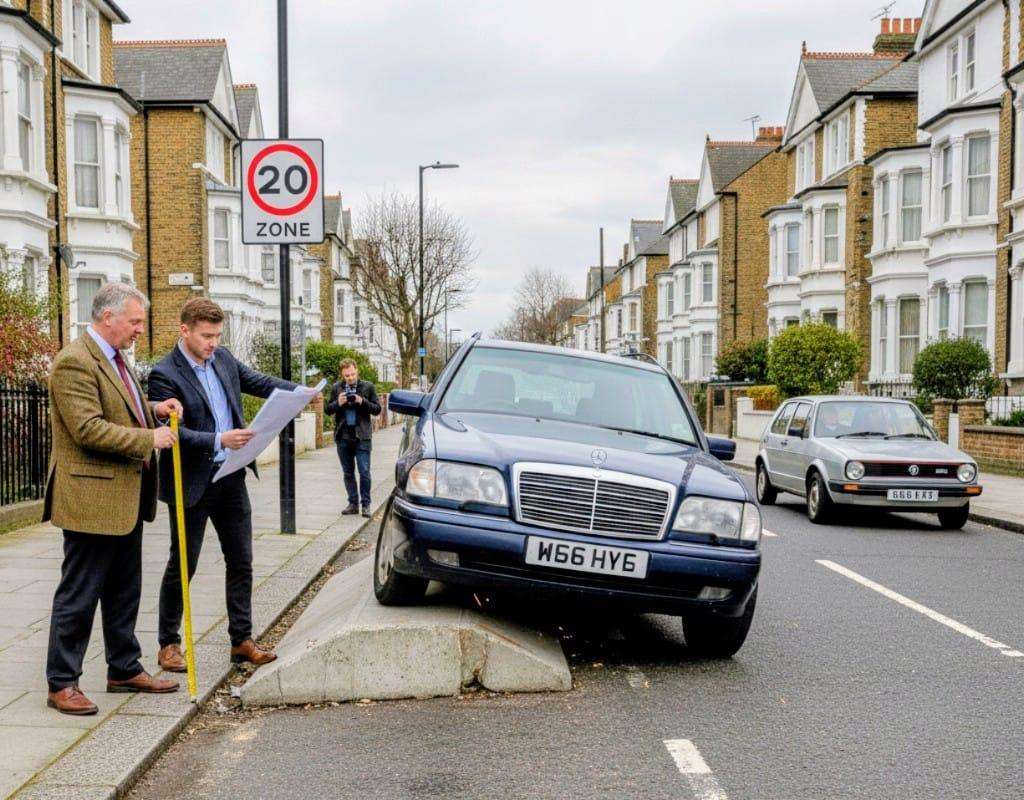
A growing rebellion is mounting across South East London as residents accuse local authorities of installing "socialist speed bumps" designed to punish owners of high-performance and luxury family vehicles. In the affluent enclave of Blackheath, motorists on Lee Terrace and Belmont Hill have commissioned independent engineering reports claiming that the new traffic-calming measures are a direct violation of the council's own safety standards. The controversy centers on "speed cushions" that residents say are essentially mountains in the road, specifically targeting cars with lower ground clearance while causing structural vibrations that shake nearby historic homes.
The localized conflict in Lewisham serves as a flashpoint for a much larger transformation of the capital’s infrastructure. As of 2026, London has seen a massive expansion of its 20mph network, with over 140 miles of the Transport for London Road Network (TLRN) now restricted to the lower limit, alongside thousands of miles of borough-controlled residential streets. For the city’s millions of residents, this shift has brought a dual burden: the psychological fatigue of navigating a nearly city-wide 20mph zone and the physical toll of navigating increasingly aggressive physical barriers that some engineers claim are built up to 105mm high—well beyond the 80mm limit cited in local guidelines.
The High Cost of Traffic Calming for Premium Car Owners
For owners of high-end automotive brands, the new infrastructure is proving to be an expensive obstacle course. Resident surveys and reports indicate that low-slung luxury models and high-performance estates are the primary victims of these oversized cushions. Vehicles such as the Mercedes-Benz C-Class, Audi A-series, and Tesla Model 3 are reportedly scraping their undercarriages even when crossing at speeds as low as 3mph. Exotic car owners, including those driving Ferraris and Porsches, have expressed total frustration, claiming they must nearly come to a complete halt to avoid "taking the underside of the car out." Even standard family vehicles like the Volkswagen Golf and Toyota Aygo have been caught in the crossfire, with residents providing video evidence of metal-on-concrete grinding.
Beyond the mechanical damage, the human impact on London’s millions of daily commuters and residents is profound. While the council justifies the measures as essential for safety near schools and hospitals, the reality for many is a degraded quality of life. In Blackheath, the physical impact of heavy skip lorries and delivery trucks hitting these bumps is causing "house-shaking" vibrations, leading to fears of long-term structural damage to residential properties. Cyclists have also joined the chorus of disapproval, noting that cars swerving to straddle the bumps often veer dangerously into cycling lanes, creating a more hazardous environment for the very "vulnerable road users" the schemes are meant to protect.
Crumbling Infrastructure Amidst a Pothole Epidemic
The rise of aggressive speed bumps comes at a time when the rest of the UK's road network is in a state of visible decay. Recent data for 2025 and 2026 reveals that the UK is currently battling a "pothole epidemic," with over one million craters estimated across council-controlled roads. The RAC reported a staggering increase in pothole-related breakdowns, with call-outs for broken suspension springs and distorted wheels rising by nearly 25% year-on-year. For Londoners, the irony is sharp: while councils spend significant portions of their 2025/26 capital programs on building new "mountains" in the road, existing "craters" remain unfilled.
Statistics show that the average repair bill for a car damaged by poor road surfaces has climbed to approximately £460, a cost that is increasingly being borne by taxpayers who feel they are paying twice—once through council tax for the installation of the bumps, and again at the mechanic to fix the resulting damage. In Lewisham alone, the 2025/26 Strategic Transport and Highways Capital Programme is heavily focused on "Vision Zero" goals, yet residents argue that the focus on speed cushions ignores the fundamental need for smooth, well-maintained arterial roads. As the 20mph zones continue to cover almost every corner of the 20-mile radius of inner London, the tension between municipal safety goals and the rights of vehicle owners remains at an all-time high.