




.svg)
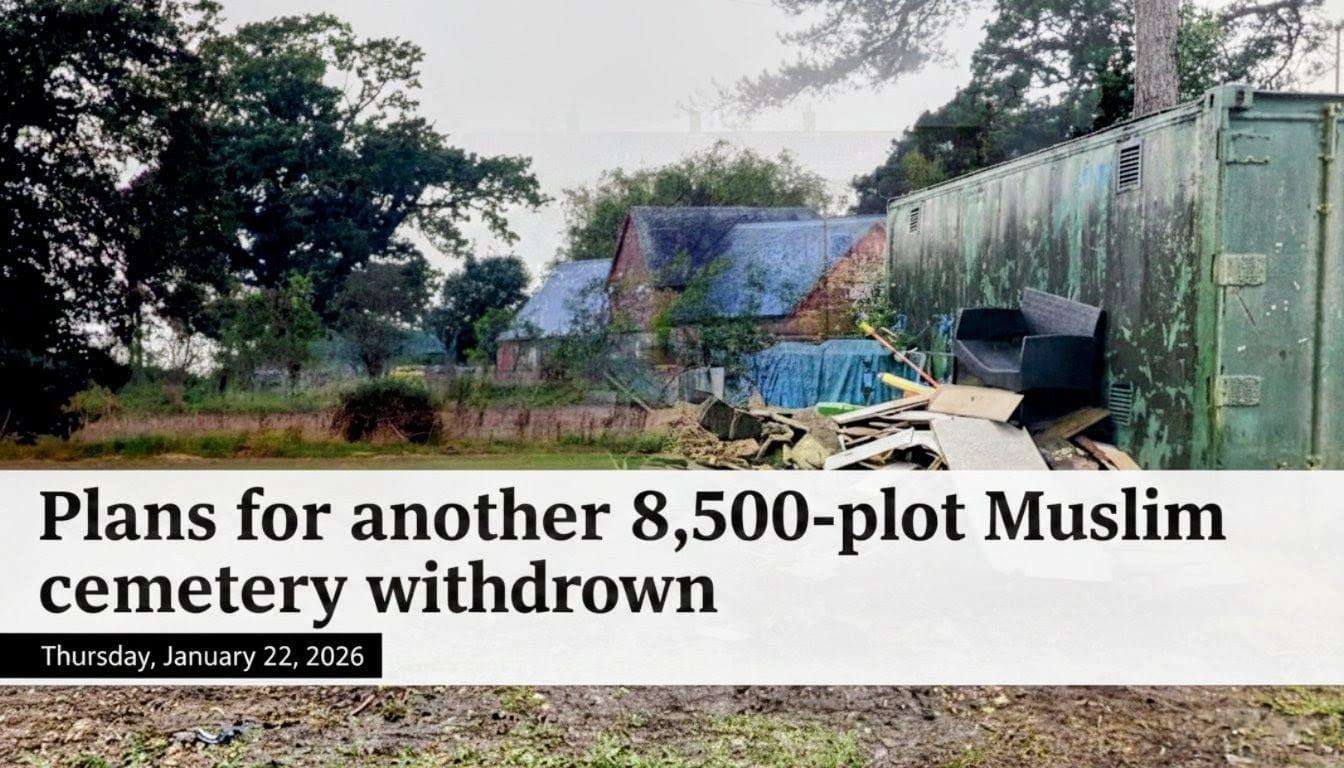
The withdrawal of plans for the 8,500-plot Thaqwa Cemetery in Solihull has exposed a raw nerve in the British Muslim community, particularly for the British Bangladeshi and Pakistani families of the West Midlands. This was not a simple administrative hiccup; it was the collapse of a lifeline. For a community that holds the sanctity of the grave as a non-negotiable pillar of faith, the loss of this 27-acre site at Catherine-de-Barnes is a catastrophic blow. As the pioneer generation of British Bangladeshis reaches old age, the urgency for local, Sharia-compliant burial space has moved from a "community need" to a full-blown civil rights emergency. The withdrawal marks a surrender to a system that appears increasingly designed to exclude minority faith requirements from the British landscape.
The "Grey Belt" Trap and Technical Sabotage
A deeper analysis into the withdrawal reveals a sophisticated web of planning obstacles that target faith-based developments. Under new 2025 planning reforms, land previously protected as "Green Belt" is being reclassified as "Grey Belt" to prioritize high-density housing, often leaving religious infrastructure in a legal limbo. In Solihull, the Thaqwa project was suffocated by a "war of attrition" involving over 1,400 local objections and a sudden pivot by the Environment Agency regarding groundwater contamination. While commercial developments are often granted mitigation pathways, cemetery projects for the Muslim community are frequently met with "insurmountable" technical queries. This selective rigor suggests that environmental concerns are being weaponized to block the growth of Islamic infrastructure, effectively telling British Muslims that while they are welcome to live in the UK, there is no room for them to stay once they pass.
Read Also: East London Cemetery Expansion: Hope for the End of the Muslim Burial Crisis?
Dazzling Dawn Analysis: A National Policy of Exclusion
The crisis extending from Solihull to Blackburn—where the Issa brothers are fighting a similar battle for a 35,000-plot site—highlights a national institutional blind spot. The UK’s National Planning Policy Framework fails to categorize religious burial grounds as "essential infrastructure," a designation that would give them priority over discretionary land use. For the British Bangladeshi community, this leads to a "burial apartheid" where the wealthy can afford "out-of-area" fees reaching £10,000, while working-class families are forced into the trauma of "stacked" graves or transporting their loved ones to distant cities. This is a direct threat to community cohesion, as it erodes the sense of belonging for second and third-generation British Muslims who view England as their only home but are being denied a permanent place within its soil.
Read Also: FINAL REST DENIED: The Sacred Struggle for Muslim Graves in Britain
The Breaking Point of Community Patience
Local leadership in Solihull and Birmingham has warned that the existing Muslim sections at cemeteries like Widney Manor are reaching a critical "cliff edge" of capacity. The withdrawal of the Thaqwa plans is not an isolated event but part of a pattern of "strategic delays" that have lasted over a decade across multiple applications. By the time a project is finally approved, the land is often already insufficient for the grown population. The British Bangladeshi community, which has contributed significantly to the socio-economic fabric of the UK for over 70 years, now finds its most basic religious right—a dignified burial—treated as a "nuisance" by local planning committees. Without immediate government intervention to mandate faith-specific burial quotas, the UK is heading toward a human rights scandal that will define the relationship between the state and its Muslim citizens for generations.