



.svg)
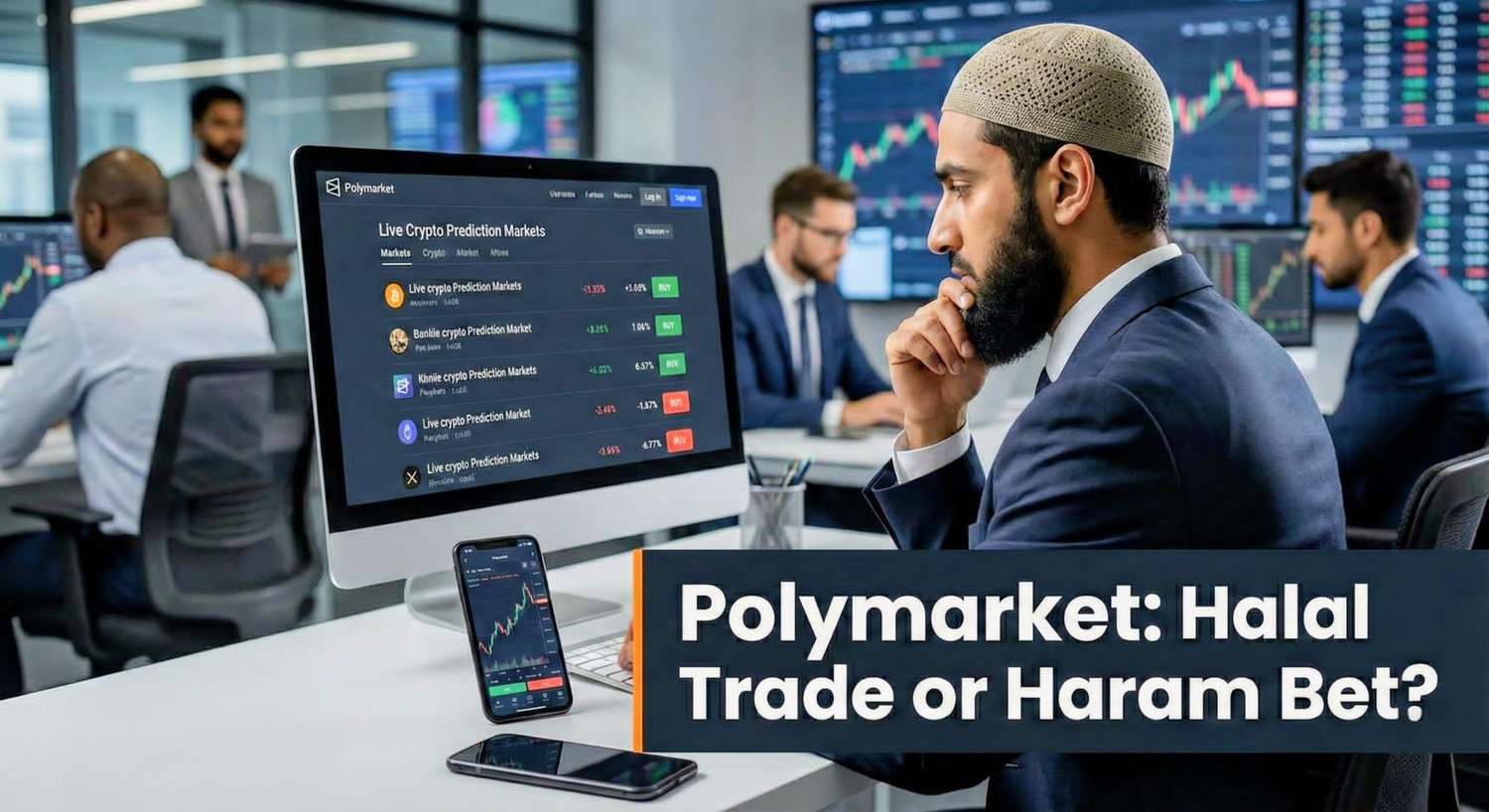
The digital finance world is witnessing a seismic shift as billions of dollars pour into prediction markets like Polymarket and Kalshi. In New York, London, and Dubai, a new generation of Muslim traders is being drawn into what looks like sophisticated financial trading but operates on a mechanism that has alarmed Islamic scholars worldwide. With over $13 billion traded on top prediction platforms recently, the line between strategic investment and prohibited gambling has never been blurrier.
For the Muslim investor navigating the high-pressure economic environments of the UK and USA, understanding the reality behind these "event contracts" is no longer optional—it is a spiritual emergency.
The Mechanics of the 'Yes or No' Economy
At first glance, platforms like Polymarket appear to be standard financial exchanges. They offer sleek interfaces, order books, and price charts that mimic the movements of the S&P 500 or Bitcoin. However, the underlying structure is fundamentally different from buying a stock or a commodity. When a trader engages in a prediction market, they are not purchasing an asset that generates value, dividends, or utility. They are purchasing a binary outcome: "Yes" or "No."
This structure is what financial regulators in the United States, including the CFTC, and gambling commissions in the UK are currently scrutinizing. In these markets, if a user bets that Bitcoin will hit $100,000 by December, they are essentially pooling money with an opposing bettor. If the event happens, the winner takes the loser's capital. If it does not, the contract expires worthless. In the strict definitions of Islamic commercial law, this stripping away of asset ownership reveals the transaction's true nature. It is a zero-sum game where one party’s profit is mathematically dependent on another party’s total loss.
The Quranic Verdict: Maysir Disguised as Market Efficiency
To understand the Islamic ruling on prediction markets, one must look beyond the branding of "decentralized finance" and examine the Quranic concept of Maysir (gambling). The Holy Quran is explicit in its prohibition of wealth transfer based on pure chance or uncertain outcomes without productive exchange.
Allah (SWT) says in Surah Al-Ma'idah:
"O you who believe! Intoxicants (all kinds of alcoholic drinks), gambling, Al-Ansab, and Al-Azlam (arrows for seeking luck or decision) are an abomination of Shaitan’s (Satan) handiwork. So avoid (strictly all) that (abomination) in order that you may be successful." (Quran 5:90)
The wisdom behind this prohibition is further clarified in the subsequent verse:
"Shaitan (Satan) wants only to excite enmity and hatred between you with intoxicants (alcoholic drinks) and gambling, and hinder you from the remembrance of Allah and from As-Salat (the prayer). So, will you not then abstain?" (Quran 5:91)
Scholars argue that prediction markets fit the classical definition of Qimar (wagering), a subset of Maysir. Unlike Tijarah (trade), where both buyer and seller can benefit—the buyer gets a product, the seller gets money—prediction markets create an adversarial relationship. The "enmity and hatred" mentioned in the Quran manifests in the financial ruin of the losing side. When a trader on Polymarket celebrates a 300% return on a political outcome, that wealth has been directly transferred from the pockets of others who guessed wrong. There is no creation of value, only a reshuffling of wealth based on speculation.
The "Truth Machine" Fallacy
Proponents of these platforms, including major tech figures, argue that they are "truth machines" that use financial incentives to predict the future more accurately than polls or experts. They claim that by putting skin in the game, participants are forced to be honest. From a secular economic perspective, this argument has merit. However, from an Islamic perspective, the utility of the outcome does not justify the haram nature of the means.
The Quran acknowledges that there is some utility in prohibited practices but ultimately rejects them.
"They ask you concerning wine and gambling. Say: 'In them is great sin, and some benefit for men, but the sin is greater than the benefit.'" (Quran 2:219)
Even if a prediction market successfully forecasts an election result or an interest rate hike, the mechanism remains a game of chance rooted in Gharar (excessive uncertainty). The Prophet Muhammad (peace be upon him) explicitly forbade transactions involving Gharar, such as selling birds in the sky or fish in the water before they are caught. Prediction markets monetize uncertainty itself, turning the unknown future—which belongs solely to Allah—into a commodity to be wagered upon.
The Silent Crisis Among British and American Muslims
The rise of these platforms is symptomatic of a deeper economic anxiety gripping young Muslims in the West. In the UK and USA, where inflation has eroded purchasing power and housing markets feel impenetrable, the allure of "fast money" is potent. Prediction markets gamify this desperation. They offer the dopamine hit of a casino with the intellectual veneer of a hedge fund.
This "gamification of finance" poses a specific spiritual threat: Ghaflah (heedlessness). The constant checking of prices, the adrenaline of the wager, and the obsession with future events distract the believer from the present reality of their duties to Allah. The mental bandwidth consumed by tracking the odds of a Fed rate cut or a geopolitical conflict is bandwidth stolen from Dhikr (remembrance) and Salah (prayer).
Furthermore, the integration of cryptocurrency into these platforms adds another layer of complexity. While crypto itself can be halal if used as a currency or store of value, using it as a chip in a digital casino taints the income derived from it. For British and American Muslim traders, the distinction is vital: buying Bitcoin to hold as an asset is fundamentally different from betting on the price action of Bitcoin via a binary contract.
The Path Forward: Authentic Investment
The Islamic alternative to the zero-sum chaos of prediction markets is the concept of risk-sharing and asset ownership. True investment involves injecting capital into a venture that produces goods or services.
For the trader seeking to grow wealth without compromising their faith, the solution lies in returning to the basics of Halal finance. This means investing in the stock market via Shariah-compliant funds where you own a share of a company that produces real value. It means utilizing Gold or Real Estate, where the asset is tangible. It implies engaging in Venture Capital or private equity, where the risk is taken on the business execution, not a binary wager on an external event.
The promise of prediction markets is a mirage. It offers wealth without work and knowledge without wisdom. For the Muslim investor, the true "winning trade" is one that purifies their wealth rather than polluting it with the uncertainty of the wager. As the global economy becomes increasingly speculative, holding fast to the principles of fair trade and asset ownership is not just a religious obligation—it is a financial safeguard against the volatility of the gambling economy.
.jpg)

_3.jpg)