




.svg)
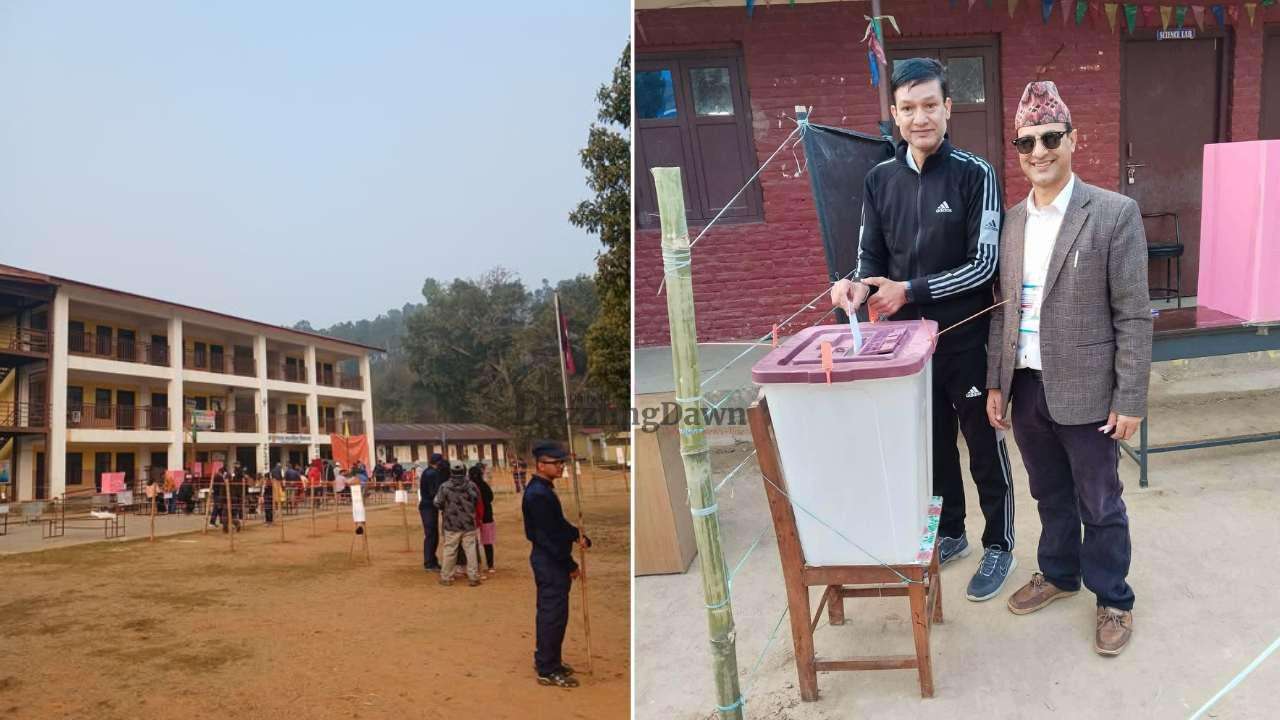
Voting officially got underway across Nepal on Thursday morning as millions of citizens headed to polling stations to elect a new government in a crucial general election shaped by months of political instability.
At polling centres such as Annapurna Vinayak School in Kathmandu, early scenes showed disciplined queues of voters, with security personnel deployed to maintain order and ensure smooth proceedings. Many voters expressed optimism about the future of the country, hoping the newly elected leadership would prioritise national development and improve living standards.
Snap Polls After “Gen Z Movement”
The snap election was triggered by the historic “Gen Z movement” in September, which led to the collapse of the KP Sharma Oli-led coalition government and the dissolution of the House of Representatives. In the aftermath, former Chief Justice Sushila Karki came out of retirement to serve as Nepal’s interim executive head.
Karki, 73, called for peaceful participation in the vote, stating that every ballot cast would play a decisive role in shaping the country’s future. Her tenure began on September 12, when she recommended dissolving the lower house, ultimately leading to Thursday’s mandate.
The Election Commission confirmed that all logistical and security arrangements were in place to facilitate free, fair, transparent, and peaceful elections after six months under interim leadership. Acting Chief Election Commissioner Ram Prasad Bhandari urged citizens to exercise their franchise without fear during the 10-hour voting period from 7 am to 5 pm.
Nearly 19 Million Voters, Over 6,500 Candidates
According to official figures, 18,903,689 registered voters are eligible to cast ballots in this election — an increase of more than 915,000 since 2022. Notably, 52 percent of voters fall within the 18–40 age bracket, highlighting the growing influence of young citizens.
A total of 6,541 candidates are competing for 275 seats in the House of Representatives. Of these, 3,406 are contesting under the First-Past-the-Post (FPTP) system, while others are participating through proportional representation.
Under the FPTP system, 65 political parties have fielded 2,263 candidates for 165 seats, alongside 1,143 independent contenders. Gender representation in direct elections remains uneven, with 3,017 male candidates, 388 female candidates, and one individual from the sexual and gender minority community.
For the 110 proportional representation seats, 63 parties have submitted lists totaling 3,135 candidates, with male and female representation equally balanced. To qualify as a national party under proportional representation, a party must secure at least three percent of the total proportional vote and win at least one FPTP seat.
Age Gap and Youth Expectations
Despite strong youth voter participation, the candidate pool skews older. Most candidates are aged between 41 and 60, while only 201 candidates are 30 or younger. This contrast underscores the generational divide between voters and political aspirants.
Tight Security and Massive Voter Movement
To ensure security, authorities deployed 341,113 personnel across 10,963 polling stations, including 149,000 temporary election police officers. A high-level Security Council meeting concluded that the environment would likely make this election more transparent than previous ones.
Officials reported significant voter movement ahead of polling day. Around 800,000 people left the Kathmandu Valley before voting, a migration typically seen only during major festivals like Dashain. To maintain order, all public and private vehicle movement was suspended from midnight on March 4 until voting concluded on March 5.
Historically, voter turnout in Nepal has averaged 69.4 percent since 2006, though participation dropped to 61.4 percent in 2022. Authorities remain hopeful that high youth engagement will boost turnout this time.
When Will Results Be Announced?
Election officials expect results for the First-Past-the-Post system to be published within 24 hours after counting begins. In remote and mountainous regions, helicopters will be used to transport ballot boxes quickly to counting centres.
Balen Shah’s Influence on the Political Landscape
The election also reflects a changing political climate, shaped in part by the rise of Balen Shah. The structural engineer and former rapper stunned Nepal’s political establishment in 2022 by winning the Kathmandu mayoral race as an independent candidate, defeating nominees from major parties.
Shah’s unexpected victory signaled a broader generational shift in voter sentiment, challenging the long-standing dominance of traditional political parties and energising younger voters ahead of the 2026 general election.