





.svg)
Mediterranean search and rescue operations have shifted to a recovery mission following a devastating shipwreck that has left over 70 people missing at sea.
New Details Emerge in Easter Sunday Mediterranean Tragedy
As the sun rose this Easter Sunday, the central Mediterranean became the site of a grim humanitarian disaster. Initial reports confirmed that a small, overcrowded vessel carrying approximately 105 migrants capsized after departing from the Libyan coast on Saturday. While 32 survivors were successfully pulled from the water by two passing merchant vessels, the scale of the loss is mounting. Two bodies have been recovered, but rescue coordinators from the NGO Mediterranea Saving Humans warn that more than 70 individuals remain unaccounted for in the frigid open waters.
Analysis of recent migration patterns suggests a high probability of Bangladeshi nationals being among those on board. Historically, the "Central Mediterranean route" from Libya is a primary corridor for Bangladeshi migrants; just last week, 21 Bangladeshis were rescued from a similar vessel near Greece, while another incident in late March saw 18 youths from the Sylhet and Sunamganj districts perish at sea. While official manifests are non-existent for such crossings, sources close to rescue operations told journalists that the passenger demographic on this specific Easter voyage reflects the usual mix of North Africans and South Asians, including those from Bangladesh.
Rescue Logistics and Political Fallout
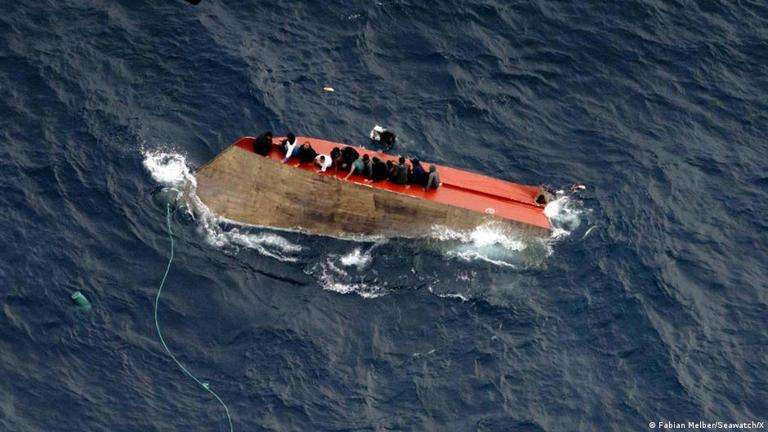
Aerial footage released by the German NGO Sea-Watch captured a harrowing scene: survivors clinging to the slick hull of an overturned boat as waves threatened to sweep them away. The incident occurred within a search-and-rescue zone technically under the jurisdiction of Libyan authorities, yet it was civilian merchant ships that ultimately intervened to transport survivors to the Italian island of Lampedusa.
"This tragedy is the direct consequence of policies by European governments that refuse to open safe and legal pathways," a representative for Mediterranea Saving Humans told journalists. The NGO highlighted that the lack of state-led rescue assets in the area often leaves merchant crews—untrained for mass-casualty marine rescues—as the first and only line of defence against such drownings.
The Path Ahead: Forensic Identification and Border Policy
What happens next will be a difficult process of identification and diplomatic friction. Italian authorities at Lampedusa are currently processing the 32 survivors to determine their nationalities and provide emergency medical care. If the missing are not found within the next 24 to 48 hours, the operation will officially transition from "search and rescue" to a "recovery and forensics" phase.
Expectations are growing for a formal investigation into why the Libyan Coast Guard did not reach the vessel in time, despite the boat being in their designated zone. This incident brings the 2026 Mediterranean death toll to at least 683, a figure that is projected to rise sharply as improving spring weather encourages more departures from North African shores.
Roberto D’Arrigo, a spokesperson for the Italian Coast Guard, stated, “The Libyan Coast Guard spearheaded this rescue operation. They were assisted by both an Italian and a Libyan commercial vessel.”
Those rescued were transferred to the Italian ship, which brought them near the port of Lampedusa—Italy’s southernmost island—on Sunday. The island has become a primary gateway to Europe for thousands of refugees and migrants.
“The survivors are nationals of Pakistan, Bangladesh, and Egypt,” D’Arrigo added. “They were moved onto an Italian Coast Guard vessel, which safely transported them to the harbor.”

.jpeg)


.jpg)
.jpg)