






.svg)
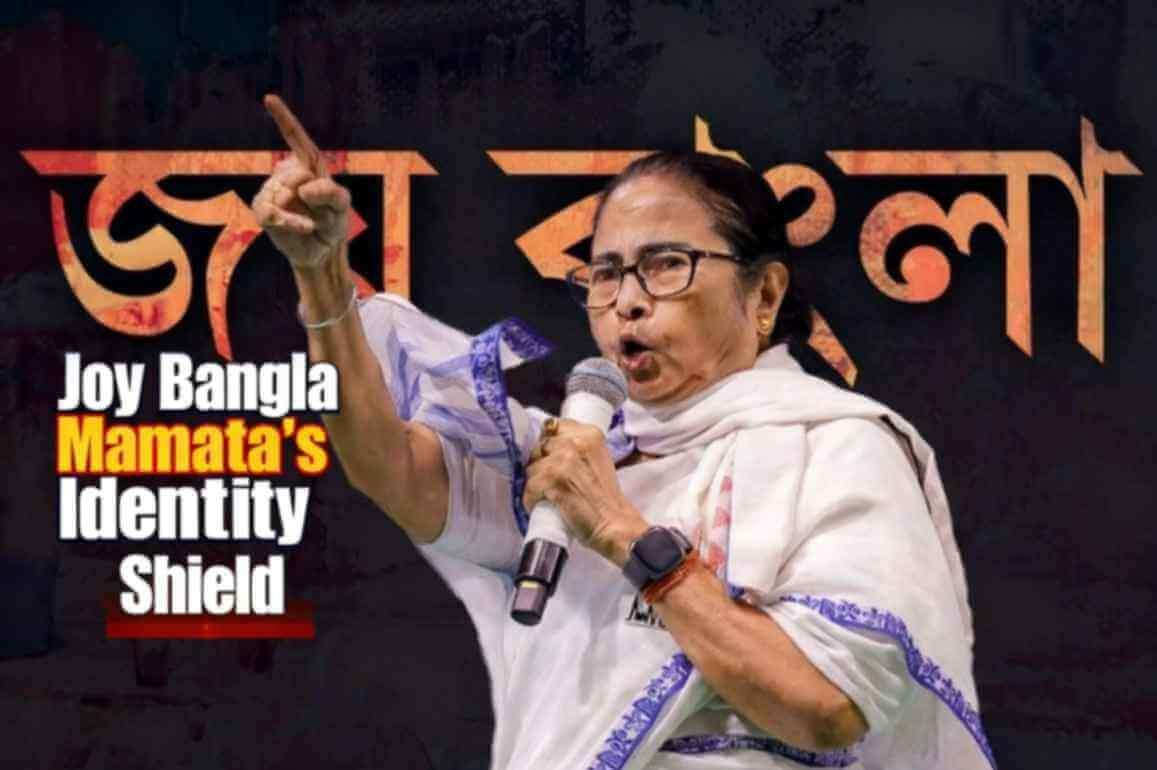
A high-stakes ideological war erupts as Mamata Banerjee pivots to cultural nativism to counter the saffron surge in the upcoming 2026 polls, Daily Dazzling Dawn realised. As West Bengal inches closer to the decisive polling dates of April 23 and 29, the political atmosphere has transcended mere governance debates, evolving into a profound struggle over the state’s cultural soul. The re-emergence of the "Joy Bangla" (Hail Bengal) slogan—traditionally the clarion call of the 1971 Bangladesh Liberation War—has moved from the periphery of Trinamool Congress (TMC) rhetoric to the absolute epicentre of its 2026 manifesto. This strategic adoption marks a definitive attempt by Chief Minister Mamata Banerjee to construct a "Bengali Sub-nationalism" fortress against the Bharatiya Janata Party’s (BJP) pan-Indian "Hindutva" narrative.
The Slogan Sovereignty Dispute-The shift is not merely phonetic but deeply symbolic. While the slogan crossed borders following the political upheaval in Bangladesh involving the Awami League, its transplantation into West Bengal politics has drawn sharp rebukes from the opposition. Suvendu Adhikari, the Leader of the Opposition and former lieutenant turned arch-rival of Banerjee, has framed the slogan as an "import," asserting that "Joy Bangla" has no place in Indian sovereignty.
However, Banerjee remains characteristically defiant. Addressing journalists recently, she reinforced her stance, stating she would chant the slogan "thousands and millions of times," effectively daring the BJP to challenge her "daughter of the soil" credentials. This linguistic tug-of-war is a calculated move to paint the BJP as an "outsider" party (Bohiragoto), a tactic that paid dividends in 2021 and is being intensified for the current cycle.
The BJP, acutely aware that a communal pitch alone may not breach the 294-seat Assembly, has attempted to adopt "Bengali-ness." Central leaders, including Prime Minister Narendra Modi and Home Minister Amit Shah, have increased their references to Bengali icons like Rabindranath Tagore and Bankim Chandra Chattopadhyay. Yet, these efforts have frequently backfired due to linguistic and historical inaccuracies that the TMC has been quick to weaponize.
Recent incidents, such as Nitin Nabin mistakenly attributing Tagore’s Nobel Prize to "peace" rather than literature and referring to Shantiniketan as a "corporation," have provided Banerjee with significant political ammunition. "They do not understand the pulse of Bengal, nor do they respect our luminaries," Banerjee remarked to journalists, highlighting a perceived disconnect between the BJP’s central leadership and the state’s intellectual heritage.
The 2026 campaign reveals a more pragmatic, performance-oriented Mamata Banerjee. Departing from her historical reliance on celebrity candidates and "glamour quotas," the TMC candidate list this year focuses on seasoned political fighters. Nearly one-third of sitting MLAs were denied tickets—a ruthless pruning based on internal performance metrics and anti-incumbency risks.
In a notable shift, former stars like Manoj Tiwary and Chiranjit Chakraborty have been sidelined in favour of "ground warriors." This suggests that the Chief Minister is preparing for a "street-fight" election where administrative delivery outweighs star power. The focal point of this battle remains the Bhawanipur-Nandigram axis. While Banerjee defends her home turf in Bhawanipur against Adhikari, the battle for Nandigram—Adhikari's stronghold—is being led by Pabitro Kar, a tactical choice aimed at splitting the local loyalties once commanded by the Adhikari family.
Despite a decade and a half in power, recent polling data suggests the "anti-incumbency" wave has yet to capsize the TMC vessel. A recent survey by CNN News18 indicates that 48.5% of voters still prefer Banerjee as the Chief Minister, projecting a comfortable majority of 184 to 194 seats for the incumbent.
The BJP’s strategy continues to lean on the "double-engine sarkar" promise and allegations of systemic corruption. However, the TMC’s iron-clad grip on the 30% minority vote, combined with a projected slice of 20-25% of the Hindu vote, creates a formidable mathematical barrier for the BJP. As the campaign enters its final three-week sprint, the question remains: can the "Joy Bangla" sentiment override the economic and centralizing pressures exerted by New Delhi? The upcoming weeks will determine if Banerjee’s brand of "cultural resistance" is enough to secure a fourth consecutive term.






.jpg)
.jpg)

.jpg)